
On This Page (Table of Contents)
In 2026, shipping PCBs from China to India breaks down into three transport lanes based on your batch weight and destination port charges.
Match your order weight against Indian customs and terminal rules before booking freight.
- Under 45 kg (Prototypes) moves via DHL or FedEx Express in 3 to 5 business days under electronic courier forms
CBE-XIIorCBE-XIII. - 45 kg to 300 kg (Trial Batches) moves via Direct Commercial Air Cargo into Delhi (
DEL) or Mumbai (BOM) in 4 to 7 calendar days. Avoid ocean LCL here because Indian port de-stuffing fees exceed air freight. - Over 300 kg (Mass Production) sails on Direct Ocean Vessels from Shekou or Nansha to Nhava Sheva (
13–16 days), Chennai (13–16 days), or Mundra (17–21 days).
Combining typical 7 to 15+ days of board fabrication (depending on order volume and workshop scheduling), 24-hour China trucking, pre-arrival customs filing, and 3 days of port release gives a 30-to-35-day factory-to-SMT cycle.
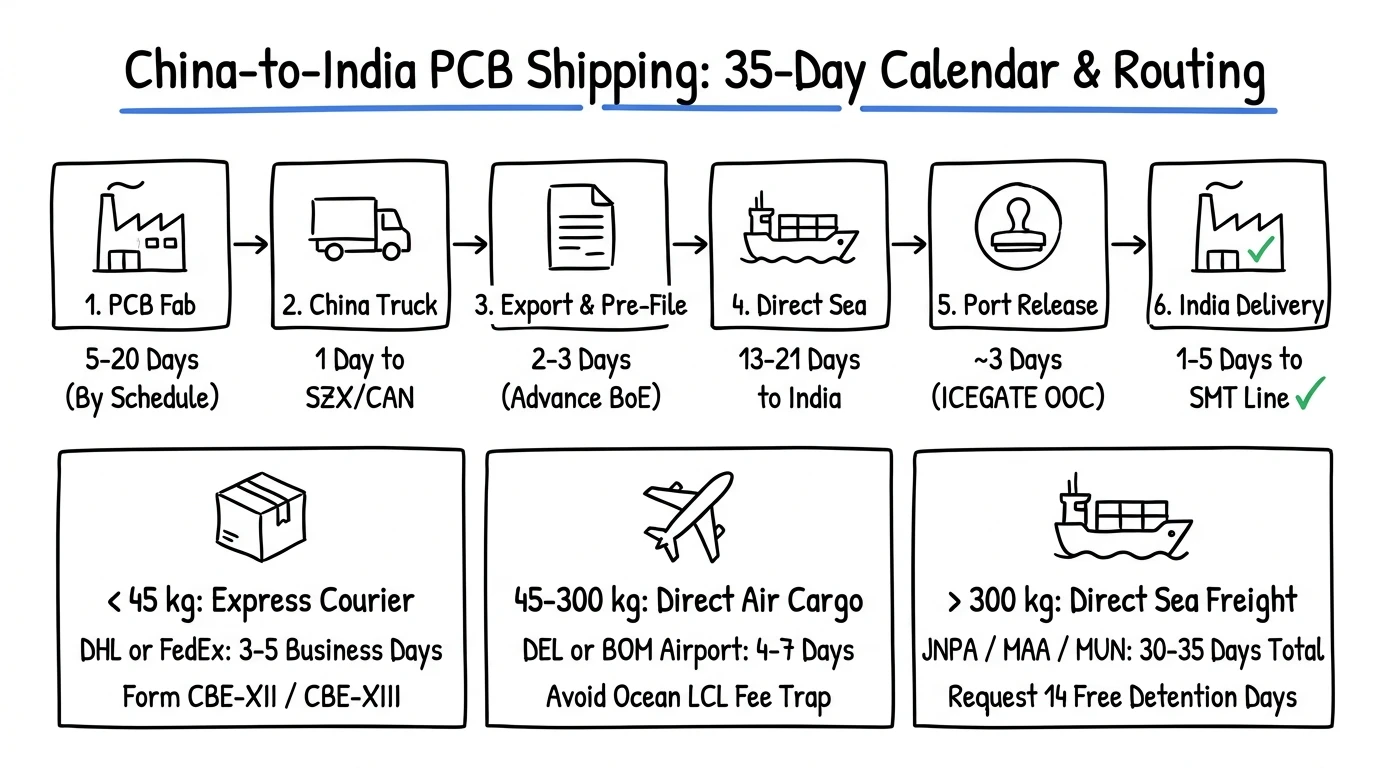 Figure 1. The 35-day factory-to-SMT procurement calendar from our Xinfeng plant to Indian lighting assembly hubs, paired with weight-based routing lanes.
Express, Air Freight, or Ocean? The Logistics Decision Matrix for Bare Aluminum PCBs
Picking the right shipping mode for bare single-sided aluminum PCBs starts with metal density and Indian port fees, not just the carrier rate.
A standard 1.0 mm single-sided aluminum PCB weighs roughly 2.7 kg per square meter.
A modest 100 m² order puts 270 kg of aluminum on the scale before adding export cartons.
| Batch Weight & Area (1.0mm MCPCB) | Recommended Mode | Door-to-Door Timeline | Billing Weight Rule | Indian Customs Form | Key Cost Trap to Avoid |
|---|---|---|---|---|---|
< 45 kg (< 16 m²) | International Express (DHL / FedEx) | 3–5 Business Days | Actual Gross Weight (>200 kg/m³ density) | Electronic CBE-XII (free samples ≤₹10k) or CBE-XIII / CBE-XIV | Never declare $0.00 on free samples; complete KYC before dispatch to avoid ₹1,000/day storage. |
45 – 300 kg (16 – 110 m²) | Direct Commercial Air Cargo (SZX/CAN/HKG → DEL/BOM/MAA) | 4–7 Calendar Days | Actual Gross Weight (>166.7 kg/m³ density) | Normal ICES Air Bill of Entry (File by end of arrival day) | Do not book Ocean LCL here; Indian CFS de-stuffing and DO minimums invert the landed cost. |
> 300–500 kg or FCL (> 110–180 m²) | Direct Ocean Freight (Shekou/Nansha → JNPA/MAA/MUN) | 30–35 Days Total (13–21d vessel leg) | Ocean W/M (1 CBM = 1,000 kg) or 20' FCL | Advance Sea Bill of Entry (File day before vessel arrival) | Skip cheap Singapore/Colombo transshipments; request 14 Free Detention Days at booking. |
1. Why Dense Aluminum PCBs Beat Volumetric Weight Pricing
Airlines and couriers bill whichever is higher between actual gross weight and volumetric weight.
DHL Global Forwarding calculates commercial air volumetric weight as Length × Width × Height (cm) / 6000, which equals 166.7 kg per cubic meter (CBM).
DHL Express uses a tighter divisor of 5000, or 200 kg per CBM.
Plastic lamp housings are light, bulky cargo that get penalized by volumetric pricing.
Bare aluminum PCBs work the opposite way. Tightly stacked aluminum boards inside export cartons exceed 1,500 kg per CBM.
Because your shipment sits far above the 200 kg/m³ cutoff, you pay strictly for actual scale weight.
2. The 100–300 kg "LCL Destination Charge Trap" at Indian Ports
First-time buyers often book Less-than-Container-Load (LCL) sea freight for a 150 kg or 250 kg order (55 to 90 m²) to save money.
Origin LCL freight quotes in China look cheap on paper.
The hidden bill arrives when the container is stripped at a Container Freight Station (CFS) in Nhava Sheva or Chennai.
Ocean LCL tariffs bill on a minimum 1 CBM or 1,000 kg basis. Even if 200 kg of aluminum PCBs occupy only 0.15 CBM, the consolidator bills a full 1 CBM minimum.
Published schedules like the Allcargo Terminals Chennai CFS Tariff and the Kences LCL Tariff add four fixed local charges onto that single cubic meter.
- CFS de-stuffing and handling fees
- Consolidator Delivery Order (DO) and documentation fees
- Terminal Handling Charges (THC) and port security levies
- 18% local GST on destination service fees
On a 100 kg to 250 kg batch, those fixed Indian port fees regularly exceed the cost of flying the cartons into Delhi or Mumbai airport.
LCL cargo also moves slower than full containers. DHL Global Forwarding notes that LCL consolidation and CFS deconsolidation add 4 to 5 extra days on the same route.
Compare a complete door-to-door LCL landed quote against direct commercial air cargo before booking batches under 300 kg.
China-to-India Ocean & Air Transit Times: The 35-Day Factory-to-SMT Buffer
Freight forwarders commonly pitch "14 days to India" when quoting sea freight.
That figure only covers port-to-port vessel sailing time.
Planning your SMT line in Pune, Noida, or Chennai around a 14-day buffer will leave your pick-and-place machines idle.
| Origin Gateway (South China) | Indian Destination Gateway | Primary LED Manufacturing Hubs Served | Published Direct Transit | Official Customs Release (NTRS 2025 / 2026) | Recommended Total Buffer (PO to Factory Floor) |
|---|---|---|---|---|---|
| Shenzhen (Shekou) | Nhava Sheva (JNPA) | Mumbai, Pune, Aurangabad, Surat | 15 Calendar Days (CMA CGM CIX) | 65h 53m – 72h 50m (~3 Days) | 30–34 Calendar Days |
| Guangzhou (Nansha) | Nhava Sheva (JNPA) | Western India & Maharashtra belt | 13–16 Calendar Days (OOCL CIX1) | 65h 53m – 72h 50m (~3 Days) | 28–33 Calendar Days |
| Shenzhen (Shekou) | Chennai (MAA Seaport) | Chennai, Sriperumbudur, Bengaluru, Hosur | 13 Calendar Days (CMA CGM IEX) | 88h 42m (~3.7 Days) | 28–32 Calendar Days |
| Guangzhou (Nansha) | Mundra Port | Ahmedabad, Vadodara, Rajkot, Morbi | 17–21 Calendar Days (OOCL CIX1) | 55h 34m (~2.3 Days) | 32–36 Calendar Days |
| Mundra Port + Rail | Delhi NCR (ICD Dadri / TKD) | Noida, Greater Noida, Gurugram, Faridabad | 17–21d Sea + 3d Block Train (CMA CGM CONCOR) | 55h 34m at gateway / ICD clearance | 36–42 Calendar Days |
| HKG / SZX / CAN Air | Delhi (DEL) / Mumbai (BOM) ACC | Pan-India urgent production runs | 1–3 Days Flight (Direct vs. connecting uplift) | 35h 03m (DEL) / 45h 08m (BOM) | 10–15 Calendar Days (including PCB fabrication) |
1. Direct Sailing Rotations vs. Transshipment Traps
South China ports offer direct weekly express strings into both coastlines of India.
CMA CGM's CIX service sails from Shekou to Nhava Sheva in 15 calendar days.
OOCL's CIX1 schedule connects Guangzhou Nansha to Nhava Sheva in 13 to 16 days, continuing north to Mundra in 17 to 21 days.
On the East Coast route serving Tamil Nadu and Karnataka, CMA CGM's IEX rotation runs from Shekou to Chennai in 13 calendar days.
Containers bound for Delhi NCR (Noida, Gurugram, Faridabad) discharge at Mundra and move inland on CONCOR block trains to ICD Dadri or ICD Tughlakabad.
CMA CGM's block-train benchmark specifies 3 days of rail transit from Mundra to Delhi NCR, plus rail-siding wait time.
Skip discounted ocean quotes that route via Singapore or Colombo transshipment.
Feeder vessels discharging in Singapore or Colombo must wait for mother-vessel space. During pre-Diwali peaks or monsoon congestion, container rollovers at transshipment hubs add 7 to 14 unscheduled days.
2. Inside the 35-Day End-to-End Procurement Calendar
Our plant in Xinfeng (Ganzhou, Jiangxi) produces roughly 200,000 m² per month of single-sided aluminum PCBs across two automated circuit lines and two high-speed stamping presses.
Six sequential steps run from purchase order confirmation until boards reach your SMT feeders in India.
- Factory Fabrication (Typically 5–20 Days, Subject to Schedule). Lead times depend on order volume, material stock, and workshop scheduling. As a general reference, small batches (
<50 m²) take around 5 days in low season and 10 days in peak season, while volume orders run around 7 days in low season and 15 to 20 days in peak season (new tooling or large runs add time). Using high-speed die-punching for volume aluminum PCBs keeps repeat orders moving faster once the die is ready. - Inland China Trucking (1 Day). Highway trucks move packed pallets from our Xinfeng plant to Shenzhen or Guangzhou port warehouses within 24 hours.
- Export Customs & CY Cut-Off (2–3 Days). Export containers must gate into the South China terminal 2 to 3 days before vessel departure.
- Direct Ocean Voyage (13–21 Days). Covers port-to-port sailing to Nhava Sheva, Chennai, or Mundra.
- Indian Seaport Clearance & Gate-Out (3–5 Days). Covers customs release plus physical terminal gate-out.
- Indian Inland Haulage (1–5 Days). Covers local trucking to Mumbai or Chennai plants, or rail haulage up to Delhi NCR.
Summing those six steps explains why experienced Indian sourcing teams reorder on a 30-to-35-day rolling calendar.
Indian Customs Clearance (ICEGATE): NTRS Release Times & How to Avoid Demurrage
Most port delays in India happen on paper before the ship drops anchor.
India's CBIC National Time Release Study (NTRS 2025) and the JNCH TRS 2026 release measure exact import release durations from cargo arrival to Out-of-Charge (OOC).
Across Indian seaports, the national average release time stands at 79 hours 04 minutes (~3.3 days), dropping to 66 hours 02 minutes for green-channel RMS entries.
- Mundra Port averages 55 hours 34 minutes (
~2.3 days), making it the fastest major seaport in India. - Nhava Sheva (
JNPA/JNCH) improved from 72 hours 50 minutes in 2025 to 65 hours 53 minutes in August 2026 (40 hours 40 minutes for AEO importers). - Chennai Seaport averages 88 hours 42 minutes (
~3.7 days). - Delhi (
DEL) & Mumbai (BOM) Air Cargo average 35 hours 03 minutes at Delhi and 45 hours 08 minutes at Mumbai.
Note that Out-of-Charge is customs release, not physical truck departure. NTRS 2025 records an average extra 27 hours 26 minutes at seaports between OOC and terminal gate-out.
Invoice errors destroy those averages immediately. At air cargo hubs, a single customs query stretches release time to 151 hours (6.3 days), while two queries push dwell time past 267 hours (11.1 days).
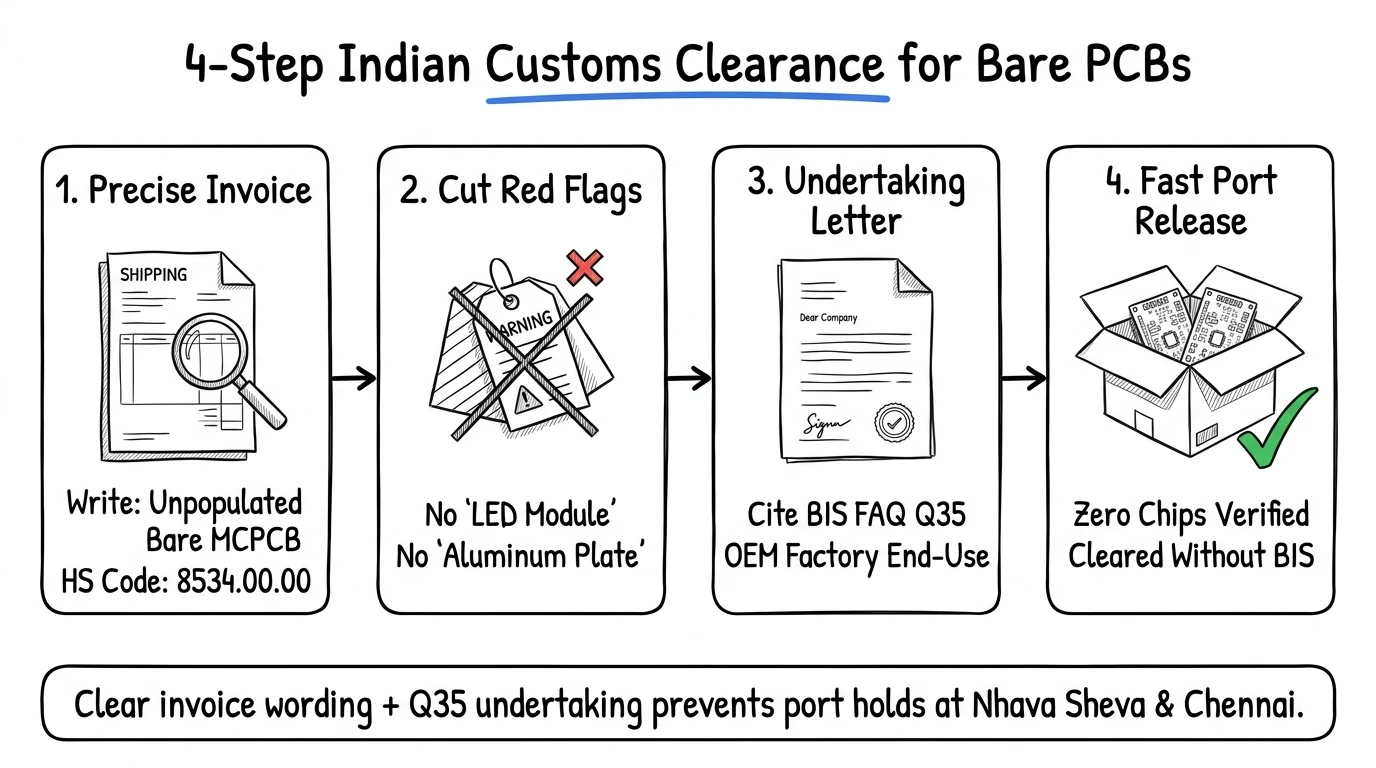 Figure 2. Pre-arrival document alignment between our export team and your Indian Customs House Agent (CHA) prevents queries that push clearance past 150 hours.
1. The Section 46 Filing Deadline: Sea Cargo vs. Air Cargo
Section 46(3) of the Indian Customs Act sets strict filing deadlines, clarified by CBIC Circular No. 08/2021-Customs and Mumbai Customs Public Notice No. 01/2026-27.
- Sea Cargo from China or Hong Kong requires the Bill of Entry on ICEGATE before the end of the day preceding vessel arrival (including holidays). Brokers can file an Advance Bill of Entry up to 30 days before arrival once the Bill of Lading is issued.
- Air Cargo Shipments require the Bill of Entry before the end of the day of aircraft arrival.
Missing the Section 46 deadline triggers automatic statutory late fees.
Customs assesses ₹5,000 per day for the first 3 days of default, and ₹10,000 per day from the 4th day onward (capped at ₹50,000).
Our shipping desk sends draft Commercial Invoices and Packing Lists upon dispatch, and forwards the Bill of Lading copy as soon as the carrier issues it, giving your CHA the full 13-to-21-day ocean voyage to file well ahead of vessel arrival.
2. Pre-Clearance Checklist: IEC, GSTIN, e-Sanchit, and Port AD Code
Verify four registration items with your clearing agent on the ICEGATE portal before your first shipment sails.
- Active IEC and GSTIN Linkage. Confirm your DGFT Import Export Code is active and linked to your factory GSTIN.
- Port AD Code Registration. Register your bank's 14-digit Authorized Dealer (AD) Code in the customs EDI system at the exact port of entry (ICEGATE Bank Account Management Manual).
- e-Sanchit Digital Upload. Have your CHA upload the digitally signed Commercial Invoice, Packing List, and Bill of Lading to ICEGATE e-Sanchit to generate Image Reference Numbers (
IRNs). - Clear Unpopulated Wording. Describe bare boards accurately to match Indian BIS exemption rules for bare LED aluminum PCBs. Unpopulated boards require zero MeitY BIS registration.
3. 14 Free Detention Days vs. Port Storage Demurrage
Importers frequently confuse shipping line Detention with port terminal Demurrage.
- Port/CFS Demurrage (Storage) is billed by the port terminal if your container stays inside the yard past the 3 to 5 calendar day free storage window.
- Container Detention (Equipment Free Time) is billed by the ocean carrier (Maersk, CMA CGM, OOCL) if you do not return the empty box within the standard 4 to 7 free days.
Instruct your shipper to request 14 Free Detention Days in writing before Bill of Lading issuance on Full Container Load (FCL) bookings.
Remember that 14 days of free equipment detention does not waive port yard storage. You still need an Advance Bill of Entry and prompt duty payment to pull the container out within 3 to 5 days.
Courier Sample Rules (CBE-XII) and Why "Grey DDP" Destroys Your 18% GST Credit
Our standard cooperation path starts with a prototype sample, moves to a small trial run, and scales to repeat volume orders.
How you clear that first 5 kg DHL sample parcel and structure Incoterms on mass production directly controls your tax recovery.
1. Clearing Free PCB Prototypes via Express Courier (CBE-XII vs. CBE-XIII)
For overseas lighting buyers with volume project plans, we normally waive the prototype fee (or credit it back on mass production, with express freight covered by the buyer).
Printing $0.00 on a free sample invoice is a costly mistake.
Indian customs officers reject $0.00 invoices immediately. Under Indian Customs Valuation Rules, free samples still require a truthful, supportable customs value for assessment. Both FedEx and DHL require shippers to declare a realistic production value.
Under CBIC's Courier Imports and Exports (Electronic Declaration and Processing) Regulations, electronic express imports use four specific forms instead of obsolete manual forms CBE-IV and CBE-V.
- CBE-XI (Form B) covers documents only.
- CBE-XII (Form C) covers bona fide commercial samples supplied free of charge with a customs value up to ₹10,000 and no foreign-exchange payment.
- CBE-XIII (Form D) covers paid prototypes or dutiable courier parcels valued up to ₹1,00,000.
- CBE-XIV (Form E) covers commercial courier shipments exceeding ₹1,00,000 (CBIC Circular 33/2010-Customs and DHL India's KYC Norms confirm no ₹10 lakh cap applies on electronic filings).
We print two clear statements on every free sample invoice for India.
Description of Goods — Bare Single-Sided Aluminum Printed Circuit Board Prototypes for Engineering Evaluation (Unpopulated, HS 8534.00.00).Valuation Note — Sample of No Commercial Value, Supplied Free of Charge; Value for Customs Purposes Only is USD [Actual Supportable Value].
Upload your IEC, GSTIN, PAN, and authorization letter to the FedEx India or DHL KYC portal before the parcel leaves China.
Missing KYC triggers bonded storage under DHL India's published rate guide after 3 calendar days at ₹1,000 per day plus ₹20/kg/day, plus a 2% Duty Tax Processing fee (minimum ₹1,100).
2. Why FOB/CIF With Your Own CHA Beats "Grey-Market DDP"
Freight agents on trade portals often pitch "all-inclusive DDP (Delivered Duty Paid) shipping to India with zero customs hassle."
For a GST-registered Indian lighting factory, grey-market DDP is an expensive financial trap.
Review our 2026 import duty and 30% anti-dumping tax calculation for LED PCBs in India to see the tax breakdown.
When declaring bare single-sided aluminum PCBs under HS Code 8534.00.00, a classification backed by Indian CESTAT tribunal precedent, your shipment carries three tariff layers.
- 0% Basic Customs Duty (BCD) under Notification No. 24/2005-Customs.
- 30% CIF Anti-Dumping Duty (ADD) for unlisted Chinese producers under Notification No. 03/2024-Customs (ADD) (populated LED PCBAs under
8539.51.00are exempt under Footnote iii). - 18% Integrated GST (IGST) under Notification No. 09/2025-Integrated Tax (Rate), calculated on
CIF + 30% ADD(equaling 23.40% of CIF).
On ₹100 of CIF value, you pay ₹30 in ADD and ₹23.40 in IGST, totaling 53.40% at the port.
Importing under FOB or CIF terms with your own IEC, GSTIN, and licensed CHA protects your tax credit in three ways.
- ICEGATE transmits your Bill of Entry directly to the GSTN portal (GSTN Bill of Entry Manual).
- The full 23.40% IGST populates your GSTR-2B credit ledger as a 100% recoverable Input Tax Credit (ITC).
- Your bank matches the Bill of Entry against your wire transfer in the RBI IDPMS system.
Under "grey DDP," forwarders group several buyers' cargo under a third-party trading company's IEC and GSTIN.
Your company name never appears on the Bill of Entry. You lose the entire 23.40% IGST credit permanently and hold zero legal import proof for tax audits.
Export Packaging Reality: IPC-1602A (2024) vs. Factory Bulk Packing for OSP Aluminum PCBs
Many logistics blogs claim every bare PCB crossing the ocean must be vacuum-sealed inside foil bags with desiccant and humidity cards.
Check both the active industry standard and how single-sided aluminum PCBs behave at sea before paying that surcharge.
First, update your standard reference. IPC-1601 is obsolete; it was replaced by IPC-1602 in 2020, and the current active edition is IPC-1602A (2024) Standard for Printed Boards Storage and Handling.
Second, separate surface pad solderability from board moisture absorption.
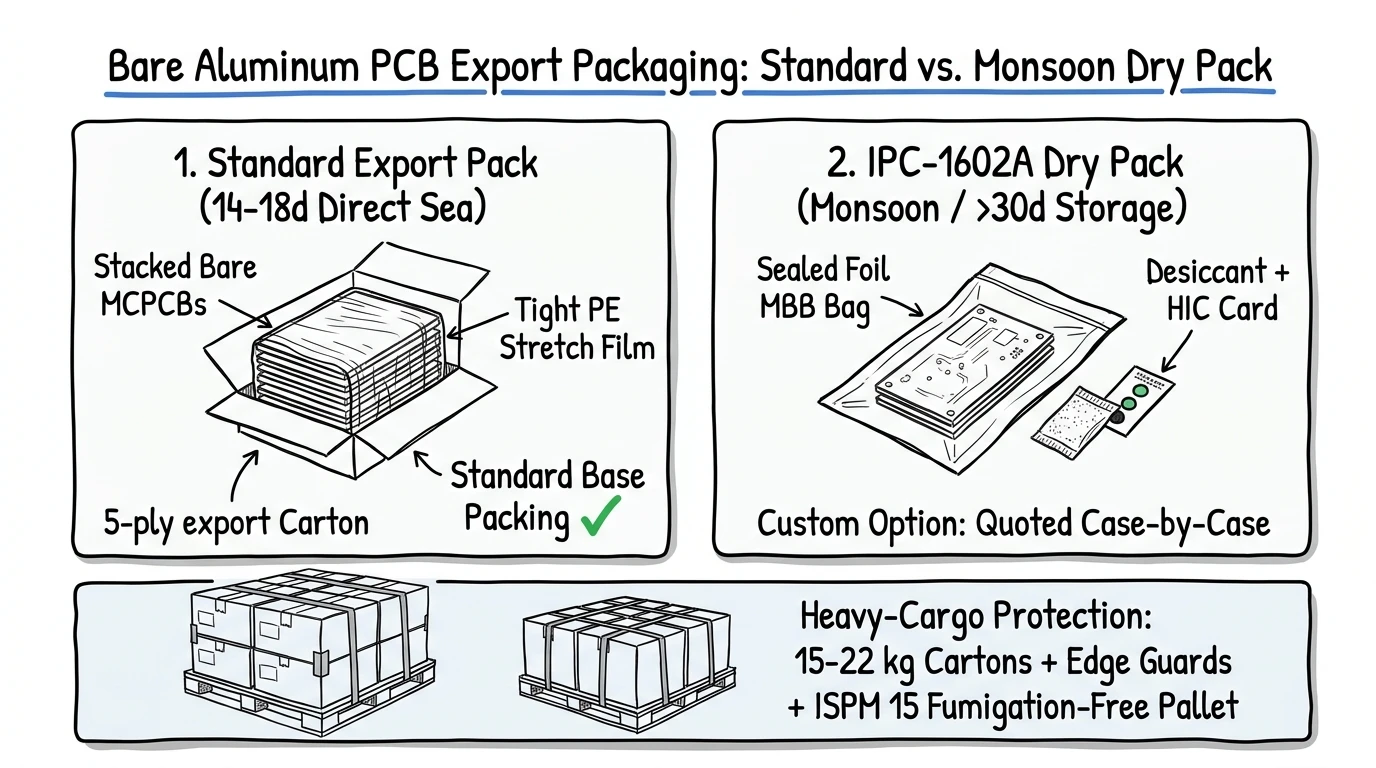 Figure 3. Standard air-excluded PE stretch bundling for 14–18 day direct voyages versus IPC-1602A MBB dry packing for Indian monsoon or long-storage shipments.
| Packaging Tier | Typical Layer Construction | Recommended Shipping & Storage Scenario | Pre-SMT Baking & Handling Rule | Cost Impact |
|---|---|---|---|---|
| Standard Export Carton & Pallet Packing | Tightly wrapped PE stretch/shrink film + export master cartons on ISPM 15 plywood or plastic pallets | 14–18 day direct vessels (non-monsoon) where boards enter SMT production shortly after arrival | Inspect pads; if damp, bake HASL at 105°C–120°C for 2–4h, or OSP at 60°C–80°C for 1–2h and mount immediately | Standard Base Packing |
IPC-1602A Dry-Pack Option (Confirm Case-by-Case) | Sealed low-WVTR Moisture Barrier Bag (MBB) + Desiccant + Humidity Indicator Card (HIC) inside master cartons | June–September Indian Monsoon, transshipment voyages (>25 days), coastal port dwell risks, or warehouse storage exceeding 30 days | Verify HIC spot reading upon opening MBB; reseal unused boards with fresh desiccant | Quoted case-by-case (Based on board size, quantity & packing specs) |
1. Standard Direct Voyages (14–18 Days): Why Tight PE Bundling Works
Multilayer FR-4 boards act like sponges because woven fiberglass and plated through-holes trap moisture deep inside the core.
Single-sided aluminum PCBs have a completely different build. Each board combines a solid 0.6–1.6 mm aluminum base, an insulating dielectric layer, and top copper traces with no plated through-holes.
We finish bare boards with either OSP (Organic Solderability Preservative) or HASL (Hot Air Solder Leveling).
As Shikoku Chemicals' Preflux OSP guide and MacDermid Alpha's ENTEK PLUS datasheet explain, dense organic coatings bond to copper to block air oxidation before reflow.
On 13-to-16-day direct sailings where boards go straight to your SMT line, tightly wrapping board stacks in multi-layer air-excluded PE film inside export cartons works well for standard commercial shipments.
Tight bundling stops heavy aluminum plates from sliding and scratching the solder mask, while keeping out surface condensation without adding extra packaging fees.
2. Monsoon Voyages & Long Storage: When to Request IPC-1602A MBB Dry Packing
Standard PE film excludes bulk air pockets, but its Water Vapor Transmission Rate (WVTR) is higher than metallized foil.
Under IPC-1602A, dry packing seals boards inside a low-WVTR Moisture Barrier Bag (MBB) with desiccant pouches and a Humidity Indicator Card (HIC).
Because vacuum foil bags and desiccant packs require extra materials and manual sealing, pricing is never a flat percentage. Discuss custom MBB dry packing and confirm the exact cost with your supplier case-by-case before ordering in three situations.
- Indian Monsoon Sailings (June to September) expose cargo to port humidity above 80%–90% RH at 35°C–45°C in Nhava Sheva and Chennai.
- Extended Port or ICD Dwell occurs on transshipment routings or inland rail haulage to Delhi NCR exceeding 25 to 30 days.
- Long Warehouse Stocking happens when importing a multi-month buffer of bare boards stored without climate control.
If bare boards absorb ambient moisture during monsoon storage, follow strict baking limits by surface finish.
- HASL Boards can be baked at 105°C to 120°C for 2 to 4 hours before reflow.
- OSP Boards must never be baked at 105°C+ for extended hours because high heat destroys the organic film. If damp OSP boards require dehumidification, use a low-temperature short bake at 60°C to 80°C for 1 to 2 hours and run SMT reflow immediately.
3. Heavy-Cargo Mechanical Protection & ISPM 15 Pallet Rules
Mechanical impact crushes far more aluminum PCBs during transit than humidity ever will.
We hold a standard 0.5 mm copper pullback from the board edge for physical short-circuit prevention and basic edge insulation (finished single-sided aluminum PCBs typically withstand 800–1,200V AC in practice, compared to ~3,000V raw laminate ratings). A dropped carton that dents the aluminum edge inward can bridge the dielectric barrier and short the circuit.
Three practical export packing habits prevent edge dents and Indian port quarantine holds.
- Sensible Carton Weight. Keeping export cartons around 15 kg to 22 kg lets handlers move boxes safely without bursting seams (FedEx Heavy Package Guidelines).
- Pallet Strapping & Corner Protection. Securing stacked cartons onto pallets with outer stretch wrap, edge protection, and strapping bands prevents load shifting at sea per the IMO/ILO/UNECE CTU Code.
- Fumigation-Free
ISPM 15Pallets. India's Plant Quarantine Order, 2003 and Chennai Customs Public Notice 15/2009 penalize untreated solid wood. Palletizing sea cargo on engineered plywood or plastic export pallets (or heat-treated pallets with IPPC ISPM 15 stamps) avoids quarantine delays.
How We Ship Volume Aluminum PCB Orders to India
We specialize in single-sided bare aluminum PCBs for LED lighting and also offer turnkey LED PCB assembly as an added service, aligning production scheduling, stamping tooling, and export paperwork around your Indian port of entry.
1. Die-Punching to Speed Up Mass Production (~300 m² Break-Even)
For boards with dense mounting holes or contoured outlines on orders over 300 m², switching from CNC routing to compound die-punching typically saves around 10 RMB (~$1.40 USD) per square meter and speeds up output (for simple hole-free strip boards, CNC routing and punching can cost nearly the same).
A dedicated single-sided aluminum PCB stamping die costs roughly 3,000 RMB (~$420 USD). We refund 100% of that die fee once your cumulative orders reach 30 times the tooling cost (~90,000 RMB / $12,600 USD), and we cover lifetime die maintenance on repeat orders.
2. Export Document Coordination & Payment Terms
Our standard payment terms are 30% deposit and 70% balance before shipment.
We share Commercial Invoice and Packing List drafts (with clear unpopulated HS 8534.00.00 or populated HS 8539.51.00 descriptions) upon shipment and forward the Bill of Lading copy as soon as it is issued, giving your CHA plenty of time to file on ICEGATE before the vessel reaches India.
3. 4 Specs to Send for a Landed FOB or CIF Quote
- Gerber files (RS-274X), plus your BOM if you want a parallel SMT assembly quote.
- Board thickness and copper weight (
0.6–1.6 mmthickness;12 µm,25 µm, or35 µmcopper, with12 µmmost common). - Thermal grade and surface finish (
0.6–0.8 W/m·Kvolume standard or1.0 W/m·Kcommercial grade;OSPorHASLfinish). - Order quantity, destination port (
JNPA,MAA,MUN, orDEL), and any special packing requests.
Frequently Asked Questions (FAQ)
What is the fastest way to ship 100 kg to 200 kg of bare aluminum PCBs from China to India?
Direct Commercial Air Cargo from Shenzhen (SZX), Guangzhou (CAN), or Hong Kong (HKG) to Delhi (DEL) or Mumbai (BOM) is the best choice for a 100 kg to 200 kg batch.
Total transit takes 4 to 7 calendar days including airport customs release (35 to 45 hours average under NTRS). High-density aluminum PCBs (~2.7 kg/m²) are billed strictly by actual gross weight, avoiding the heavy Indian CFS de-stuffing and Delivery Order fees that penalize small Ocean LCL shipments.
When must my Indian customs broker file the Bill of Entry to avoid ₹5,000/day late fees?
Under Section 46(3) of the Indian Customs Act, the deadline depends on your transport mode.
For ocean shipments from China, your broker must file the Bill of Entry on ICEGATE before the end of the calendar day preceding vessel arrival. For air cargo, the Bill of Entry must be filed before the end of the day of aircraft arrival. Late filing triggers a statutory penalty of ₹5,000 per day for the first 3 days and ₹10,000 per day thereafter (capped at ₹50,000).
Can I import free PCB prototypes via DHL or FedEx into India without paying customs duty?
Yes, if the shipment qualifies under CBIC Form CBE-XII as bona fide commercial samples supplied free of charge with a customs value not exceeding ₹10,000 and no foreign-exchange payment.
Even when we waive your prototype fee, the Commercial Invoice must never state $0.00. Declare a realistic supportable value labeled "Sample of No Commercial Value, Value for Customs Purposes Only," and upload your IEC, GSTIN, and KYC documents to the courier portal before dispatch.
Do single-sided OSP aluminum PCBs require vacuum foil bags for ocean shipping to India?
Not for standard dry-season sailings. On 13-to-16-day direct ocean vessels where boards enter SMT assembly shortly after arrival, tightly wrapped multi-layer PE film inside export cartons protects OSP and HASL boards reliably without extra dry-pack fees.
Confirm custom IPC-1602A MBB dry packing (Moisture Barrier Bags with desiccant and Humidity Indicator Cards, quoted case-by-case based on board size and volume) with your supplier before ordering if you are shipping during the June–September Indian monsoon, booking transshipment vessels, or storing bare boards for more than 30 days before reflow.
Need a quotation?
Send Gerber files and basic specifications. We reply within 1 business day.
Ask for Quote