
On This Page (Table of Contents)
In 2026, the import duty on LED PCB in India depends entirely on whether your Chinese aluminum boards arrive as unpopulated bare circuits or soldered LED assemblies.
Per HS 8534.00.00, bare single-sided aluminum PCBs pay 0% Basic Customs Duty (BCD) through Notification No. 24/2005-Customs. Standard unlisted Chinese PCB factories face a 30% CIF residual Anti-Dumping Duty (ADD) under Notification No. 03/2024-Customs (ADD). Customs then levies an 18% Integrated GST (IGST) on that duty-inclusive value. This compounding tariff creates a 53.40% total cash outlay at the port. For GST-registered lighting manufacturers, the 18% IGST is 100% recoverable as an Input Tax Credit (ITC). That credit leaves your factory with an exact 30.00% net unrecoverable sunk tax.
Importing populated LED assemblies (HS 8539.51.00) bypasses the 30% anti-dumping duty under Table Footnote (iii). Assembled boards carry a 20% BCD, a 2% Social Welfare Surcharge (SWS), and an 18% IGST. This structure cuts your port cash outlay to 43.96% and drops your net sunk tax to 22.00%.
Factories assembling lights for export can bypass both taxes entirely through Advance Authorisation (AA) licenses.
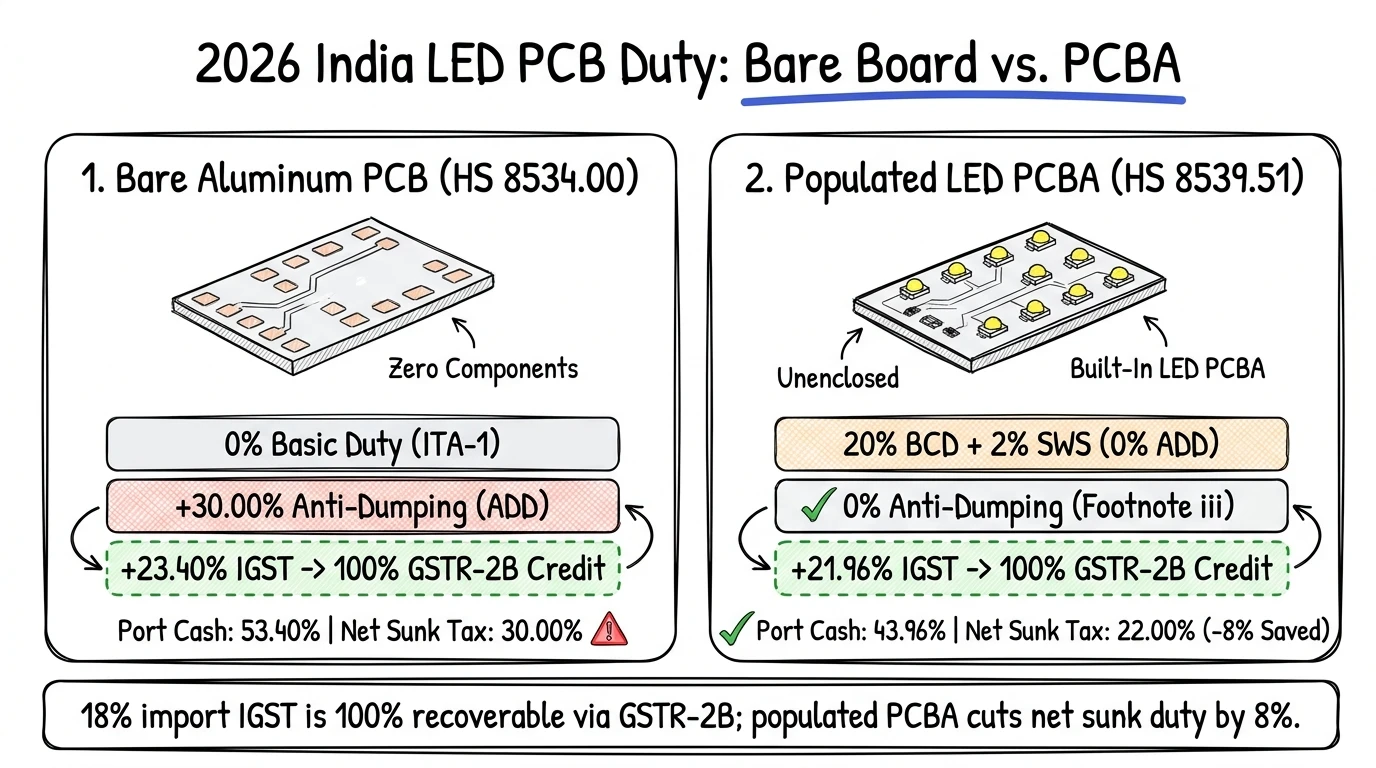 Figure 1. Cascading customs tax breakdown for Indian LED PCB imports, comparing bare MCPCBs (53.40% outlay / 30% sunk) with populated PCBAs (43.96% outlay / 22% sunk).
Why "Assembly State" Dictates Your Indian Customs Tariff
Indian customs does not evaluate a shipment based on generic trade names like "LED PCB."
Officers classify boards strictly by their physical assembly state upon arrival at Nhava Sheva (JNPT), Chennai, or Delhi air cargo.
Heading 8534 covers unpopulated printed circuits exclusively.
Once a board carries soldered surface-mount components, it leaves Chapter 8534 permanently.
1. Bare Metal-Core PCBs (HS 8534.00.00)
An unpopulated aluminum circuit board consists of etched copper foil, a thin polymer dielectric barrier, and an aluminum backing sheet. It contains zero active semiconductors, resistors, or connectors.
Importers often worry about customs officers trying to classify metal-backed boards as raw aluminum sheets under Chapter 76.
World Customs Organization rules resolve that issue immediately. Follow the HS code 8534.00.00 classification rules for bare aluminum PCBs to establish that functional circuit etching overrides base metal weight.
Following India's commitment to the Information Technology Agreement (ITA-1), bare boards enjoy a statutory 0% BCD.
Trade defense measures alter that baseline for Chinese goods.
2. Populated LED PCB Assemblies (HS 8539.51.00)
An assembled board carries surface-mounted components soldered onto the contact pads.
Mounting LED emitters, current-limiting resistors, or terminal connectors turns the board into an active lighting sub-assembly.
Unenclosed populated LED boards belong under Heading 8539.51.00 (LED light sources and modules) at a 20% BCD rate.
Instruct your broker to avoid generic Heading 9405.99.00 (luminaire parts). Customs auditors often push boards into 9405.99.00 to assess a higher 25% statutory BCD.
Declaring 8539.51.00 brings two practical results.
You escape the 30% PCB anti-dumping duty completely. In exchange, your basic customs duty steps up from 0% to 20%.
The 2026 Cascading Formula: Bare MCPCB vs. Populated PCBA
Indian customs duties do not add together in a simple linear sum.
Taxes calculate sequentially in a compounding cascade. Each layer builds upon the prior duty-inclusive base.
Customs calculates every charge against the Assessable Value (AV).
Assessable value equals the CIF price (Cost of Goods + Ocean or Air Freight + Marine Insurance) converted into Indian Rupees using the official exchange rate published bi-weekly by the Central Board of Indirect Taxes and Customs (CBIC) under Section 14 of the Customs Act.
Cascading Math for Bare Aluminum PCBs (8534.00.00)
Bare boards imported from China follow a strict compounding sequence.
- Basic Customs Duty (BCD) is ₹0 (0% under Notification No. 24/2005-Customs).
- Social Welfare Surcharge (SWS) is ₹0 because BCD is zero.
- Anti-Dumping Duty (ADD) adds the 30% CIF residual rate for standard unlisted Chinese producers under Notification No. 03/2024-Customs (ADD).
- IGST Valuation Base combines CIF value plus ADD to reach 130% of CIF.
- Integrated GST (IGST at 18%) applies to that 130% base, generating 23.40% of CIF.
Combine your border charges to determine clearance payments.
Some brokers assume aluminum MCPCBs qualify for the "Inlay PCB" exemption inside Notification 03/2024.
The Directorate General of Trade Remedies (DGTR) defines an inlay PCB as a board with discrete copper blocks embedded inside an FR4 core. Regular surface-laminated aluminum boards do not qualify and must pay the full 30% tariff.
Cascading Math for Populated LED PCBAs (8539.51.00)
Assembled boards shift your tax burden into standard customs duties while eliminating trade defense tariffs.
- Basic Customs Duty (BCD) is 20% of CIF value.
- Social Welfare Surcharge (SWS) adds 10% of BCD, equaling 2.00% of CIF.
- Anti-Dumping Duty (ADD) is 0% because Table Footnote (iii) excludes populated boards.
- IGST Valuation Base totals CIF value plus BCD plus SWS, reaching 122% of CIF.
- Integrated GST (IGST at 18%) applies to that 122% base, producing 21.96% of CIF.
Summing these charges yields your total cash payment at clearance.
Assembled modules save 9.44 percentage points in immediate border cash outlay compared to bare boards.
Port Cash Outlay vs. Real Sunk Cost: How 18% IGST Recovery Works (GSTR-2B)
A 53.40% or 43.96% tax bill at the port sounds alarming to purchasing managers.
That headline figure confuses cash-flow timing with permanent manufacturing expense.
The 18% IGST levied on import is not a permanent cost.
Per Indian GST statutory provisions, import IGST functions as a refundable input credit rather than a dead-weight tariff.
Once your customs broker files your Bill of Entry on ICEGATE, the customs platform transmits your duty payments directly to the Goods and Services Tax Network (GSTN).
Those tax payments appear inside your monthly GSTR-2B electronic credit ledger.
Under Notification No. 06/2022-Central Tax (Rate), India raised the domestic GST on finished LED lamps and luminaires from 12% to a uniform 18%.
Your 18% import IGST matches your 18% domestic output GST rate, eliminating inverted duty accumulation.
You offset your domestic tax liability directly against the IGST credits accumulated during customs clearance.
Only BCD, SWS, and anti-dumping duties represent permanent sunk expenses.
Avoid clearing commercial cargo under informal courier modes like express parcels. Courier declarations frequently fail to link your company's GSTIN correctly, permanently stranding your 18% tax credit.
Worked Example: Landed Cost Math per $10,000 CIF Invoice Value
Compare the tax math across a uniform $10,000 CIF invoice benchmark (approximately ₹865,000 at 1 USD = ₹86.50).
On a bare-board order, $10,000 CIF represents roughly 1,000 m² of standard 1.0 mm aluminum MCPCBs for downlights or batten fixtures.
| Tax & Cost Component | Statutory Rate & Legal Basis | Pathway A: Bare Aluminum PCB (8534.00.00) | Pathway B: Populated LED PCBA (8539.51.00) | Pathway C: Advance Authorisation (Export License) |
|---|---|---|---|---|
| CIF Assessable Value (AV) | Commercial Invoice + Freight | $10,000.00 (₹865,000) | $10,000.00 (₹865,000) | $10,000.00 (₹865,000) |
| Basic Customs Duty (BCD) | 0% (Notn 24/2005) vs. 20% | $0.00 (₹0) | $2,000.00 (₹173,000) | $0.00 (Exempt) |
| Social Welfare Surcharge (SWS) | 10% of BCD | $0.00 (₹0) | $200.00 (₹17,300) | $0.00 (Exempt) |
| Anti-Dumping Duty (ADD) | Notn 03/2024 (30% CIF vs. Footnote iii) | $3,000.00 (₹259,500) | $0.00 (Exempt) | $0.00 (Exempt via FTP 4.14) |
| IGST Valuation Base | CIF + BCD + SWS + ADD | $13,000.00 (₹1,124,500) | $12,200.00 (₹1,055,300) | $10,000.00 (₹865,000) |
| Integrated GST (18%) | Levied on IGST Base | $2,340.00 (₹202,410) | $2,196.00 (₹189,954) | $0.00 (Exempt) |
| Total Port Cash Outlay | Total cash paid at customs | $5,340.00 (53.40%) | $4,396.00 (43.96%) | $0.00 (0.00%) |
| Less: Recoverable GST ITC | Credited via GSTR-2B ledger | -$2,340.00 (-₹202,410) | -$2,196.00 (-₹189,954) | $0.00 |
| Net Unrecoverable Sunk Tax | Permanent factory duty expense | $3,000.00 (30.00%) | $2,200.00 (22.00%) | $0.00 (0.00%) |
On an equal $10,000 invoice benchmark, populated PCBAs save $800 in permanent tax and free up $944 in port working capital.
Check your full bill of materials before choosing a pathway.
A populated PCBA invoice (8539.51.00) bundles the bare board, LED packages, passive parts, and SMT labor into one 22% dutiable base.
Loose, unmounted SMD LED packages (HS 8541.41.00) enter India at 0% BCD.
- Indian plants with high-speed SMT lines usually pay less total tax by importing bare boards (30% ADD) and loose LED packages (0% BCD) separately.
- Factories without low-cost local SMT capacity often achieve a lower total unit cost through turnkey PCBA imports, leveraging Chinese component volume pricing and assembly yields.
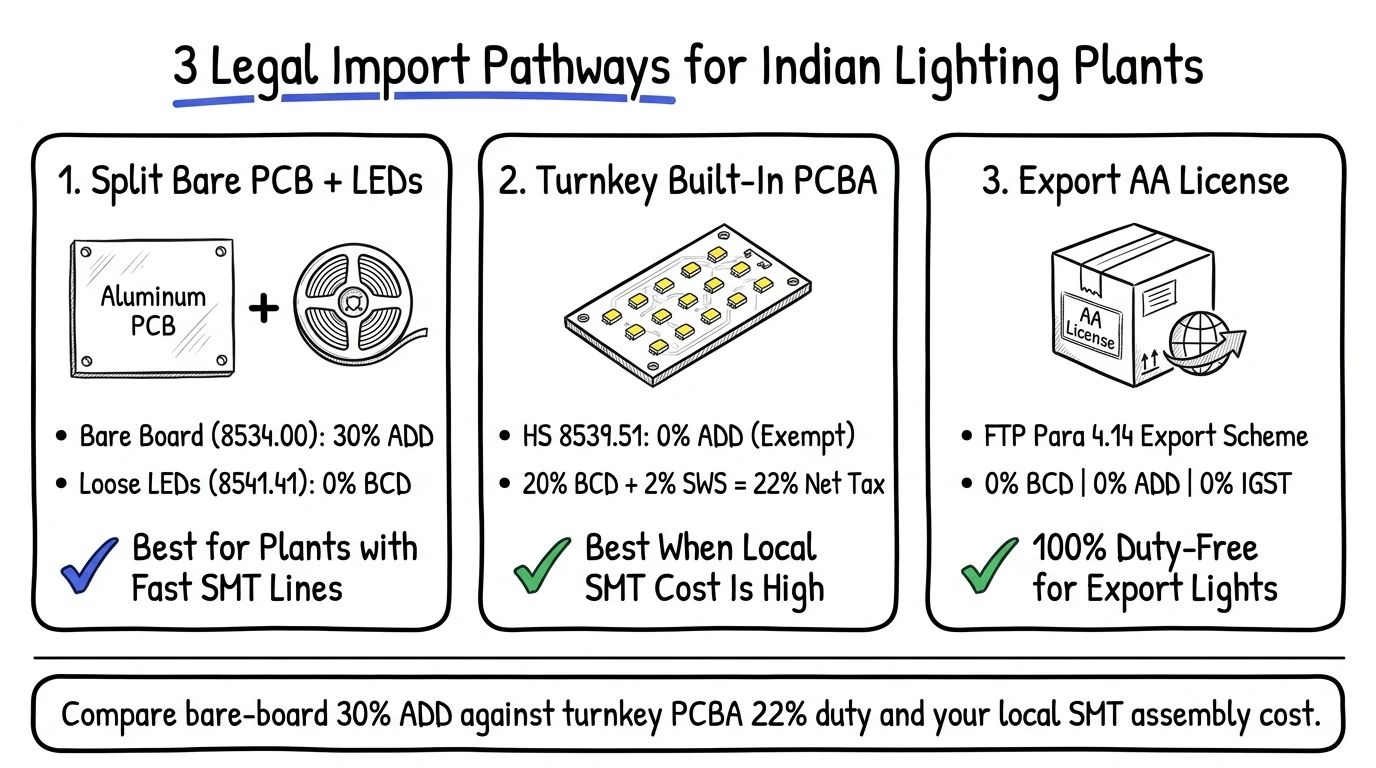 Figure 2. Three legal import pathways for Indian lighting manufacturers based on local SMT line capacity and export share.
Pathway C. The Advance Authorisation Export Channel
Indian lighting manufacturers who assemble luminaires for export to Europe, the Middle East, or Africa have access to Pathway C.
Under Foreign Trade Policy 2023 Paragraph 4.14 and Customs Notification No. 21/2023, factories holding an Advance Authorisation (AA) license import inputs duty-free.
Raw aluminum PCBs clear with 0% BCD, 0% ADD, and 0% IGST.
The same exemption covers Export Oriented Units (EOU) and Special Economic Zone (SEZ) operations. If any portion of your finished lighting inventory is diverted to the domestic Indian market, deferred duties must be settled immediately.
4 Customs Clearance Rules to Prevent Port Holds & BIS Delays in India
Accurate tax math will not help your factory if shipments sit in physical demurrage at Nhava Sheva.
Follow four operational rules on every shipping dossier.
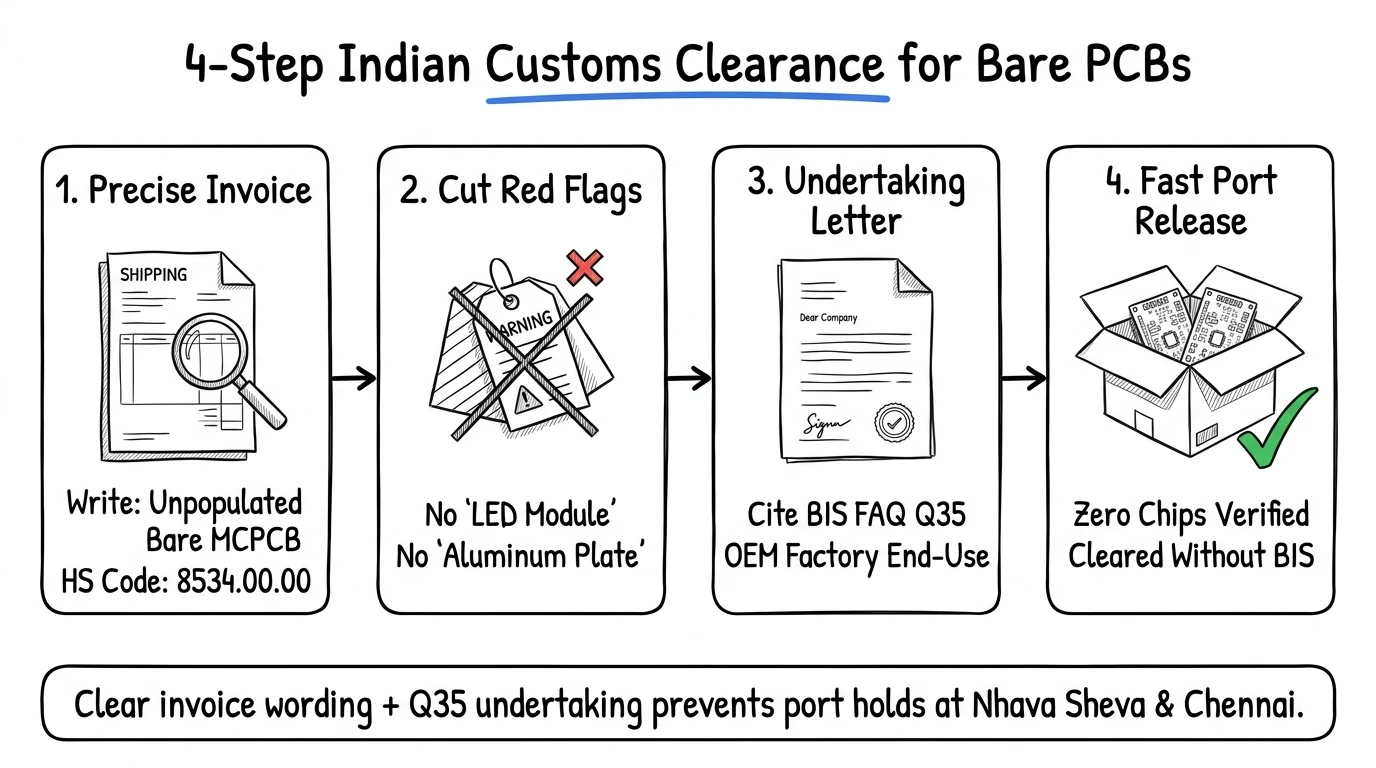 Figure 3. Indian port clearance workflow covering commercial invoice naming standards, BIS exemption undertakings, and ICEGATE matching.
1. Print Precise Technical Names on Invoices
Automated customs risk engines flag vague invoice wording for physical inspection bays.
Never print "Aluminum Sheet," "Heat Sink Panel," or generic "LED Parts" on documents. Those terms trigger Chapter 76 metal classifications and costly reassessment audits.
For bare boards under Heading 8534.00.00, enter this approved phrasing on your manifest. Bare single-sided aluminum printed circuit boards (MCPCB), unpopulated; etched copper conductors on insulating dielectric layer; zero mounted electronic components; for LED lighting assembly.
For populated boards under Heading 8539.51.00, print this approved phrasing on your invoice. Populated LED printed circuit board assemblies (PCBA); surface-mount LEDs and components soldered on aluminum base; built-in integral modules without enclosure for luminaire manufacturing.
2. Safeguard Your BIS Exemption
Bare boards require zero Bureau of Indian Standards (BIS) testing.
Review the Indian BIS exemption rules for bare aluminum PCBs and built-in modules to confirm your regulatory boundary under MeitY Clause Q35.
Populated boards require specific documentation.
Standalone retail LED modules require mandatory BIS registration under IS 16103 (Part 1).
Unenclosed sub-assemblies imported strictly as internal luminaire components are exempt from standalone port testing.
Include an OEM End-Use Undertaking on factory letterhead stating that your populated boards are unenclosed integral components built specifically for assembly inside finished luminaires.
3. Respect Section 9A(1A) Anti-Circumvention Rules
Never ask a manufacturer to solder a single dummy 0-ohm jumper or blank resistor onto a bare board to claim Heading 8539.
Indian customs authorities actively audit minimal assembly modifications under Section 9A(1A) of the Customs Tariff Act.
If inspectors discover non-functional parts mounted solely to bypass Heading 8534, they seize the cargo, collect the 30% ADD retroactively, and impose punitive fraud penalties.
Genuinely functional LED circuit boards avoid circumvention risks entirely.
4. Lock Your IEC, GSTIN, and Certificate of Origin
Verify that your Importer Exporter Code (IEC) and GSTIN match identically across the Bill of Lading, Commercial Invoice, and ICEGATE entry.
A single typographical error in your GSTIN blocks customs data from populating your GSTR-2B credit pool.
Demand a preferential or non-preferential Certificate of Origin (COO) from your Chinese supplier.
A stamped COO confirms Chinese factory origin, preventing customs valuation officers from loading arbitrary assessable values onto your shipment.
How We Help Indian Buyers Lower Landed Costs (Bare Board vs. Turnkey PCBA)
Because we run both single-sided aluminum PCB fabrication lines and in-house SMT assembly, we quote both customs pathways side by side from one drawing package.
1. Stamping Tooling to Cut Your CIF Tax Base (300 m² Break-Even)
When bare boards carry a 30% anti-dumping duty, every dollar trimmed off your factory FOB price lowers your customs tax bill by another $0.30.
On multi-hole LED boards, CNC routing costs roughly $1.40 USD more per square meter than mechanical die-punching.
Once a board design reaches 300 m², switching to high-speed die-punching for aluminum PCBs drops your unit price immediately.
A dedicated compound stamping die costs $420 USD. We refund 100% of that $420 USD die fee once your cumulative volume reaches 30 times the tooling cost (roughly $12,600 USD), and we cover lifetime die maintenance on repeat orders.
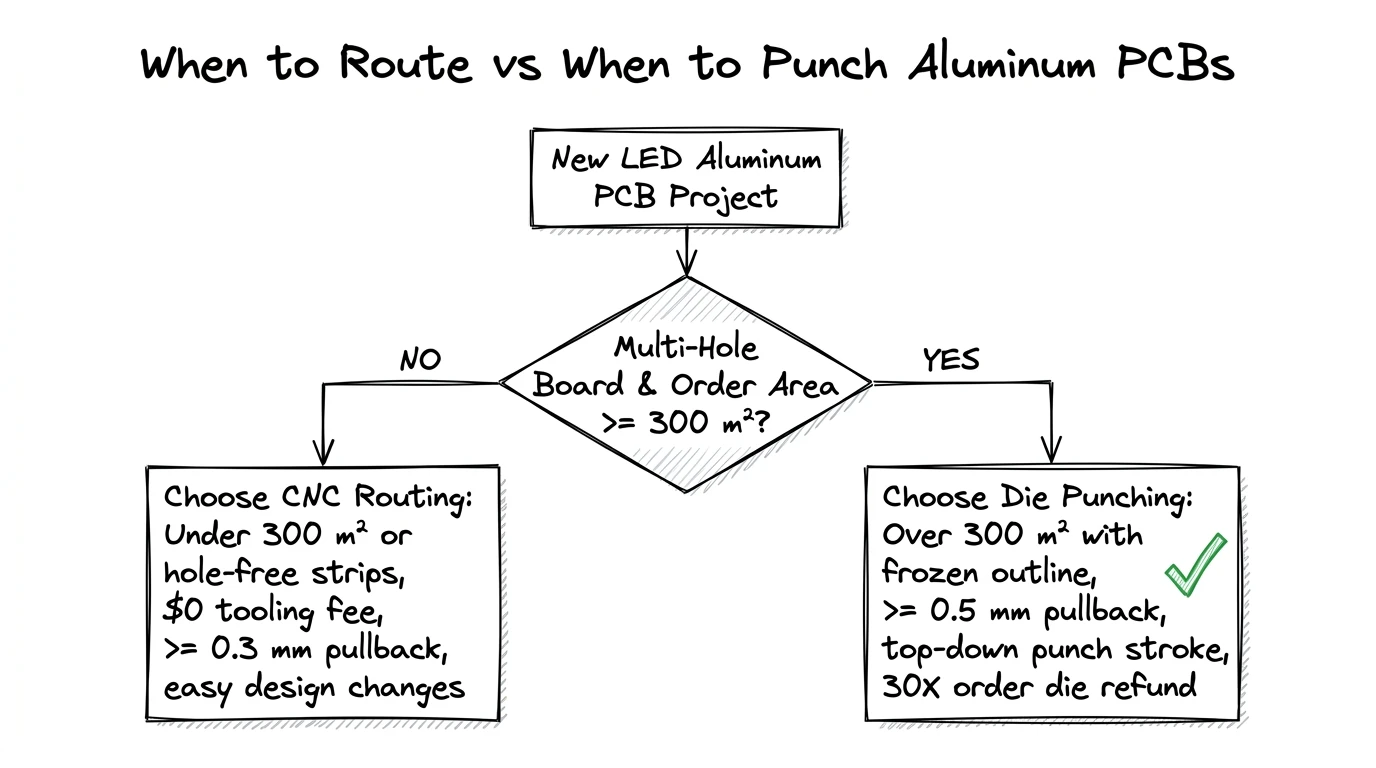 Figure 4. Switching multi-hole boards over 300 m² from CNC routing to compound stamping lowers your FOB unit price and shrinks your 30% CIF duty base.
2. Side-by-Side Bare Board vs. Turnkey PCBA Quoting
Send us your Gerber files and BOM so you can compare both landed-cost options with your customs broker.
- Option A is single-sided bare aluminum PCB manufacturing (
HS 8534.00.00). Built for Indian factories holding Advance Authorisation export licenses or running high-speed local SMT lines. - Option B is turnkey LED PCB assembly services (
HS 8539.51.00). We source the LED packages, solder the boards on our in-house SMT lines, and ship unenclosed built-in modules. This legally cuts your net sunk duty from 30% to 22%.
3. 4 Specs to Send for a Dual Landed-Cost Quote
- Gerber files (RS-274X), plus your BOM and LED package specs if you want a parallel PCBA quote.
- Board thickness and copper weight. Bulbs and batten tubes typically use 0.8–1.2 mm aluminum with 12 µm copper, while floodlights and street lights use 25 µm or 35 µm copper.
- Thermal grade and surface finish. Choose 0.6–0.8 W/m·K (volume standard) or 1.0 W/m·K commercial grade, paired with OSP or HASL finish.
- Order volume and destination port (such as Nhava Sheva, Chennai, or Mundra) so we can calculate stamping amortization and CIF freight together; see our guide on shipping bare aluminum PCBs from China to India for direct ocean transit times and Section 46 pre-filing deadlines.
Frequently Asked Questions (FAQ)
How long will India's 30% anti-dumping duty on Chinese bare PCBs stay in force?
Under Paragraph 2 of Notification No. 03/2024-Customs (ADD), the anti-dumping duty took effect on March 14, 2024, and remains in force for five years (through March 13, 2029) unless revoked or amended earlier.
Indian lighting buyers should treat the 30% bare-board tariff (or the 22% populated PCBA duty alternative) as a multi-year baseline when planning production budgets.
Can we import unetched aluminum copper-clad laminates (raw CCL) to avoid the 30% PCB anti-dumping duty?
Not if you are a luminaire assembly plant. Unetched raw laminates (CCL) do not fall under 8534.00.00 because they carry no etched circuit pattern yet. Customs classifies them as raw metal or composite sheets under Chapter 76 or Chapter 74.
Unless your Indian facility runs a full wet-chemical etching, photoresist exposure, and solder-mask line, unetched laminate sheets cannot be used to mount LEDs.
Does transshipping Chinese bare PCBs through Vietnam or ASEAN bypass the 30% anti-dumping duty?
No. Transshipment fraud also carries severe customs penalties.
Notification 03/2024 applies to bare PCBs originating in or exported from China, regardless of which intermediate port the container passes through.
Indian customs actively audits ASEAN Certificates of Origin under the CAROTAR rules. Re-exporting Chinese-etched boards through a third country without substantial manufacturing transformation leads to cargo seizure, retroactive 30% ADD collection, and statutory fines. The only legal ways to avoid the 30% ADD are importing genuine populated PCBAs (8539.51.00) or clearing bare boards under an Advance Authorisation export license.
Need a quotation?
Send Gerber files and basic specifications. We reply within 1 business day.
Ask for Quote