
On This Page (Table of Contents)
Prefer watching on YouTube?youtube.com/watch?v=F1qGwoSqsc4
Do bare LED aluminum PCBs require BIS certification to enter India?
No. Unpopulated bare aluminum PCBs under HS Code 8534.00.00 are 100% exempt from BIS registration.
Under the MeitY Compulsory Registration Scheme (CRS), mandatory BIS rules apply only to finished, active lighting products.
Unpopulated metal-core PCBs have no LEDs, drivers, or semiconductors mounted on the pads. Indian customs treats them as passive raw components, not active appliances.
Check which product category your shipment falls into before booking freight.
- Bare Aluminum PCB (
8534.00.00) requires no BIS license under BIS CRS FAQ Clause Q35. - Built-in LED PCBA (
8539.51.00) requires no standalone BIS at port when imported as an unenclosed OEM sub-assembly. - Independent LED Module (
8539.51.00) requires a mandatory BIS R-number under IS 16103 (Part 1).
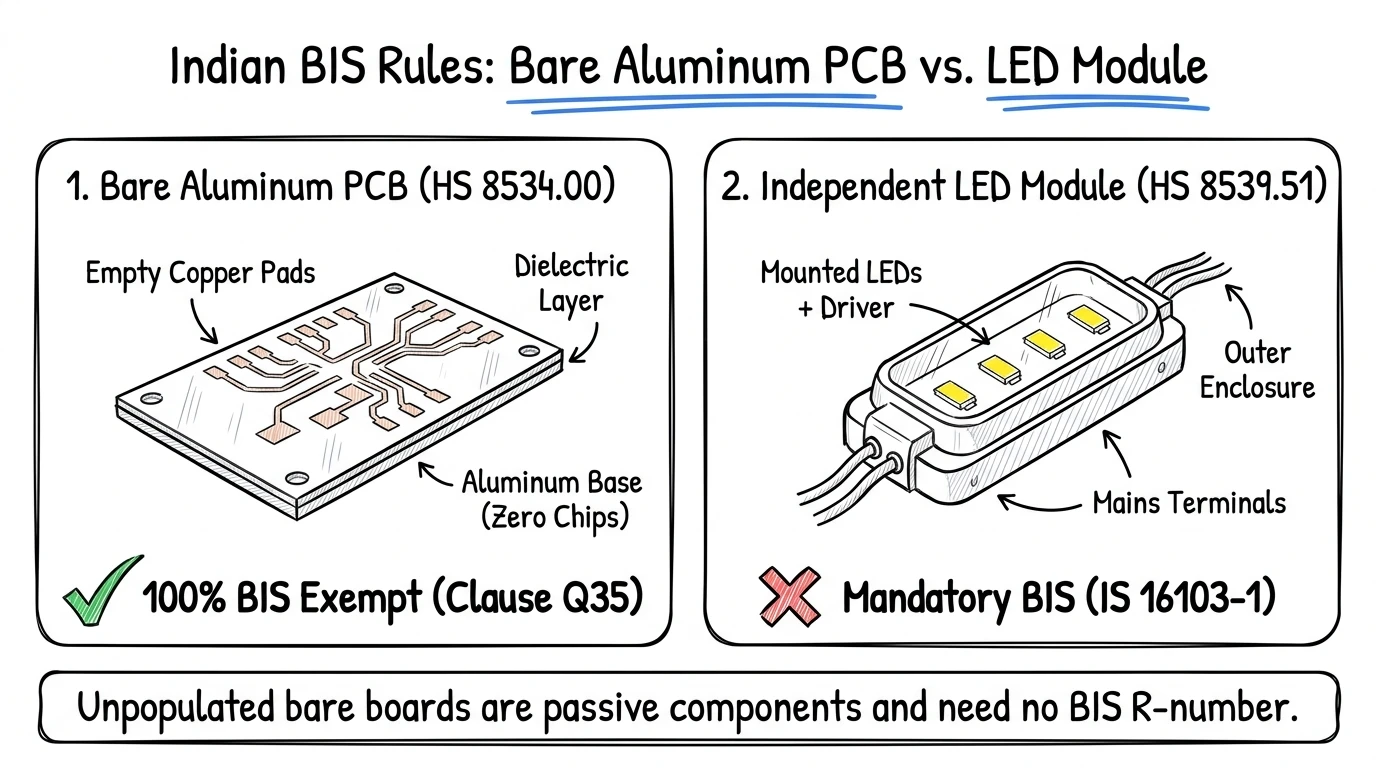 Figure 1. Regulatory boundary between unpopulated bare MCPCBs (exempt under Clause Q35) and finished active modules under Indian BIS rules.
Why Bare Aluminum PCBs Are Exempt from Indian BIS
Bare aluminum PCBs are exempt from BIS because Indian safety standards only regulate active electronic devices.
For general LED lighting, the mandatory BIS CRS product list covers four active categories.
- Self-ballasted LED lamps under IS 16102 (Part 1)
- Complete fixed and street luminaires under IS 10322 (Part 5)
- DC or AC supplied electronic control gear (drivers) under IS 15885 (Part 2/Sec 13)
- Independent LED modules for general lighting under IS 16103 (Part 1)
None of those standards cover unpopulated printed circuit boards.
Clause Q35 of the official BIS CRS FAQ confirms this exemption directly.
"Bare PCBs without components are not covered under the scope of the Compulsory Registration Order."
At major ports like Nhava Sheva (JNPT), Chennai, and Mundra, bare boards clear under HS code 8534 customs classification for aluminum PCB.
A bare board consists only of etched copper tracks, an insulating dielectric layer, and an aluminum base. Because it cannot emit light or regulate current on its own, customs officers cannot demand a BIS registration number (R-number).
Bare Board vs. Built-in PCBA vs. Independent Module
Port holds usually happen when brokers mix up bare boards, built-in assemblies, and standalone retail modules.
Whether your cargo needs an R-number depends on what is soldered onto the board and whether it has an outer housing.
| Physical Form | Typical HS Code | Standalone BIS Required? | Governing Standard | Customs Clearance Action |
|---|---|---|---|---|
| Bare Aluminum PCB (Unpopulated) | 8534.00.00 | No (100% Exempt) | None (Passive Part) | Clear with descriptive commercial invoice |
| Built-in LED PCBA (Mounted LEDs, no shell) | 8539.51.00 | No (Component level) | Tested inside luminaire | Attach OEM factory end-use undertaking |
| Independent LED Module (With housing/terminals) | 8539.51.00 | Yes (Mandatory) | IS 16103 (Part 1) | Requires valid R-number on packaging |
| Complete LED Luminaire (Finished fixture) | 9405.11 / 9405.42 | Yes (Mandatory) | IS 10322 (Part 5) | Requires full CRS brand license |
1. Bare Metal-Core PCB (8534.00.00)
This is an unpopulated single-sided aluminum board.
It carries etched copper traces, a polymer dielectric layer, and a 1060 or 5052 aluminum core with zero soldered parts. It is 100% exempt from BIS.
2. Built-in (Integral) LED PCBA (8539.51.00)
This is an assembled board with surface-mounted LEDs and resistors, but no outer housing or mains terminal block.
Indian lighting factories import these boards to screw directly inside bulb bodies, downlights, or street light castings.
Official BIS IS 16103 (Part 1) implementation guidelines state this exemption clearly.
"Integral modules not having their own enclosure shall be treated as integral components of luminaires ... They shall be tested as assembled in the luminaire."
Because it has no standalone housing, an integral PCBA does not need an individual BIS mark at customs. Your local lab tests the board inside your complete fixture during IS 10322 luminaire certification.
3. Independent LED Module (8539.51.00)
An independent module includes mounted LEDs plus its own protective enclosure, lens, or mains terminal block.
Electricians can wire it directly to power outside a luminaire housing.
Independent modules require mandatory BIS registration under IS 16103 (Part 1). Importing them without a valid R-number printed on the label leads to port seizure.
Commercial Invoice Wording That Prevents Port Holds
Even though bare boards are legally exempt, vague shipping paperwork will route your shipment straight to manual inspection.
Customs screening software scans manifests for lighting and metal keywords.
The Proven Invoice Description Template
When we ship bare boards to India, we print this exact text on the Commercial Invoice (CI) and Packing List (PL).
Bare single-sided aluminum printed circuit boards (MCPCB), unpopulated; etched copper conductors on insulating dielectric layer; containing zero electronic components or mounted semiconductors; for industrial manufacturing use; HS Code 8534.00.00
4 Red-Flag Terms to Delete From Your Invoice
- Delete "LED Board." Customs officers read "LED Board" as an active LED assembly and hold the cargo for a BIS certificate.
- Delete "LED Module." "Module" triggers automatic IS 16103-1 compliance flags in the ICEGATE system.
- Delete "Lighting Parts." Generic descriptions trigger manual spot checks across Indian ports.
- Delete "Aluminum Plate." Appraisers may push the shipment into Chapter 76 raw aluminum and charge metal anti-dumping duties.
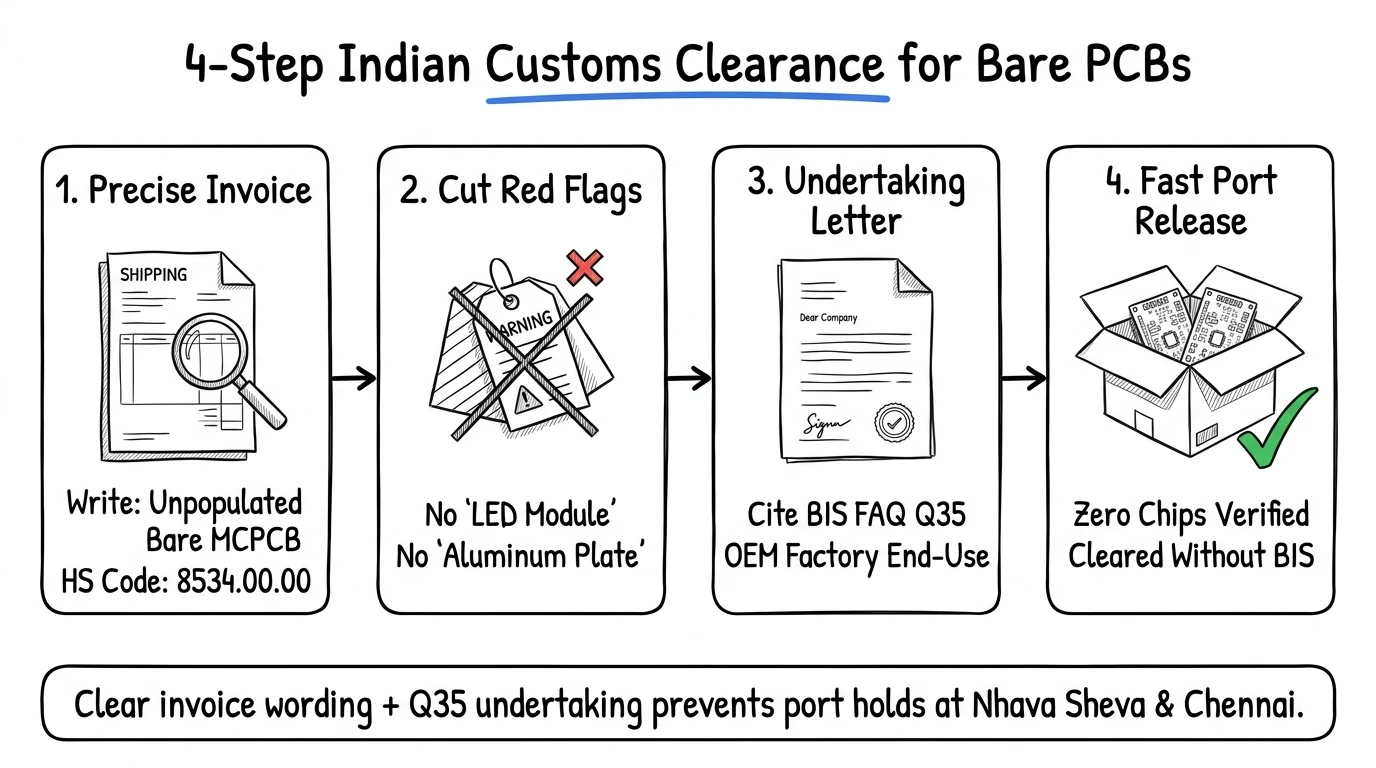 Figure 2. Four-step customs clearance flow for bare aluminum PCBs entering Indian ports.
The 1-Page Importer's Undertaking
Pair your commercial invoice with a one-page Self-Declaration Undertaking on your company letterhead for your Custom House Agent (CHA).
That letter confirms three facts for the port appraiser.
- Unpopulated state. Goods under the Bill of Lading are raw aluminum printed circuit boards with zero semiconductors.
- Legal exemption. Unpopulated boards are exempt from MeitY's CRS order under BIS FAQ Clause Q35.
- Factory end-use. Imported boards go directly to your local assembly line to build finished LED luminaires.
When an inspector opens a carton and sees bare copper pads matching your letter, the cargo clears without delay.
Do You Need UL Yellow Card Laminates for Local BIS Testing?
Clearing port customs is step one. Step two is testing your assembled luminaire at an Indian lab for your own IS 10322 BIS license.
Sourcing agents often claim you must buy aluminum laminates with a searchable US UL 94V-0 Yellow Card (E-file). Many brokers warn that Indian labs will reject your fixture without one.
For mass-market consumer lighting, that advice adds a 15% to 30% material surcharge you do not need.
How Indian Labs Actually Test PCB Fire Safety
Under IS 10322 (Part 5), Indian test labs verify internal PCB fire resistance using the 650°C Glow-Wire Test (IEC 60695-2-11).
Lab technicians press a glowing 650°C wire tip against the board's dielectric layer for 30 seconds.
Your board passes if two physical conditions are met.
- Any flame dies out within 30 seconds after pulling the glow-wire tip back.
- No burning drops fall and ignite the tissue paper placed underneath.
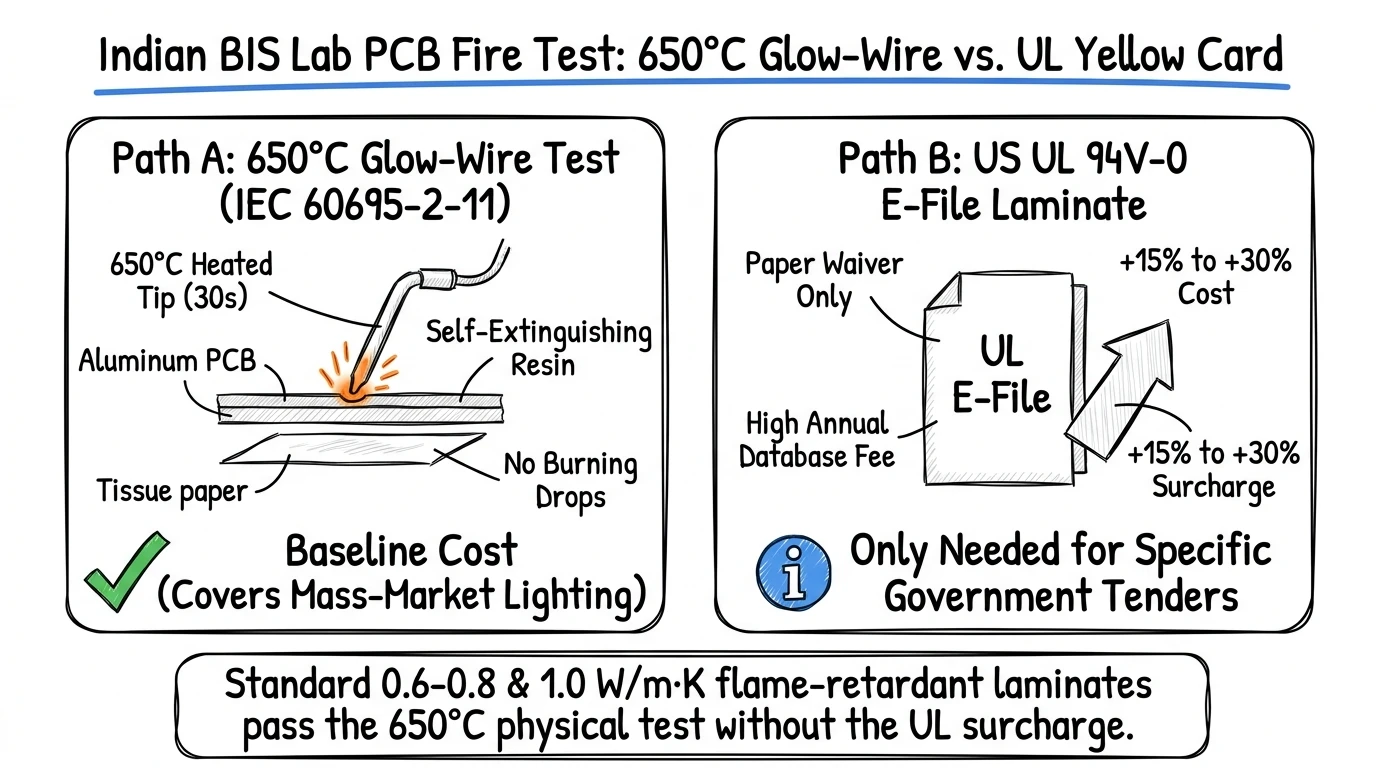 Figure 3. Standard commercial flame-retardant aluminum laminates pass the Indian lab's 650°C physical glow-wire test without the 15%–30% US UL E-file surcharge.
| Evaluation Metric | Standard Commercial Flame-Retardant | Official UL E-File Laminate | Practical Fit for India |
|---|---|---|---|
| Flammability Resin | Self-extinguishing industrial epoxy | UL 94V-0 database-listed chemistry | Both pass the 650°C physical test |
| Lab Verification | 650°C physical glow-wire test on fixture | Paper certificate waives physical test | Physical test covers most fixtures |
| Laminate Price | Baseline volume pricing | +15% to +30% per square meter | Commercial laminate protects margin |
| Target Orders | Mass-market A60 bulbs, T8 tubes, floodlights | Government or export tenders requiring UL | Pay for UL only when tenders demand it |
Where the 15%–30% UL Price Gap Comes From
Holding a searchable US UL E-file simply lets the Indian lab skip that 30-second physical test on paper.
Laminate mills pay tens of thousands of dollars every year to maintain an active UL database listing. Raw material suppliers pass that annual fee straight into the square-meter board price.
For high-volume Indian lights like A60 bulbs, T8 batten tubes, and floodlights, our standard 0.6–0.8 W/m·K and 1.0 W/m·K laminates use self-extinguishing epoxy resin. Both grades pass the 650°C glow-wire test directly.
Unless a municipal tender explicitly writes a searchable UL file number into your contract, paying the UL surcharge wastes your margin.
How We Build and Inspect Volume Orders for India
Indian lighting factories buying single-sided aluminum PCB boards in volume care about two numbers: landed cost per square meter and consistent edge insulation.
1. Die-Punching vs. CNC Routing (The 300 m² Break-Even)
For small trial runs, we cut board outlines on CNC routing tables.
On typical multi-hole boards, CNC routing costs roughly $1.40 USD more per square meter than mechanical stamping.
Once your order reaches roughly 300 m², switching to high-speed die-punching for aluminum PCBs immediately lowers your unit cost.
A dedicated compound stamping die costs around $420 USD. We refund 100% of that $420 USD die fee once your cumulative orders hit 30 times the tooling cost (roughly $12,600 USD), and we cover lifetime die maintenance for repeat orders.
2. Copper Pullback and Real Voltage Limits
Raw laminate sheets rate around 3,000V AC in lab reports.
Once a board is punched or V-scored, the exposed aluminum edge brings practical finished-board withstand voltage down to 800–1,200V AC.
We hold a standard 0.5 mm copper-to-edge pullback margin on our stamping dies. That clearance stops the punch blade from smearing copper into the aluminum wall and causing arc shorts.
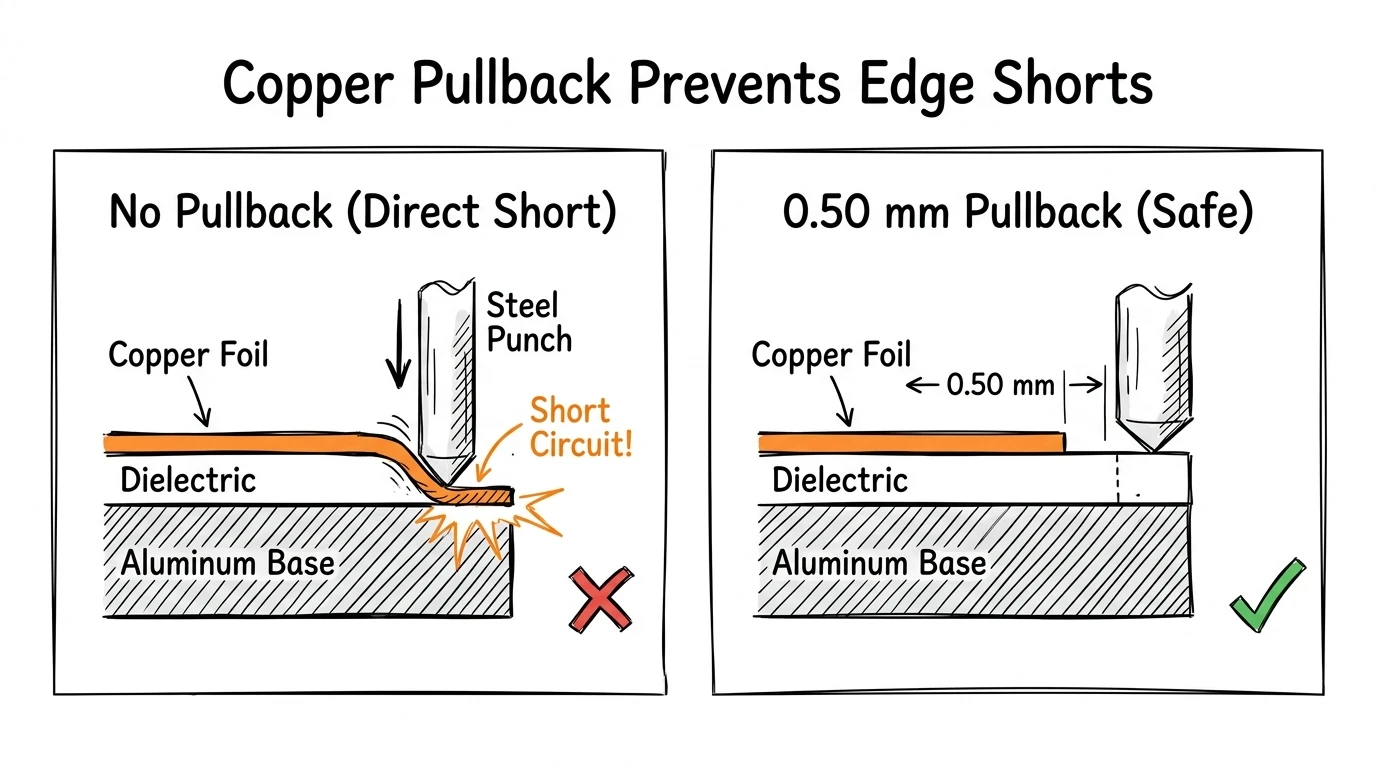 Figure 4. Keeping a 0.50 mm copper-to-edge pullback prevents stamping blades from smearing copper down into the aluminum base.
3. In-House AOI vs. Outsourced Lab Testing
Every production batch goes through Automated Optical Inspection (AOI) on our shop floor to catch trace shorts or pinholes before surface finishing.
We do not run routine Hi-Pot testing on bare boards during daily mass production. Open and short electrical testing is performed after SMT assembly on populated LED boards.
If a utility tender requires formal dielectric breakdown or thermal conductivity reports (such as Microtek lab reports), tell us before quoting so we can arrange paid third-party testing.
4 Specs to Send for a Fast Quote
- Gerber files (RS-274X) with copper, solder mask, silkscreen, and outline layers.
- Thickness and copper weight. Bulbs and tubes typically use 0.8 mm to 1.2 mm aluminum with 12 µm copper, while 25 µm / 35 µm handles high-power floodlights.
- Thermal grade and finish. Choose 0.6–0.8 W/m·K (volume standard) or 1.0 W/m·K, with OSP or HASL finish.
- Order volume, so we can compare CNC routing against stamping tooling right away.
Frequently Asked Questions (FAQ)
Does the BIS exemption also exempt bare aluminum PCBs from India's 30% anti-dumping duty?
No. BIS safety rules and customs anti-dumping tariffs are completely separate.
Unpopulated bare aluminum PCBs under HS 8534.00.00 need zero BIS registration, but they still carry India's 30% CIF Anti-Dumping Duty (ADD) under Notification No. 03/2024-Customs, plus 18% IGST.
To avoid that 30% bare-board ADD legally, many Indian factories use our in-house SMT assembly services and import built-in LED PCBAs under HS 8539.51.00.
Populated boards are excluded from the PCB anti-dumping order (paying 20% BCD + 2% surcharge instead of 30% ADD). See our 2026 Indian customs duty breakdown for bare vs. populated LED PCBs for the full GSTR-2B tax credit math. They still clear port without a standalone BIS R-number when declared as unenclosed OEM components.
Do bare aluminum PCBs need BEE Star Labeling, WPC, or EPR certificates at Indian ports?
None of those apply to bare metal-core boards.
BEE Star Labeling regulates finished lamps based on lumen efficacy. WPC (ETA) certification only covers boards with wireless RF modules like Wi-Fi or Bluetooth.
Because a bare aluminum PCB has no radio transmitter or light output, customs will not ask for BEE or WPC permits. If your QA file needs RoHS or REACH material reports, confirm with our team before quoting.
What changes at customs if we import SMT-assembled LED boards instead of bare PCBs?
Three details change on your import entry.
- Tariff code: Switch from
8534.00.00(bare printed circuits) to8539.51.00(LED modules/assemblies). - Invoice wording: Print "Built-in integral LED modules without enclosure, for internal assembly into finished luminaires" so customs does not treat them as retail modules under IS 16103-1.
- Lab file: Make sure your local test lab lists that LED board specification inside the Construction Data Form (CDF) of your finished luminaire's IS 10322 BIS license.
Final Technical Takeaway
Unpopulated bare aluminum PCBs belong under HS Code 8534.00.00 and are 100% exempt from Indian BIS CRS registration under Clause Q35.
Most port holds come from two preventable mistakes. Shippers either write vague terms like "LED Board" or "LED Module" on the Commercial Invoice, or importers pay a 15% to 30% surcharge for US UL Yellow Card laminates when local Indian labs only run a physical 650°C glow-wire test.
Before your next shipment sails, lock in clean unpopulated invoice wording with your customs broker, attach a one-page OEM undertaking letter, and move repeat orders over 300 m² to compound punch tooling. Review our China-to-India PCB ocean transit times and ICEGATE pre-filing guide to align your Section 46 Bill of Entry deadline and 35-day factory-to-SMT buffer.
Need a quotation?
Send Gerber files and basic specifications. We reply within 1 business day.
Ask for Quote