
On This Page (Table of Contents)
What is the correct HS code for bare aluminum PCBs?
The short answer: HS Heading 8534 (HS 8534.00).
Bare single-sided aluminum PCBs are legally printed circuits. They are not raw aluminum articles under Chapter 76.
Getting this wrong costs serious money.
If your freight forwarder or customs broker mistakenly enters Chapter 76 on the import declaration, port authorities will treat your cargo as raw metal.
That single error triggers customs holds, manual audits, and sudden anti-dumping duties of up to 30% to 50%.
Here are the exact country-specific tariff codes you should declare:
- United States:
8534.00.0095(0% base duty + 25% Section 301) - European Union:
8534 00 19 00(0% duty) - India:
8534 00 00(0% BCD + 18% IGST; subject to 03/2024 anti-dumping rules)
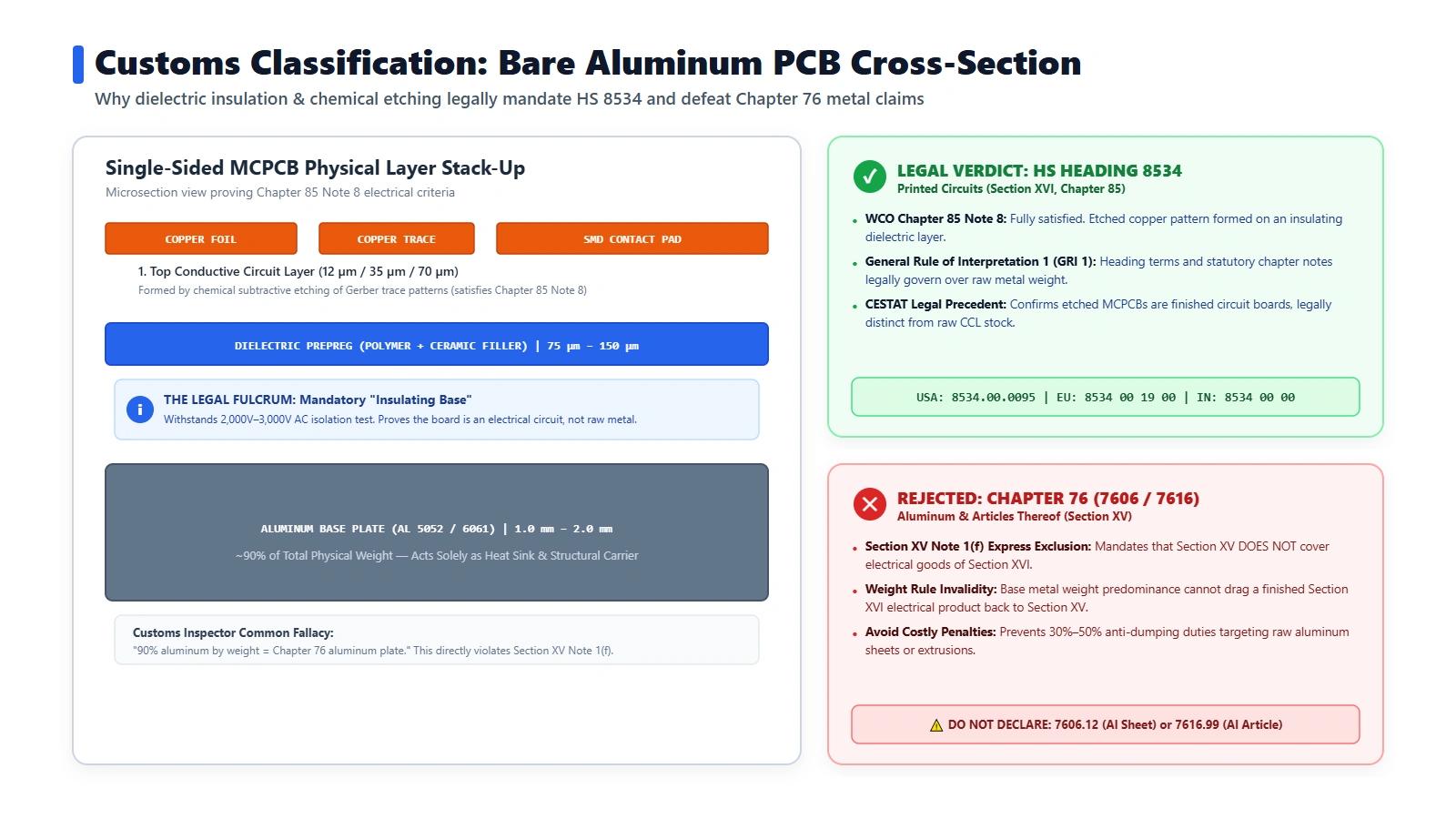 Figure 1. Cross-section breakdown of a single-sided aluminum MCPCB showing why dielectric isolation legally establishes Heading 8534 over Chapter 76.
The Legal Defense: Why Aluminum PCBs Belong in HS 8534, Not Chapter 76
Here is a common scenario at customs ports.
An inspector opens your shipping crate. They see a solid slab of white-coated metal. They put it on a scale.
Aluminum makes up roughly 90% of the physical board weight.
The inspector's first instinct?
"This is mostly aluminum. It belongs under Heading 7606 as an aluminum plate, or Heading 7616 as an aluminum article."
Do not accept that classification. It is legally incorrect.
Here is the exact legal argument that settles the dispute.
1. General Rule of Interpretation 1 (GRI 1)
International customs classification starts with GRI 1.
Classification is determined strictly by the terms of the headings and relative Section or Chapter Notes.
Turn to HS Chapter 85 Note 8. It defines printed circuits as:
"circuits obtained by forming on an insulating base, by any printing process (for example, embossing, plating-up, etching) ... conductor elements, contacts or other printed components ... alone or interconnected according to a pre-established pattern."
A bare aluminum metal-core PCB (MCPCB) checks every single legal requirement:
- Etched copper tracks: The circuit layout is formed by chemical etching.
- Dielectric insulating layer: A thin polymer layer sits directly under the copper traces. Review standard dielectric layer thickness and insulation values.
- Aluminum base: Acts as a mechanical backplane and heat sink behind the dielectric.
- Unpopulated state: No active or passive components are mounted yet.
Notice what the legal note requires. It requires the circuit pattern to sit on an insulating base.
It does not require the entire structural body to be non-metallic. The dielectric layer satisfies the requirement completely.
2. The Section XV Note 1(f) Exclusion
What if the customs officer cites Section XV Note 7 and insists that base metal weight overrides everything else?
Point them directly to Section XV Note 1(f).
Section XV covers base metals, including Chapter 76 aluminum. Note 1(f) explicitly states that Section XV does not cover articles of Section XVI (machinery, mechanical appliances, and electrical goods).
Heading 8534 is inside Section XVI.
Because an etched aluminum board meets the definition of a printed circuit under Heading 8534, it is legally excluded from Chapter 76.
Base metal weight rules only apply when deciding between competing metals inside Section XV. They have zero legal authority to pull an electrical article back out of Section XVI.
3. Raw CCL vs. Etched Bare PCB
There is one critical distinction to remember.
Customs courts draw a sharp line between raw stock and completed boards.
In Arktron Electronics v. Commissioner of Customs (Final Order 50945/2025), India's CESTAT confirmed that unetched copper-clad laminate (CCL) is an unworked raw material. Raw aluminum CCL can be classified under Chapter 76 or Chapter 74.
The moment copper is etched into functional circuit traces, its legal identity changes permanently. It becomes a finished bare printed circuit under Heading 8534.
Global Tariff Matrix: US, EU, and India Compared
Every country uses the same 6-digit WCO base: 8534.00.
However, national customs systems require 8-to-10 digit statistical suffixes. Declaring the wrong suffix can cause automatic manifest rejections.
Here is how the top three import markets compare:
| Destination Market | Tariff Item (8-10 digit) | Base Duty | Additional Tariffs / ADD | Chapter 76 Exclusion Basis |
|---|---|---|---|---|
| United States | 8534.00.0095 | 0% (Free) | +25% Section 301 (List 3) | Extrusion AD/CVD excludes rolled sheet |
| European Union | 8534 00 19 00 | 0% (Free) | 0% | Reg 2021/1784 excludes composite sheets |
| India | 8534 00 00 | 0% BCD + 18% IGST | 30% CIF ADD (Notification 03/2024) | CESTAT precedent confirms MCPCB is a PCB |
United States: Do Not Pick Suffix .0020 or .0040
Under the USITC HTSUS 2026 Schedule, Heading 8534 carries a standard base duty rate of Free (0%).
Here is the trap.
Many customs brokers search their database and pick .0020 or .0040.
Do not let them do that.
In the US tariff schedule, suffixes .0020 and .0040 are strictly reserved for boards "Having a base wholly of impregnated glass."
An aluminum PCB has a solid metal core. Its base is not wholly of glass.
The only legally accurate 10-digit classification for standard single-sided aluminum MCPCBs is:
8534.00.0095 ("Printed circuits: Other: Other").
What about trade remedy tariffs?
- Section 301: Chinese-origin boards remain subject to a 25% tariff under Heading 9903.88.03.
- Aluminum Extrusion Anti-Dumping (A-570-967): US Commerce orders explicitly exclude aluminum plates or sheets produced by processes other than extrusion. Standard aluminum PCBs are manufactured from flat rolled sheets, completely outside extrusion remedies.
European Union: Single-Sided vs. Multilayer
The European Union Combined Nomenclature (Regulation EU 2025/1926) splits Heading 8534 into two subheadings:
8534 00 11 00: Multilayer printed circuits.8534 00 19 00: Other printed circuits (single-sided and double-sided).
Single-sided bare aluminum boards fall under 8534 00 19 00.
Base duty is 0%.
EU trade defense measures on Chinese rolled aluminum (Regulation 2021/1784) target raw sheets without backing. They do not apply to functional printed circuits.
India's PCB Anti-Dumping Dilemma: 4 Ways to Protect Your Margins
India is one of the fastest-growing manufacturing hubs for LED luminaires. It also enforces some of the strictest trade remedies in the world.
Under Ministry of Finance Notification No. 03/2024-Customs (ADD), India imposes an anti-dumping duty of up to 30% of CIF value on bare PCBs up to 6 layers from China and Hong Kong.
Many importers hope their boards qualify for the "Inlay PCB" exemption.
They do not. The notification defines an inlay board as one with separate metal blocks pressed into the laminate. Surface-laminated aluminum boards are fully subject to the 30% duty.
How do you protect your landed costs?
Here are the four practical pathways.
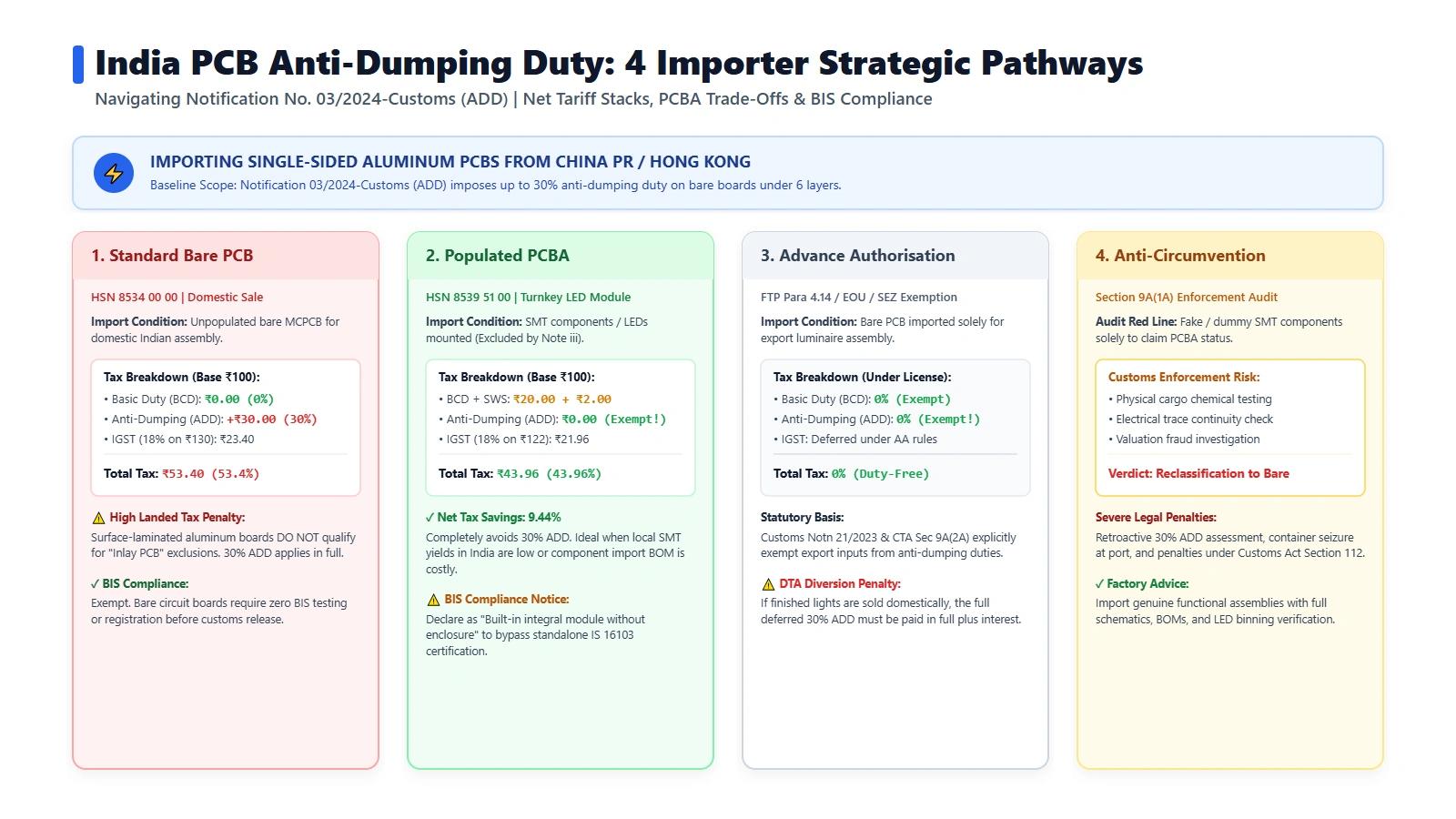 Figure 2. Regulatory decision flow for importing aluminum circuit boards into India under Notification 03/2024-Customs (ADD).
Pathway 1: The PCBA Conversion (What Brokers Don't Tell You)
The most popular engineering strategy is importing populated boards instead of bare boards.
Table Footnote (iii) of Notification 03/2024 explicitly excludes:
"Populated printed circuit boards of all sizes."
When you mount LEDs, resistors, or connectors onto the aluminum board, it is no longer a bare printed circuit under 8534. It becomes an LED light engine under Heading 8539.51.00.
This eliminates the 30% anti-dumping duty immediately.
Here is the catch: It replaces the anti-dumping duty with a 20% Basic Customs Duty (BCD).
Here is the exact math comparing ₹100 of bare board against ₹100 of populated board:
| Cost Element | Bare Aluminum PCB (8534.00.00) | Populated LED Module (8539.51.00) | What It Means for You |
|---|---|---|---|
| Assessable Value Benchmark | ₹100.00 | ₹100.00 | Equal-value baseline for comparison |
| Basic Customs Duty (BCD) | ₹0.00 (0% under Notn 24/2005) | ₹20.00 (20% standard rate) | BCD jumps from zero to 20% |
| Social Welfare Surcharge (SWS) | ₹0.00 | ₹2.00 (10% of BCD) | Standard surcharge on BCD |
| Anti-Dumping Duty (03/2024) | ₹30.00 (30% CIF) | ₹0.00 (100% exempt) | ADD disappears under Footnote (iii) |
| IGST Valuation Base | ₹130.00 | ₹122.00 | Value + BCD + SWS + ADD |
| IGST (18%) | ₹23.40 | ₹21.96 | Paid at customs; creditable under GST |
| Total Import Taxes | ₹53.40 (53.40%) | ₹43.96 (43.96%) | Net tax rate savings: 9.44% |
On identical values, the populated module route saves 9.44 percentage points in total import taxes. Review our complete 2026 India LED PCB import duty and GSTR-2B calculation guide for a full $10,000 CIF landed-cost breakdown.
Keep total invoice value in mind. A populated board includes the cost of LEDs, solder paste, and pick-and-place assembly. That means total assessable value will be higher.
If your Indian factory suffers from high SMT defect rates or expensive local component sourcing, using our in-house Turnkey LED PCB Assembly services delivers higher yields while dodging the 30% ADD penalty.
Pathway 2: Beware the BIS Certification Trap
Under Indian BIS exemption rules for bare aluminum PCBs, unpopulated boards do not require Bureau of Indian Standards (BIS) certification.
Populated LED boards can trigger it.
Under IS 16103 (Part 1), standalone LED modules imported as finished consumer products require mandatory BIS CRS registration, an Authorized Indian Representative (AIR), and an R-number.
However, there is an official exemption for lighting manufacturers.
BIS guidelines state that:
"Integral modules not having their own enclosure shall be treated as integral components of luminaires ... They shall be tested as assembled in the luminaire."
If you import bare-board LED assemblies without a plastic housing, ensure your shipping documents describe them as:
Built-in integral LED modules without enclosure, for assembly into luminaires.
This precise description stops customs officers from demanding a standalone BIS certificate at port clearance.
Pathway 3: Export Manufacturing Schemes (Advance Authorisation / EOU / SEZ)
Do you assemble finished lighting fixtures in India for export to the Middle East, Europe, or Africa?
You can import bare Chinese aluminum PCBs with zero anti-dumping duty.
Under Foreign Trade Policy 2023 Paragraph 4.14 and Customs Notification No. 21/2023-Customs, goods imported under an Advance Authorisation (AA) license are exempt from anti-dumping duty under Section 9A.
The same exemption applies to 100% Export Oriented Units (EOU) and Special Economic Zones (SEZ) under Section 9A(2A).
If any of those finished lights are later sold domestically inside India, the deferred 30% ADD must be paid in full.
Pathway 4: Do Not Use "Dummy" Components
Some trading agents advise customers to solder a single 0-ohm jumper or blank resistor onto a board to claim the "populated PCB" exclusion.
Do not follow this advice.
Under Section 9A(1A) of the Customs Tariff Act, Indian customs actively investigates anti-circumvention tactics.
If customs inspectors discover non-functional dummy components mounted solely to alter product appearance, they will reclassify the consignment as bare boards, demand the 30% ADD retroactively, and issue administrative fines.
Only import assemblies with genuine, functional LED circuitry.
Commercial Invoices: The Words That Cause Customs Holds
Customs automated screening systems use keyword scanning algorithms.
Vague or casual wording on your commercial invoice (CI) and packing list (PL) will flag your container for manual examination.
The Proven Invoice Description Template
Copy and paste this description for unpopulated single-sided aluminum boards:
Bare single-sided aluminum printed circuit boards (MCPCB), unpopulated; etched copper conductor tracks and contact pads on an electrically insulating dielectric layer bonded to an aluminum base plate; no mounted electronic components; for LED lighting assembly.
Be sure to list board dimensions, overall thickness (e.g., 1.6 mm), and finished copper weight (e.g., 1 oz / 35 µm). Match these specs against our standard single-sided aluminum PCB manufacturing capabilities.
4 Words to Delete From Your Invoices
- Delete: "Aluminum Sheet" or "Aluminum Plate"
Why: The targeting algorithm automatically categorizes your shipment under Chapter 7606, triggering anti-dumping questionnaires.
Fix: Always write "Bare Printed Circuit Board (Aluminum Base)." - Delete: "Heat Sink Panel"
Why: Customs treats the shipment as structural fabricated metal under Heading 7616.99, ignoring the electrical circuit completely.
Fix: Write "Aluminum-core PCB with thermal dissipation base." - Delete: "Aluminum Substrate" or "IMS Substrate"
Why: Customs officers mistake unpopulated PCBs for raw copper-clad laminate (CCL), which does not qualify for Heading 8534.
Fix: Write "Etched bare PCB, finished circuit pattern formed." - Delete: Generic "LED Parts" or "Electronic Accessories"
Why: Triggers automatic entry rejections under US CBP CSMS 62490006 for unacceptable vague cargo descriptions.
Fix: Use the specific term "Bare Printed Circuit Board."
Port Inspection Defense: The 3 Documents You Need on Hand
If customs flags your container for physical examination, verbal explanations from your freight broker will not release the goods.
You need a certified technical dossier tied directly to the production lot numbers on the boxes.
Here are the three documents our factory provides to resolve port holds:
1. Calibrated Microsection Inspection Report
A cross-sectional micrograph provides undeniable visual proof that your boards are printed circuits.
The laboratory micrograph must measure and label three distinct layers:
- Top copper layer: Shows the etched circuit traces (e.g., 35 µm).
- Dielectric layer: Proves the presence of a continuous electrical insulating barrier (e.g., 100 µm).
- Aluminum base: Shows the structural metal backing (e.g., 1.5 mm).
The moment customs sees the dielectric layer insulating the copper traces from the aluminum base, their argument that your board is a "raw aluminum sheet" collapses.
2. Factory Traveler & Chemical Etching Process Sheet
Provide a certified copy of the factory process routing traveler.
The traveler must verify that the circuit pattern was created via chemical etching:
- Dry film photoresist lamination
- UV exposure of the gerber trace layout
- Chemical etching of unwanted copper
- Resist stripping leaving isolated conductive pads
- Solder mask printing and surface finishing (OSP or HASL)
This document proves that the product meets the exact legal definition of a printed circuit under Chapter 85 Note 8.
3. Raw Laminate Dielectric Breakdown Certificate
Include the raw laminate supplier test sheet and third-party dielectric breakdown reports (such as CNAS or Microtek test reports per ASTM D5470).
These laboratory reports verify >3,000 V to 6.16 kV AC breakdown strength on the raw dielectric layer (with 800 V to 1,200 V finished bare-board isolation; our routine volume bare-board production uses AOI inspection rather than board-level Hi-Pot testing). Providing certified material dielectric ratings proves the board is manufactured specifically for electrical isolation, not as raw sheet metal.
Final Technical Takeaway
Single-sided bare aluminum PCBs belong under HS Heading 8534.00.
WCO Chapter 85 Note 8 and Section XV Note 1(f) give you complete legal protection against Chapter 76 reclassification.
Port delays almost always come down to two mistakes: ambiguous invoice descriptions like "aluminum panel," or brokers guessing the wrong 10-digit statistical suffix.
Before your next shipment leaves the factory, confirm the exact 10-digit tariff code with your broker, keep a microsection report in your shipping binder, and calculate whether importing fully assembled LED modules offers a more cost-effective landed duty structure.
Frequently Asked Questions (FAQ)
Why should bare aluminum PCBs be classified under HS 8534.00 rather than Chapter 76?
Under World Customs Organization (WCO) General Rule of Interpretation 1 and HS Chapter 85 Note 8, printed circuits are defined by etched conductive patterns on an insulating base. Furthermore, Section XV Note 1(f) explicitly excludes goods covered by Section XVI (which includes Heading 8534) from base metal classifications. The presence of the dielectric layer and etched copper circuit legally classifies the board as a printed circuit, overriding raw aluminum metal weight.
What is the difference in import tariff between bare aluminum PCBs and populated LED modules?
Bare aluminum PCBs fall under HS 8534.00. Populated LED boards with soldered diodes and components enter under HS 8539.51.00 as LED modules. In countries like India, bare boards face a 30% CIF anti-dumping duty under Notification 03/2024, whereas populated modules are exempt from anti-dumping duty (Footnote iii), trading it for standard Basic Customs Duty (BCD) instead.
Which supporting documents resolve customs holds for aluminum PCBs?
To resolve port examinations, provide three factory documents: (1) a calibrated cross-sectional micrograph showing etched copper, dielectric layer, and aluminum base; (2) a copy of the factory routing traveler verifying chemical etching under Chapter 85 Note 8; and (3) raw laminate supplier test sheets verifying dielectric breakdown strength (>3,000V AC).
Need a quotation?
Send Gerber files and basic specifications. We reply within 1 business day.
Ask for Quote