PCB Class (IPC Class): Class 2 vs Class 3 for LED Aluminum PCBs

On This Page (Table of Contents)
For most commercial LED aluminum PCB projects, IPC Class 2 is the practical starting point. Class 3 can add cost, inspection work, documentation, and lead time, so it should be reserved for products where the application, customer requirement, environment, warranty risk, or safety consequence justifies the added control burden.
If you have seen "IPC Class 2" or "IPC Class 3" on a fabrication drawing or RFQ and were not sure what it means in practice, here is how to decide.
What Does PCB Class Mean?
PCB class is a reliability and acceptability designation commonly used with IPC standards. It helps buyers and manufacturers align on the expected manufacturing quality, inspection criteria, and acceptance level for a circuit board or assembly.
In plain terms, it helps answer this question:
What level of manufacturing variation is acceptable before a PCB or PCBA should be rejected?
The IPC-A-600 standard is commonly used for printed board acceptability. It covers visible board conditions such as copper features, surface defects, laminate quality, markings, and structural acceptability.
One practical point matters for buyers:
The class requirement should appear clearly in the fabrication drawing, purchase documentation, or acceptance notes. A casual mention in an email may not be enough for controlled production requirements.
IPC Class 1, Class 2, and Class 3 at a Glance
The three IPC classes are not a simple "good, better, best" cosmetic ranking. They reflect the reliability demands and working environment of the end product.
| IPC Class | Typical Application | Inspection Strictness | Cost and Lead-Time Impact |
|---|---|---|---|
| Class 1 | Toys, novelty LED items, simple consumer products | Basic acceptability | Baseline |
| Class 2 | Commercial LED lights, indoor fixtures, general industrial electronics | Standard production QA such as AOI and electrical test | Practical for mass production |
| Class 3 | Emergency lighting, automotive lighting, harsh-duty or safety-related products | Tighter acceptance, more verification, stronger process control | Higher cost and longer lead time |
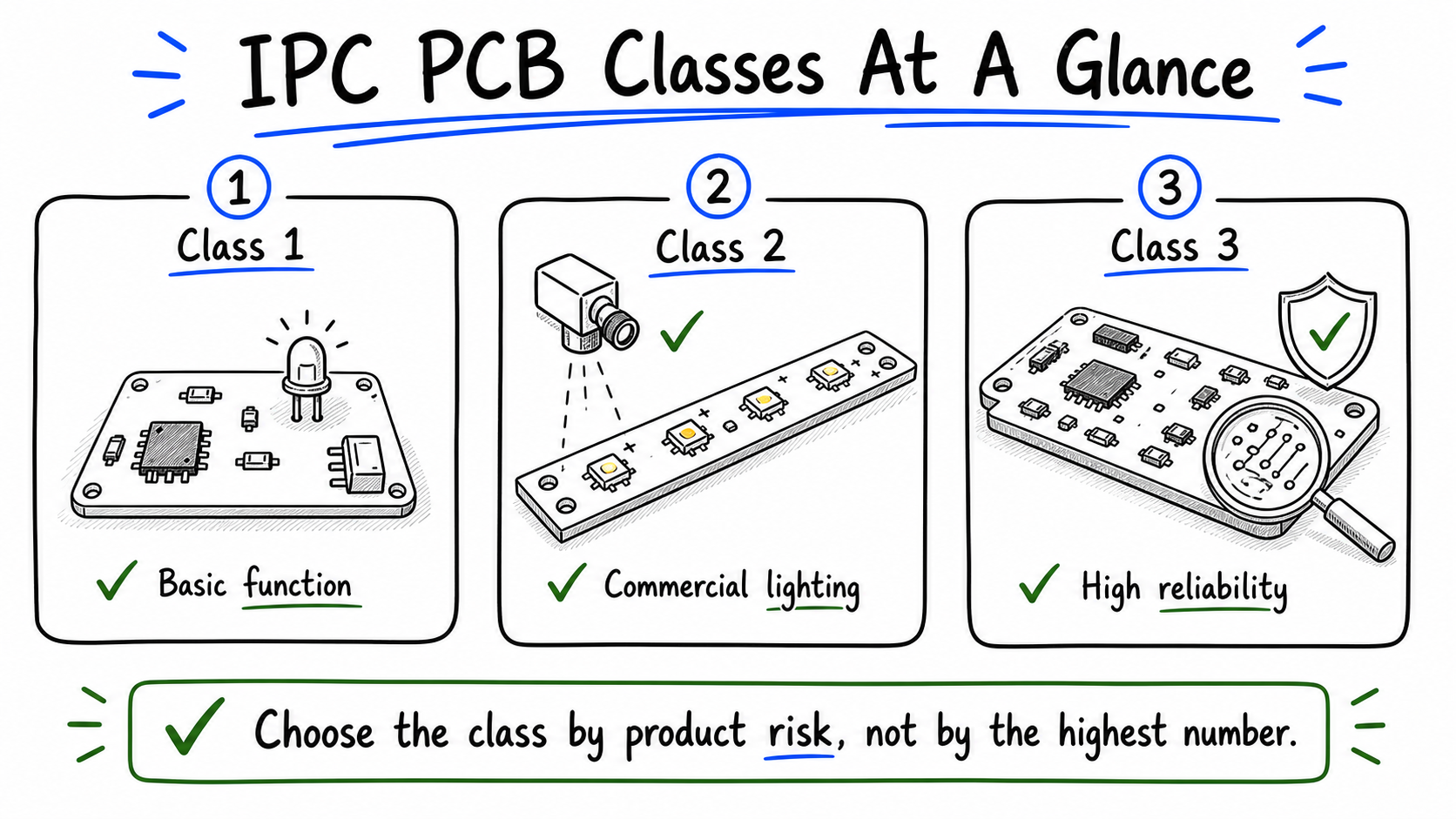 IPC classes describe different reliability expectations. Choose the class by product risk, not by the highest number.
Class 1 is rarely the right target for professional LED lighting products. Class 2 is usually the practical level for dependable commercial lighting. Class 3 becomes relevant when the consequences of failure are much higher.
IPC Class 2 vs Class 3: What Actually Changes?
The core difference is acceptability strictness. Class 3 is a higher-assurance build than Class 2, with tighter control over what is acceptable during fabrication, assembly, inspection, and documentation.
In Class 2, some limited imperfections may be acceptable if they remain within the required limits and do not affect the expected service life. In Class 3, the acceptance window is tighter because continued performance is more critical.
For buyers, Class 3 can affect the project in several ways:
- Lower yield tolerance. More boards or assemblies may fail inspection if the acceptance window is tighter.
- More inspection and verification. Depending on the design, scope, and customer requirements, Class 3 builds may require additional inspection, documentation, sampling, microsection review, thermal stress verification, or process evidence.
- More documentation. Traceability, conformance evidence, and process control expectations can be higher.
- More cost and lead time. Class 3 does not come with a universal price premium, but tighter requirements usually increase manufacturing and verification effort.
All of this can push up the aluminum PCB cost. Class 3 is necessary for high-reliability products, but it is rarely justified for standard commercial LED boards that already have a solid Class 2 requirement and a good thermal design.
Which IPC Standards Apply to Bare PCB and PCBA?
Fabrication and assembly are governed by different IPC documents. Buyers should specify the requirement for the correct stage.
| IPC Document | Stage | What It Covers |
|---|---|---|
| IPC-A-600 | Bare board fabrication | Printed board acceptability and visual inspection conditions |
| IPC-6012 | Rigid bare board fabrication | Physical performance, qualification, and board structure |
| IPC-A-610 | PCBA / SMT assembly | Electronic assembly acceptability, solder joints, placement, and visible workmanship |
| J-STD-001 | Soldering process | Soldered electrical and electronic assembly requirements |
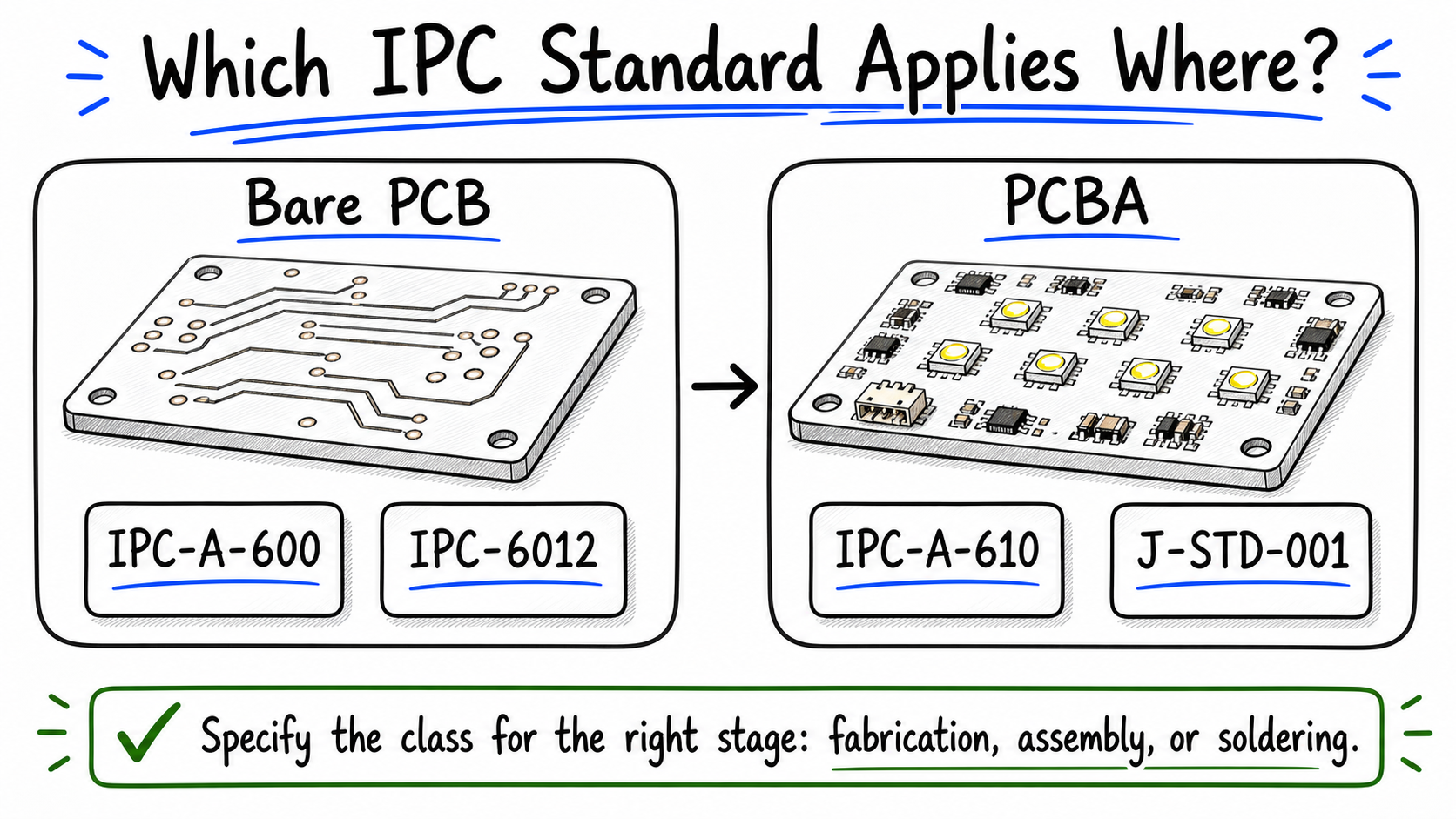 IPC-A-600 and IPC-6012 apply to bare PCB fabrication, while IPC-A-610 and J-STD-001 apply to assembly and soldering.
You can also specify different scopes. For example, a project may call for a Class 2 bare board but stricter assembly requirements if solder joint reliability is the main risk.
Lumina handles both aluminum PCB fabrication for LED lighting and SMT assembly for LED aluminum PCB. We review the drawing package to confirm whether the requested class applies to the bare board, the assembly, soldering, testing, or all of them.
What PCB Class Makes Sense for LED Aluminum PCBs?
For most commercial, residential, and general architectural LED lighting, Class 2 is the practical baseline.
That includes many:
- indoor fixtures
- LED tubes
- downlights
- panel lights
- commercial luminaires
- decorative lighting boards
Class 3 may be justified when:
- The product runs in harsher conditions such as sustained vibration, high humidity, corrosive environments, or severe temperature swings.
- Downtime is not acceptable, such as emergency lighting or safety-related systems.
- Field replacement is expensive, dangerous, or difficult.
- The customer specification explicitly requires Class 3.
- Warranty exposure is high enough that additional verification is worth the cost.
One point that often gets missed:
Class 3 does not improve the thermal conductivity of an LED aluminum PCB.
Heat dissipation depends on PCB material selection, dielectric thermal conductivity, dielectric thickness, copper weight, LED placement, thermal interface, and heat sink design. If an LED board is overheating, specifying Class 3 will not fix the thermal path by itself. It may simply make the same design more expensive.
Pattern Class and Drill Class Are Not the Same as IPC Class
Do not confuse IPC Class with pattern class or drill class. They describe different things.
Pattern class and drill class describe layout and fabrication difficulty:
- trace width
- trace spacing
- annular ring
- drill size
- hole tolerances
- manufacturing margin
Factories use these categories to decide whether they can physically produce a layout efficiently and at what cost.
IPC Class 1, 2, and 3 describe the product acceptance and reliability expectation. A simple LED aluminum PCB can have easy geometry but still require Class 3 inspection if it is used in a safety-related application. A fine-pitch board can be difficult to fabricate but still be specified as Class 2 if the end-use reliability requirement is not Class 3.
The two systems are related to manufacturing quality, but they are not the same axis. Always confirm which "class" your supplier or online calculator means.
How to Specify IPC Class in an RFQ
The most common mistake is being vague. Notes like "IPC Class 3 certified" or "manufactured to IPC standards" do not define enough by themselves.
Use explicit, document-specific language in your fabrication drawing or RFQ, such as:
"Manufacture bare boards per IPC-6012 Class 2. Inspect per IPC-A-600 Class 2."
For assembly, add:
"Assemble and inspect per IPC-A-610 Class 2. Solder per J-STD-001 Class 2."
A complete PCB file package for an LED aluminum PCB order should also include:
- Gerber files or ODB++ data
- NC drill files
- fabrication drawing with board thickness, copper weight, dielectric specification, surface finish, solder mask color, and IPC class
- BOM for SMT assembly
- pick-and-place centroid data
- assembly drawing and polarity notes
- test requirements such as AOI, electrical open/short testing, or functional testing
- project volume, including prototype, pilot, and mass production quantities
- application context, especially environment, warranty, safety, or replacement constraints
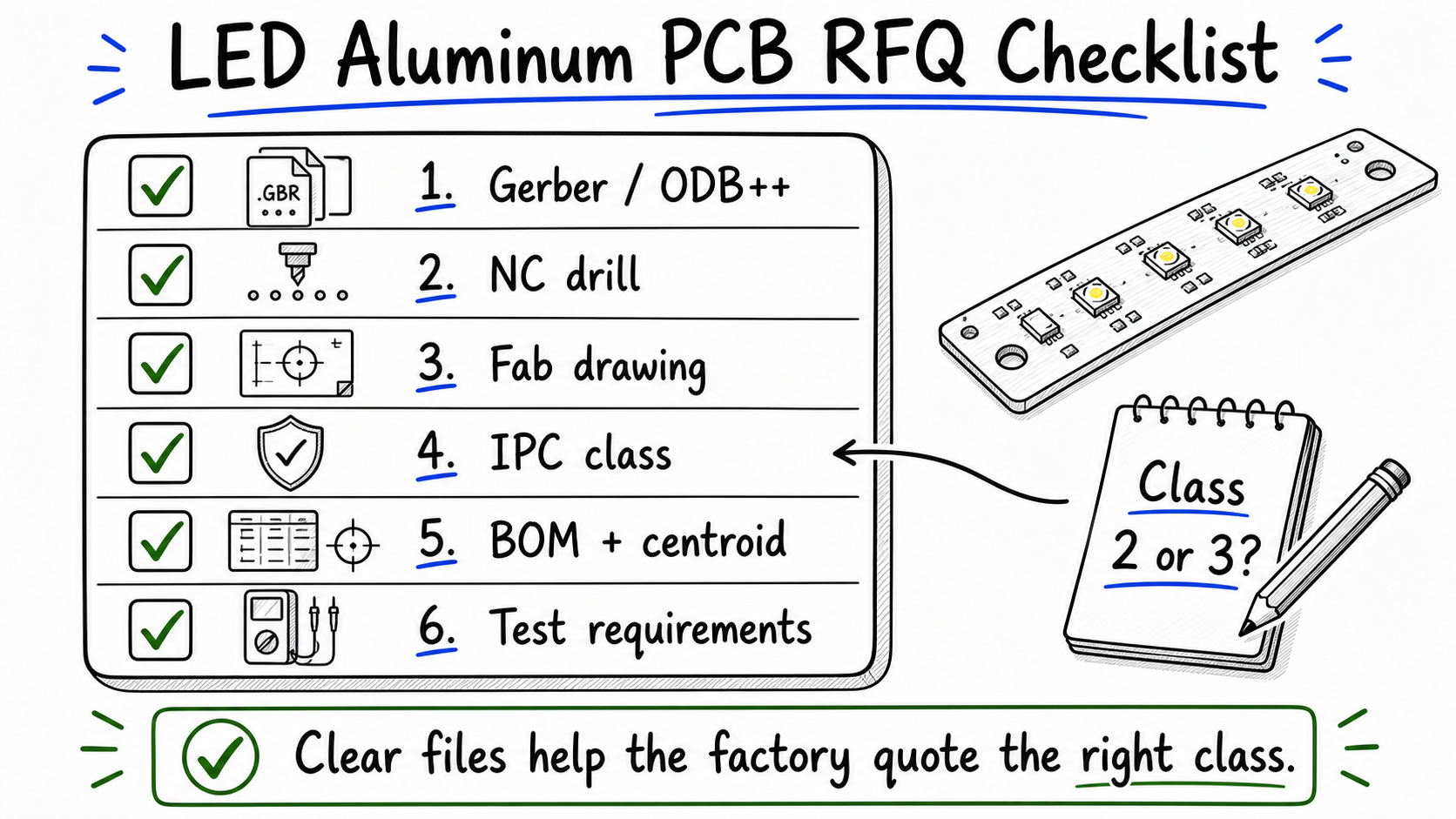 A clear RFQ package helps the factory quote the correct IPC class, inspection scope, and production cost.
For public capability statements, the safest wording is specific:
Lumina quotes and manufactures to customer-specified IPC class and acceptability requirements based on released drawings, fabrication notes, assembly scope, and test criteria.
That is clearer and safer than a blanket claim like "IPC Class 3 certified boards."
Conclusion
For LED aluminum PCBs, start with Class 2 unless the product risk clearly calls for Class 3.
Class 2 is usually the practical choice for dependable commercial lighting. Class 3 is better reserved for products where failure is safety-critical, downtime is unacceptable, the operating environment is harsh, or the customer specification explicitly requires it.
Before sending your next RFQ, make sure the class requirement is written into the fabrication drawing or purchase documentation, not just mentioned casually. If you are not sure which class applies, send your Gerber files, fabrication notes, and application details to Lumina for a pre-quote engineering review.
Need a quotation?
Send Gerber files and basic specifications. We reply within 1 business day.
Ask for Quote