How Much Does an Aluminum PCB Cost? A Practical Breakdown for LED Buyers

On This Page (Table of Contents)
There is no fixed public price for an aluminum PCB.
But there is a practical way to understand how your quote is calculated.
At Lumina, our baseline LED aluminum PCB quote is based on:
- 12 μm (0.35 oz) copper
- 1 W/m·K dielectric material
- OSP (Organic Solderability Preservative) finish
- 95% panel utilization
If your design fits this baseline, your quote is straightforward.
But if you need thicker copper, lead-free HASL, black silkscreen characters, or complex board outlines, your cost will change.
Here is what actually drives the cost of an aluminum PCB, and how you can optimize your design to get the best factory price.
1. The Real Cost Drivers
An aluminum PCB quote is not just a price list.
It is a factory review of your board design, production volume, and material specifications.
Here is a quick look at the main cost drivers:
| Cost Factor | How It Impacts Your Quote | What You Should Check |
|---|---|---|
| Board Size | Larger boards consume more raw material. | Confirm your final dimensions early. |
| Board Outline | Irregular shapes waste panel space. | Keep outlines simple to maximize panel usage. |
| Copper Thickness | Heavier copper (2 oz+) increases material cost. | Stick to 1 oz (35 μm) or 12 μm if current permits. |
| Dielectric Rating | High-performance (3.0+ W/m·K) materials carry a premium. | Match conductivity to your LEDs' real thermal output. |
| Surface Finish | Specialized finishes like HASL or ENIG add process steps. | Use OSP unless your assembly specs require HASL. |
| Order Quantity | Setup costs are amortized over the run. | Compare sample unit costs separately from bulk orders. |
| Lead Time | Expedited builds disrupt standard scheduling. | Share your target delivery date as early as possible. |
2. Lumina's Sourcing Baseline
We base our standard LED aluminum PCB quotes on a practical production baseline:
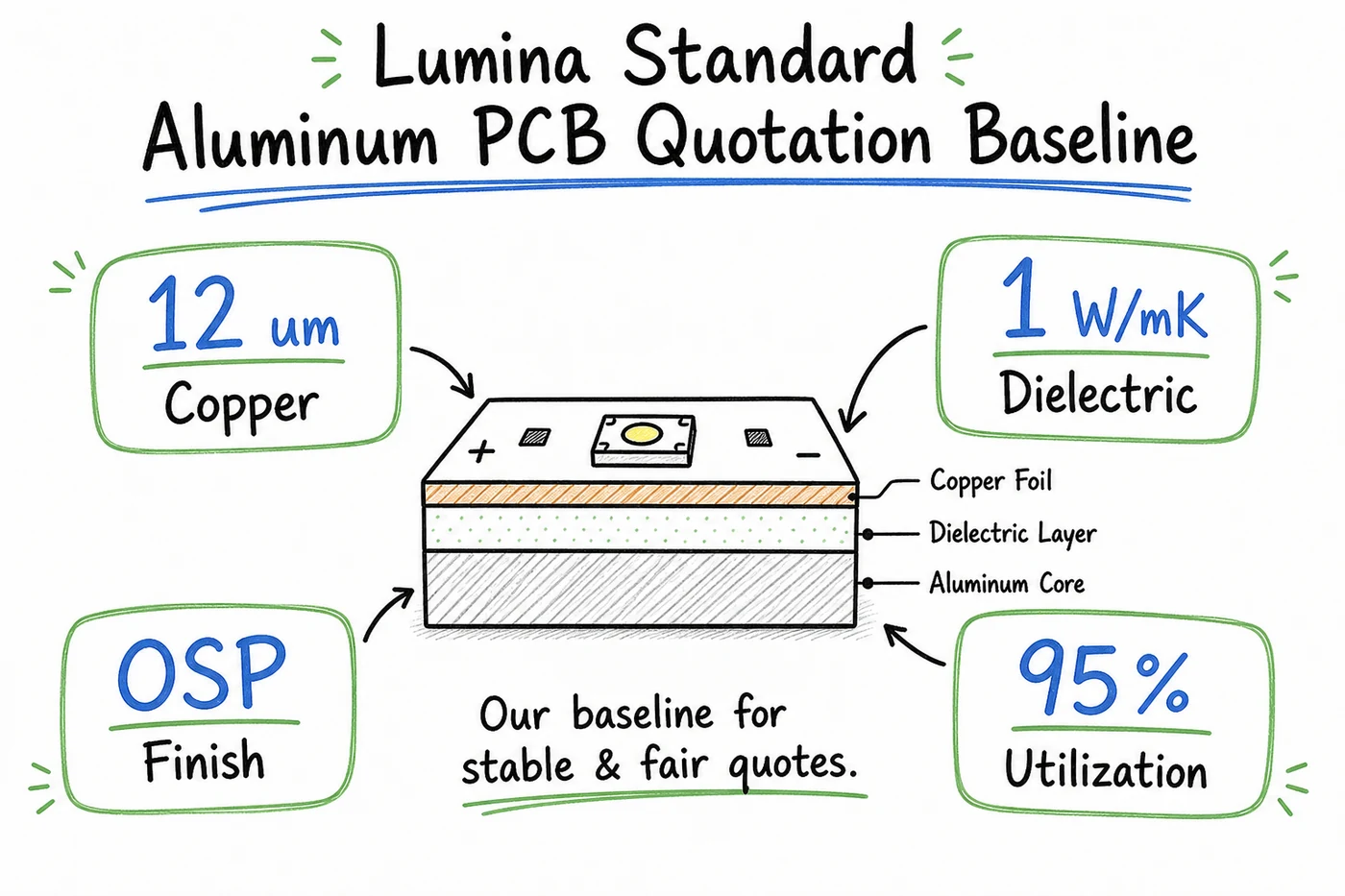 Our standard baseline helps you understand what the initial quote is based on.
| Item | Standard Baseline | When Cost Will Change |
|---|---|---|
| Copper Weight | 12 μm | Specifying thicker copper (35 μm or 70 μm). |
| Thermal Dielectric | 1 W/m·K | Upgrading to 2 W/m·K or 3 W/m·K material. |
| Surface Finish | OSP | Upgrading to lead-free HASL or ENIG. |
| Panel Utilization | 95% | Irregular shapes that lower utilization. |
| Lead Time | Standard | Requesting expedited fabrication. |
Comparing PCB quotes without checking the baseline is a common mistake.
One supplier's quote might assume OSP, while another assumes HASL.
One might assume high panel utilization, while another charges you for wasted material.
Always confirm the quotation baseline before comparing prices.
3. Why Material Specs Change the Price
An aluminum PCB is not just a sheet of metal.
It is a laminate stackup consisting of copper foil, a thin dielectric insulation layer, and the aluminum base.
The middle dielectric layer is the primary thermal bottleneck.
Material suppliers like Ventec specify thermal laminates by both dielectric thickness and conductivity. High-performance laminates cost more because they utilize advanced ceramic-filled resins.
For most standard LED lighting boards, a 1 W/m·K dielectric is highly practical and cost-effective.
Do not pay for a high W/m·K rating unless your thermal simulations prove you need it. Before paying extra for 2.0 or 3.0 W/m·K laminates, check if your LEDs actually benefit from it: our free LED Junction Temperature Calculator models your exact board dimensions and wattage to see if standard volume materials meet your thermal target.
For a deeper look at this layer, read our guide to aluminum PCB dielectric materials.
4. Why We Don't Quote by the Square Meter
Sourcing managers often ask for a "flat rate per square meter."
But publishing a flat rate is misleading.
Why?
Because two boards with the exact same surface area can have completely different manufacturing costs.
For example, a simple rectangular board fits perfectly on a production panel.
An L-shaped or circular board creates significant material waste.
This waste, combined with slower mechanical routing times, directly drives up your unit cost.
We quote based on your Gerber files to ensure you get an accurate, fair price based on actual material usage.
5. Panel Utilization: The Hidden Cost Driver
When you buy PCBs, you pay for the material area required to make your boards — including the waste.
We design our standard panel arrays to achieve 95% utilization.
If your board outline is irregular, utilization drops, and the cost of the wasted material is added to your quote.
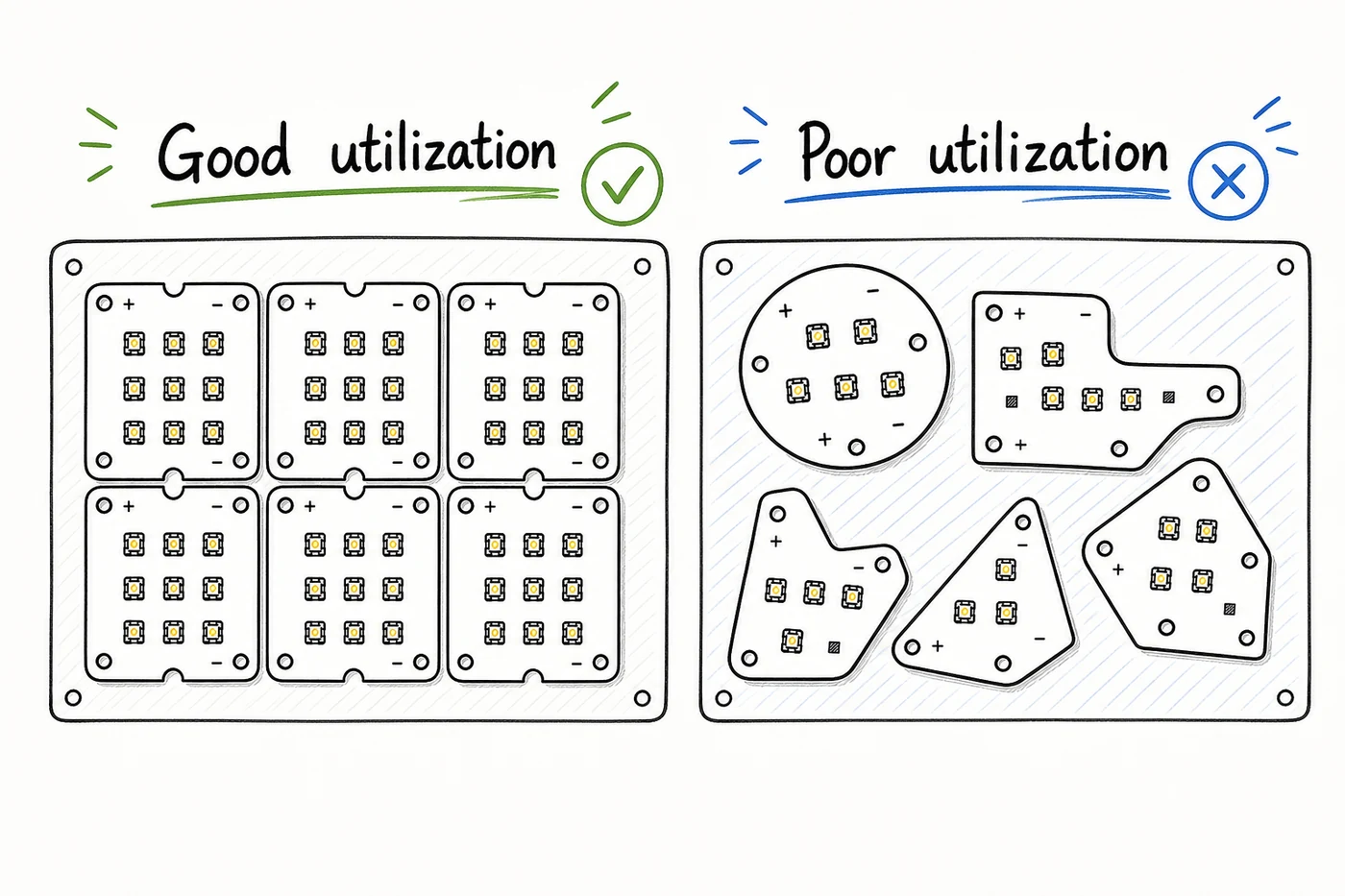 Panel utilization determines how much raw material is wasted during routing.
- Rectangular Outlines: Best panel utilization and lowest cost.
- Irregular Outlines: Lower utilization; ask your fabricator for panelization design support to minimize waste.
- Low Volume Runs: Setup fees are spread over a small area, making the cost per square meter look high.
6. OSP vs. HASL Finish
We default to OSP (Organic Solderability Preservative) because it is highly flat, reliable, and cost-effective for LED boards.
Lead-free HASL is available as an upgrade.
HASL requires dipping the boards in molten solder and leveling it with hot air, which adds process complexity and cost.
For a detailed breakdown of these finishes, check out OSP vs. HASL for LED Boards.
Use OSP as your default unless your assembly line or storage conditions specifically require HASL.
7. Silkscreen and Legend Choices
Adding a second pass of black silkscreen characters for legibility is optional.
Most standard LED boards do not require extensive legend markings on the aluminum side.
Leaving out non-essential text keeps the manufacturing process simple and keeps your costs low.
Only specify black silkscreen characters if your SMT assembly team or end customers require them.
8. Why Prototypes Cost More
Sourcing a small batch of prototype boards carries a higher unit price than volume production.
The setup steps are exactly the same:
- Engineering file review (CAM)
- Material preparation
- Imaging and etching setup
- Routing and drilling tool setup
When you order 10 pieces, these setup costs are divided by 10. When you order 10,000, they are divided by 10,000, making the setup cost negligible.
Use prototype runs to verify your design, but do not use prototype pricing to budget your mass production run.
If you are still deciding between standard FR-4 and aluminum cores, read our comparison: LED PCB vs. Aluminum PCB.
If a supplier cites an FR4 price increase, do not paste that cloth percentage onto an aluminum quote. The structures are different.
9. Sourcing Checklist
For the fastest and most accurate quote, include these files and details in your RFQ:
- Gerber Files: Copper layers, solder mask, silkscreen, drill, and board outline.
- Dimensions: Exact board or panel size.
- Quantity: Specify both prototype and volume targets.
- Base Material Specs: Base thickness (e.g., 1.6mm) and copper weight (e.g., 1 oz).
- Dielectric Conductivity: (e.g., 0.6–0.8 W/m·K baseline or 1.0 W/m·K commercial grade).
- Surface Finish: OSP, HASL, or ENIG.
- Target Delivery Date: Helps the factory check capacity.
If you only send a photo or a hand-drawn sketch, the factory has to guess, which leads to quoting delays and pricing revisions.
Summary: How to Control Your Costs
To get the most competitive quote on your aluminum PCBs:
- Stick to standard thickness baselines (1.0mm or 1.6mm aluminum).
- Use OSP finish unless you have a specific reason to upgrade.
- Keep the board outline rectangular to maximize panel utilization.
- Use standard 0.6–0.8 W/m·K dielectric material (or 1.0 W/m·K commercial grade) unless high-power components require a higher rating.
- Provide complete Gerber files with your initial RFQ.
If your design has unique requirements or you aren't sure how it fits our standard baseline, contact our team. We can review your panelization and stackup design to optimize your board for production.
Need a quotation?
Send Gerber files and basic specifications. We reply within 1 business day.
Ask for Quote