LED PCB Assembly Quote: Checklist, Pricing Factors & Fast RFQ Guide

On This Page (Table of Contents)
To get an accurate PCB assembly quote, a Gerber file alone is not enough.
Assembly quotes require component sourcing data, placement files, inspection requirements, and sometimes material specifications that go beyond what is needed to fabricate a bare board. Missing any of these can slow the quote cycle, produce inaccurate numbers, or cause the factory to come back with a list of clarification questions before pricing can begin.
If you are preparing an RFQ for an LED aluminum PCB assembly project, this guide explains what to include, what affects the quoted price, and where most delays actually come from.
PCB Fabrication Quote vs. PCB Assembly Quote
These are two different scopes, and conflating them is one of the most common causes of incomplete RFQs.
A fabrication quote covers making the bare board: the aluminum or FR-4 base, copper layers, solder mask, surface finish, drilling, and routing. The factory needs board data and specifications: panel size, layer count, copper weight, dielectric material, finish type, and quantity. IPC-2614 is the IPC documentation standard that defines what fabrication documentation should include.
An assembly quote covers building components onto that board. It prices BOM sourcing, stencil fabrication, solder paste printing, component placement, soldering, post-reflow inspection, and any additional testing the project requires. Assembly quality and workmanship is commonly evaluated against IPC-A-610, the widely used electronic assembly acceptability standard.
For a turnkey order, where the factory handles both fabrication and component procurement, the BOM often becomes the largest single cost variable. Component availability, sourcing lead times, and approved substitute policies all affect the final number.
| Quote Type | What It Prices | Main Cost Drivers |
|---|---|---|
| PCB Fabrication | Bare board manufacturing | Base material, copper weight, surface finish, board size, quantity |
| PCB Assembly | Component sourcing, placement, soldering, inspection | BOM completeness, placement count, test scope, sourcing model |
| Turnkey | Fabrication plus assembly | All of the above, plus component availability and lead time |
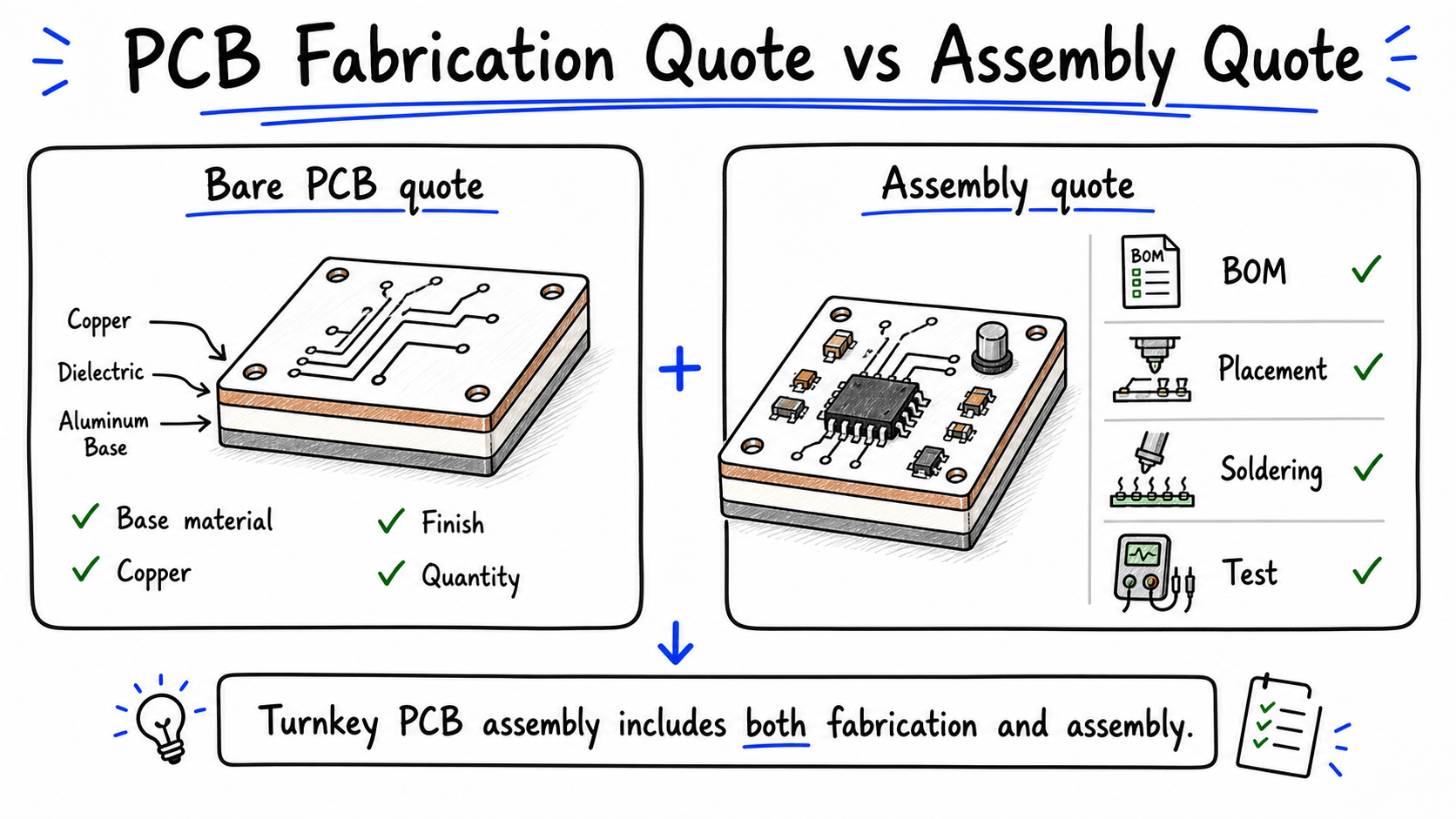 A fabrication quote covers the bare board, while an assembly quote adds BOM sourcing, placement, soldering, and testing.
For LED aluminum PCBs, both scopes are typically needed. Some factories handle both under one roof; others subcontract one of the two. Either way, both sets of specifications need to be in the RFQ.
What Files Are Required for a PCB Assembly Quote
Most quoting delays at the file stage come down to missing or mismatched documents. A complete assembly RFQ usually requires four items.
Gerber and NC Drill Files
These define the board geometry, copper pad positions, and hole specifications. The files should come from the same design revision as the rest of the assembly package. ODB++ or IPC-2581 are also accepted by many factories and can carry more complete manufacturing intent than standard Gerber-only packages.
A common issue: buyers send a 3D CAD export or a PDF layout view instead of actual Gerber RS-274X and Excellon drill files. These cannot be imported into CAM or machine programming software directly.
Bill of Materials
The BOM should be a structured spreadsheet, not a text file or image. Each line should include:
- Reference designator (R1, C3, U5, LED1, and so on)
- Quantity
- Exact manufacturer part number, including all suffix characters
- Package code or footprint
- Description or value
For a field-by-field format, DNP rules, and an LED example, use our PCB assembly BOM guide.
A BOM without complete part numbers forces the factory to manually search for matching components, often with incomplete information. This is called BOM scrubbing and is one of the most common reasons quotes take longer than expected.
Centroid or Pick-and-Place File
This file provides the X-Y position, rotation angle, and board side for each SMT component. It is what the machine programming team uses to set up placement paths and orientations. Without it, the factory cannot prepare the placement program before quoting or before first article.
For LED assemblies, the centroid data is also cross-checked against the assembly drawing to verify that LED polarity marks are consistent.
Assembly Drawing
An assembly drawing communicates what the Gerber data does not. It should show:
- Pin 1, connector orientation, and polarity markers for all polarized components
- LED cathode/anode direction callouts
- Any "do not fit" designators
- Special assembly notes, conformal coating keep-out areas, or panelization breakaway rules
For LED boards, a clear polarity marking on the drawing is one of the most practical ways to prevent reversed-LED errors in production.
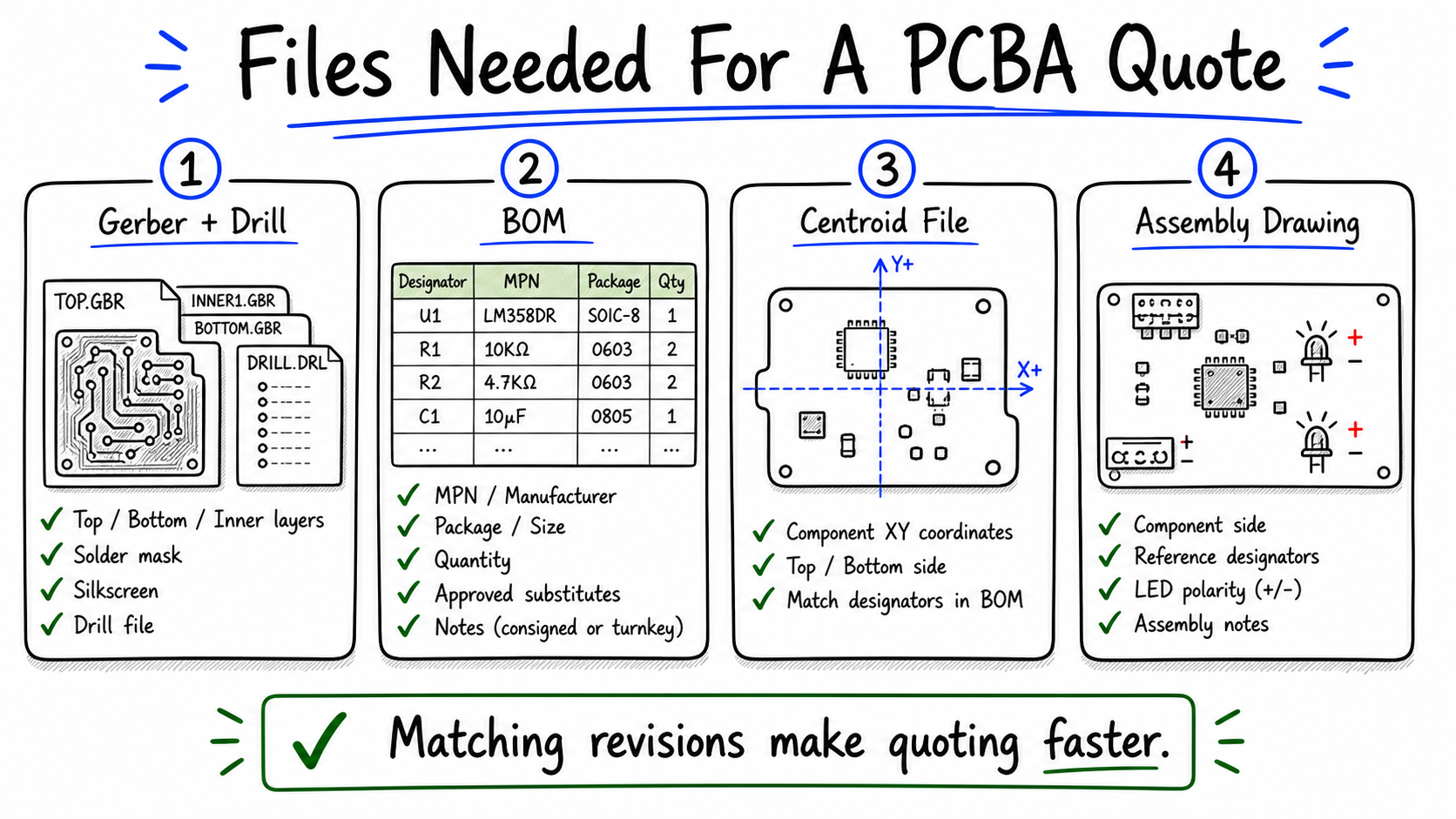 A complete quote package should include matching Gerber, BOM, centroid, and assembly drawing files.
For a full explanation of each file format and how to export them correctly, see PCB files for manufacturing.
How BOM Quality Affects the Quote
BOM quality affects both quote accuracy and quote speed. A complete, well-formatted BOM with full MPNs lets the factory run sourcing checks in a single pass. An incomplete or ambiguous BOM requires manual follow-up on each unclear line. To ensure your file meets factory requirements, review our guide on BOM lists for PCB assembly or download the pre-formatted Lumina BOM Template (.xlsx).
Why Part Number Suffixes Matter
Manufacturer part numbers are not interchangeable with product family names or shortened codes. The suffix encodes the package style, temperature grade, voltage rating, and tolerance. A BOM line that reads "MMBT3904" instead of "MMBT3904LT1G" could match multiple parts in the distributor database with different packages, reels, or pricing.
For LED components, the MPN should also include binning specifications where known, such as CCT range, flux bin, and forward voltage bin, because LED lots within the same part family can have meaningful performance differences.
Turnkey vs. Consigned Sourcing
In a turnkey build, the factory sources all BOM components. The quote includes material cost, procurement margin, and sourcing risk. This simplifies the buyer's logistics but makes BOM completeness more critical, because the factory is committing to source and price based on whatever is in the file.
In a consigned build, the buyer supplies the components. The factory charges for assembly labor and handling only. This gives the buyer control over component quality and brand, but requires clean kitting, accurate reel counts, and correct pre-cut packaging where needed.
A partial consignment model is common in LED lighting: the buyer supplies the LEDs (often chosen by bin specification from a preferred source), and the factory sources all passive components turnkey.
| Sourcing Model | Factory Supplies | Buyer Supplies | Common Use Case |
|---|---|---|---|
| Full Turnkey | All components | Nothing | Buyers without sourcing infrastructure |
| Full Consignment | Assembly labor only | All components | Buyers with established component supplier relationships |
| Partial Consignment | Passives and standard components | LEDs or specific parts | LED lighting projects where LED bin matters |
Handling Alternates and End-of-Life Parts
If the design allows approved substitute components, list them explicitly in the BOM. Pre-approved alternates let the factory work around stock shortages without stopping the quote or the order.
If any components are end-of-life or allocation-sensitive, flag them. A factory that discovers an obsolete component after confirming a price will typically come back with a revised quote or a request for engineering approval before proceeding.
For a deeper look at turnkey PCB assembly service, including how sourcing models affect scheduling.
Cost Factors in a PCB Assembly Quote
Assembly quotes are built from two types of costs: fixed NRE charges that apply once per job, and variable costs that scale with the design and quantity.
Fixed Setup Costs
These cover the one-time work needed before production starts:
- Engineering file review and machine programming
- Solder paste stencil fabrication (one stencil per assembly side)
- Feeder loading and component changeovers
- First-article inspection and process validation
For low-volume prototype orders, these fixed costs dominate the per-board price. Spreading them across a higher production quantity is usually the most direct way to reduce unit cost.
Variable Costs
These change with the design:
- Placement count. SMT assembly is priced partly by the number of placement operations. A board with 200 LEDs plus 50 passive components will have more machine time than a simpler design.
- Single-sided vs. double-sided assembly. Single-sided is simpler. Double-sided requires two solder paste printing steps, two reflow passes, and additional board handling between passes. This increases both setup and processing cost.
- Through-hole components. Any hand-soldered or wave-soldered through-hole work is more labor-intensive than automated SMT. For most LED aluminum PCBs used in lighting, through-hole assembly is either minimal or absent.
- Testing and inspection scope. Some assembly quotes may include AOI, X-ray inspection, ICT, or custom functional tests when the project requires them and the supplier supports them. Each added test step can change equipment time, labor, and fixture requirements. For standard LED aluminum PCB assembly, state the practical checks you need, such as visual inspection and power-on lighting test parameters. When an acceptance class is specified, it is typically referenced against IPC-A-610 for assembly and J-STD-001 for soldering requirements.
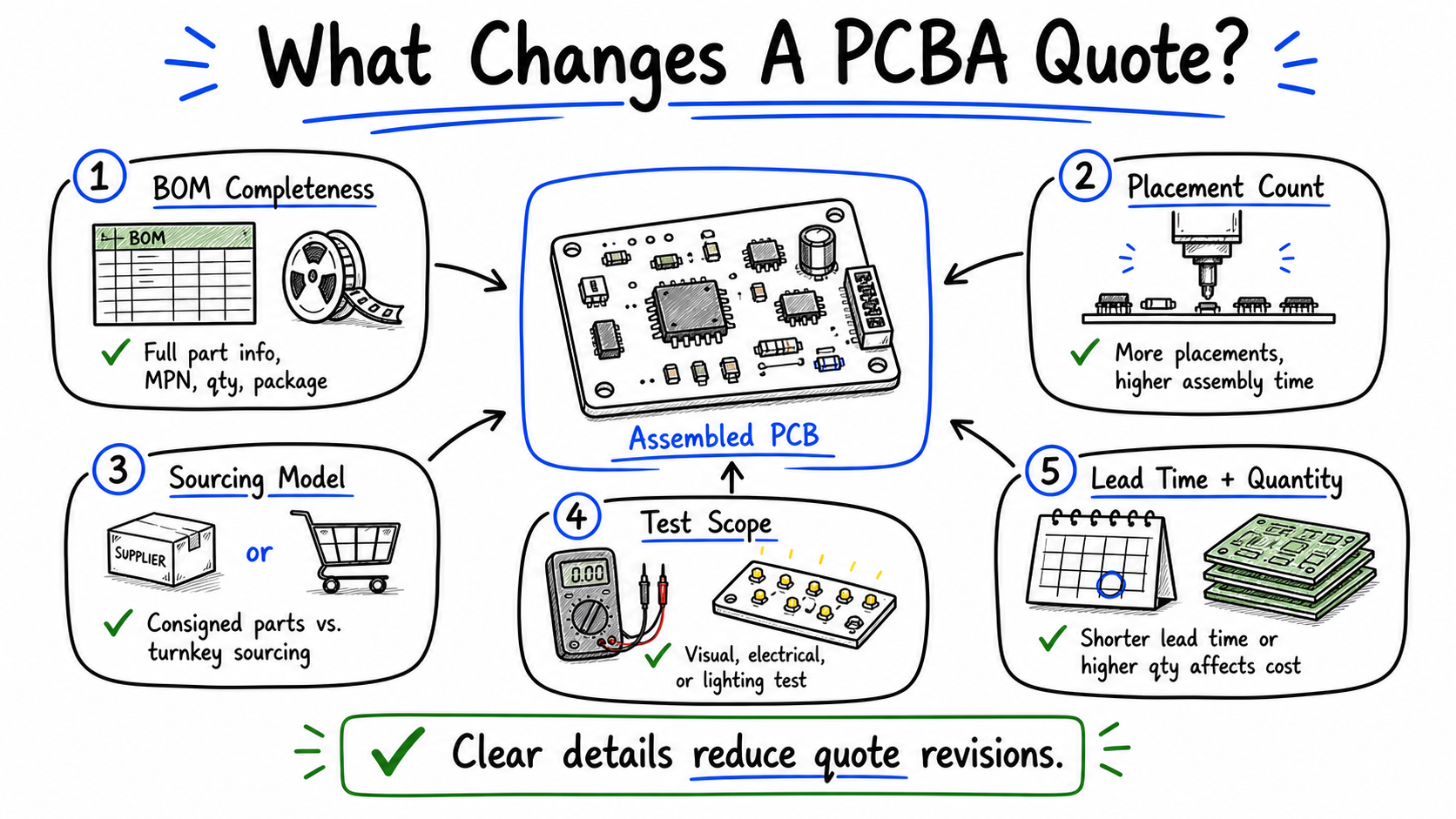 BOM quality, placement count, sourcing model, testing, quantity, and lead time all influence a PCBA quote.
For a detailed look at the SMT assembly process and what each step involves, see SMT line process for PCB assembly. For aluminum PCB material and cost factors, see aluminum PCB cost factors.
Special RFQ Details for LED Aluminum PCBs
Standard RFQ forms are not always designed with metal-core boards in mind. There are several details that buyers should add explicitly when the order involves LED aluminum PCBs.
Aluminum Base Specifications
The RFQ should state:
- Aluminum base thickness (e.g., 1.0mm, 1.2mm, 1.6mm, 2.0mm)
- Copper weight (e.g., 1 oz, 2 oz)
- Dielectric thermal conductivity, if the project has a specific requirement (e.g., 1.0 W/mK, 2.0 W/mK, 3.0 W/mK)
These parameters directly affect which fabrication materials are used and at what cost. A spec that reads "aluminum PCB" without further detail does not give the factory enough to quote accurately.
Surface Finish for LED SMT
Surface finish affects flatness, which affects how consistently LEDs sit on the board during reflow.
OSP is a flat, cost-effective finish and is a practical choice for most standard LED aluminum PCB production. ENIG provides excellent flatness and longer shelf life at higher cost, making it useful for boards that will be stored before assembly or for fine-pitch pads. HASL is less preferred for high-power LED assemblies because the uneven surface can cause LED packages to tilt slightly, which can affect the thermal contact between the LED and the board.
| Surface Finish | Flatness | Shelf Life | Cost | SMT Suitability for LEDs |
|---|---|---|---|---|
| OSP | Excellent | 6-12 months | Lower | Suitable for most standard LED aluminum PCB production |
| ENIG | Excellent | 12+ months | Higher | Suitable for longer storage or fine-pitch pads |
| HASL | Variable | 12+ months | Lower | Less preferred for high-power LED SMT |
LED Polarity and Assembly Drawing
A reversed LED fails silently: it does not short the circuit, it simply does not light up. In a string-wired LED board, one reversed LED can prevent an entire string from illuminating.
Mark LED polarity on the assembly drawing clearly, including cathode and anode direction for every position. For multi-LED arrays where all positions look the same, a polarity legend by package type is clearer than individual position callouts. Polarity marks should appear on both the silkscreen layer and the assembly drawing PDF.
Panelization and Depanelization
Metal-core boards require different singulation methods than FR-4. Common options include V-scoring, router with break-off tabs, or punching for specific shapes. Each method has different edge tolerances and equipment requirements.
If the board will be panelized, provide a panel drawing or specify the preferred depanelization method and whether flatness after singulation is critical for the application.
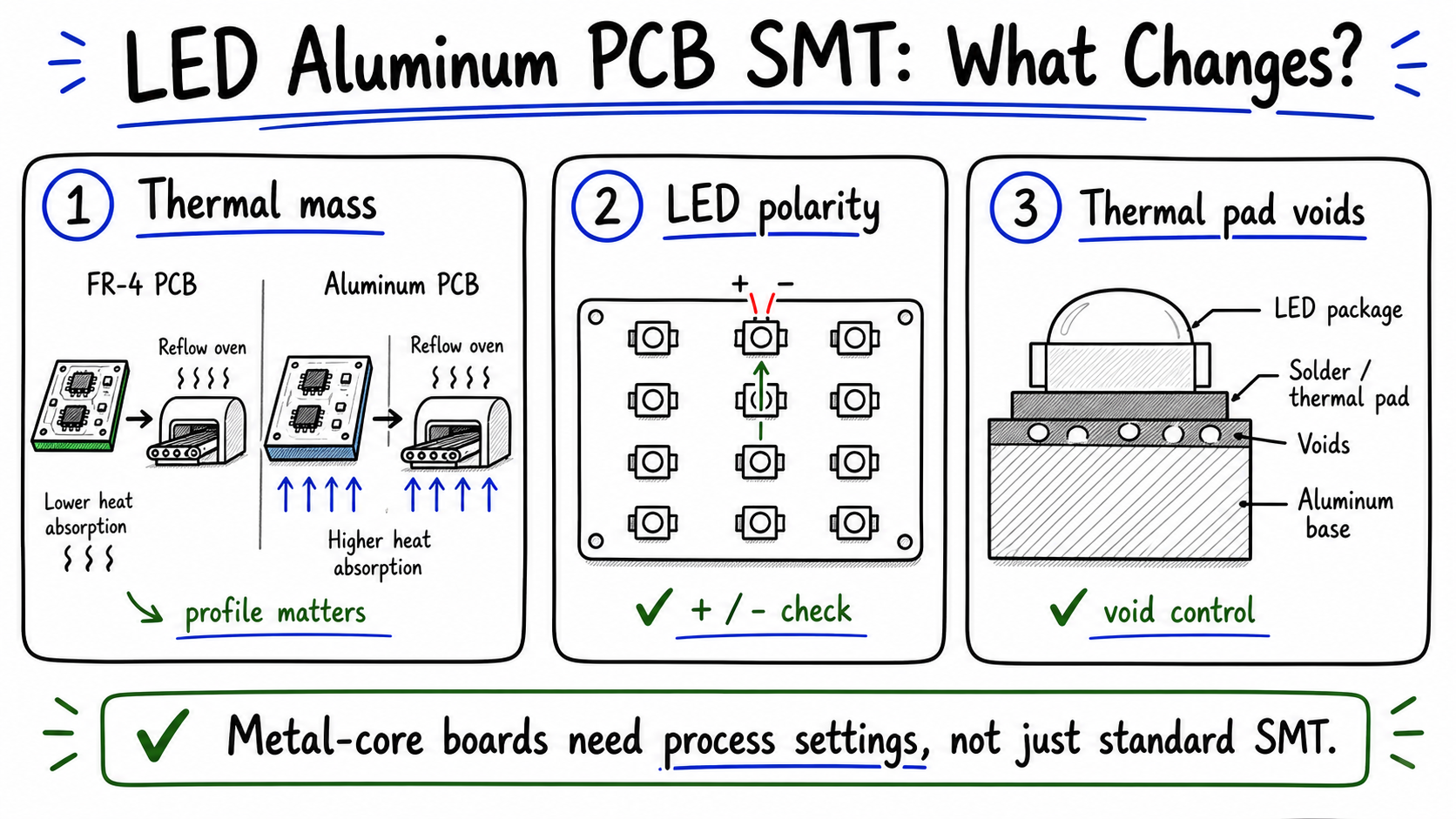 LED aluminum PCB assembly quotes should account for thermal mass, LED polarity, and thermal pad solder quality.
Power-On Lighting Test
For LED aluminum PCB assemblies, a power-on lighting test is the most practical final check before shipment.
The test applies current to the LED strings and verifies that all LEDs illuminate correctly, with no open circuits, reversed LEDs, or dim strings. It is not a substitute for functional system testing, but it is an efficient way to screen for the most common LED assembly failures.
State the test parameters in the RFQ when this check is required:
- Current applied per string (e.g., 350 mA, 700 mA)
- Whether 100% of finished boards are tested or whether a sampling plan applies
- Pass/fail criteria: all LEDs illuminate, no reversed LEDs, no open strings
For projects that specify a workmanship class, IPC-A-610 Class 2 is the practical baseline for most commercial LED lighting assemblies. Class 3 applies when the application demands higher-reliability assurance, such as emergency lighting or safety-critical products. See PCB class and IPC standards for a comparison.
For more on LED aluminum PCB fabrication and assembly scope, see LED PCB assembly and aluminum PCB manufacturing.
Why Online Instant Quotes Sometimes Change After Review
Online quote tools are a useful starting point for fast estimates, but the number they produce is based on automated parsing of uploaded files and nominal assumptions.
They typically cannot check whether the BOM contains parts with allocation constraints, whether the centroid file is correctly matched to the current Gerber revision, whether the stencil apertures need adjustment for a specific thermal pad design, or whether the LED orientation in the placement program will match what the assembly drawing specifies.
Engineering and DFM Review
After the files are reviewed by engineers, a quote may change if there are clearance issues, footprint mismatches, or process settings that the automated system flagged as a default but that need adjustment for the actual design.
Sourcing Confirmation
Component availability at the time of quoting is not guaranteed at the time of order confirmation. For turnkey orders, any part that is out of stock, on allocation, or at a significantly different price than when the instant quote ran will typically cause a price revision.
Testing and Assembly Notes
If the test requirements are vague or not stated, the initial quote may not include the correct test scope. A clear test note upfront prevents this revision from happening after the order is placed.
The practical way to limit quote changes is to submit a complete package with explicit instructions. Factories that have to make assumptions tend to either price conservatively to cover the uncertainty, or quote on assumed defaults that may not match what the project actually needs.
RFQ Checklist for PCB Assembly
Before submitting an RFQ, confirm that these items are included and clearly specified.
| RFQ Element | Required or Optional | Notes |
|---|---|---|
| Gerber files (RS-274X format) | Required | Match the design revision used for the BOM and assembly drawing |
| NC Drill files (Excellon format) | Required | Include correct units |
| Bill of Materials | Required | Full MPNs, quantities, reference designators, package codes |
| Centroid / CPL file | Required for SMT | Must match Gerber and BOM reference designators |
| Assembly drawing | Required | Polarity callouts, connector orientation, DNF designators |
| Build quantity | Required | State prototype and production quantities separately if different |
| Target lead time | Required | State sample lead time and production lead time separately |
| Sourcing model | Required | Turnkey, consigned, or partial consignment |
| Surface finish | Required | Confirm OSP, ENIG, or HASL based on assembly process |
| PCB base material | Required for MCPCB | Aluminum thickness, copper weight, dielectric thermal spec |
| Panelization information | Required if panelized | Depanelization method, rail dimensions, tooling holes |
| Approved BOM alternates | Recommended | Helps avoid quote delays caused by stock shortages |
| Test requirements | Recommended | Inspection class (e.g., IPC-A-610 Class 2), power-on test parameters |
| LED polarity drawing | Required for LED boards | Cathode and anode direction per position or by package type |
Gerber RS-274X remains the most universally supported format, though IPC-2581 and ODB++ are increasingly preferred by factories because they carry richer manufacturing intent, including stackup, assembly, and test data, in a single file package.
For the power-on lighting test requirement, a specific note in the RFQ is more effective than a general instruction. For example:
Power-on lighting test example: finished modules tested at rated current (350 mA per string), either 100% or by the agreed sampling plan. Pass criteria: all LEDs illuminate, no reversed LEDs, no open strings.
That level of detail allows the factory to include the correct test labor and fixture setup in the initial quote, rather than adding it as a revision when the order is being confirmed.
Conclusion
For most LED aluminum PCB assembly projects, the main causes of quoting delays are not unusual technical problems. They are missing files, incomplete BOM data, vague sourcing instructions, or unspecified test requirements.
A complete RFQ package with matching Gerber files, a formatted BOM with full MPNs, a centroid file, a polarity-marked assembly drawing, and clear test instructions gives the factory what it needs to quote accurately without stopping to ask questions.
For LED aluminum PCBs, add the base material specification, confirm the surface finish, and include the power-on lighting test parameters.
If you are preparing a quote request for an LED aluminum PCB project, review our LED PCB assembly service workflow and send your Gerber files, BOM, centroid file, assembly drawing, and test requirements to Lumina. We will review the file package and respond with a factory-direct quote for fabrication and SMT assembly.
Need a quotation?
Send Gerber files and basic specifications. We reply within 1 business day.
Ask for Quote