FR4 Price Increase in 2026: What Actually Went Up

On This Page (Table of Contents)
Electronic glass cloth used in FR4 went up through August 2026.
Reported China indications, mid-August versus October 2025:
- 7628: about RMB 4.4/m → about RMB 10.1/m
- 2116: about RMB 4.5/m → RMB 12.7/m
- 1080: RMB 4.5/m → RMB 13.1/m
Thin 2116 and 1080 moved first. Standard 7628 followed.
Copper-foil processing fees, resin, and thin inventories added more pressure.
These are cloth numbers. A laminate sheet and a finished PCB are different products. They will not all move by the same percentage.
Data cutoff: August 24, 2026. These are reported China market or supplier indications, not a global FR4 index.
What Is Actually Increasing: Glass Cloth, FR4 Laminate, or the Finished PCB?
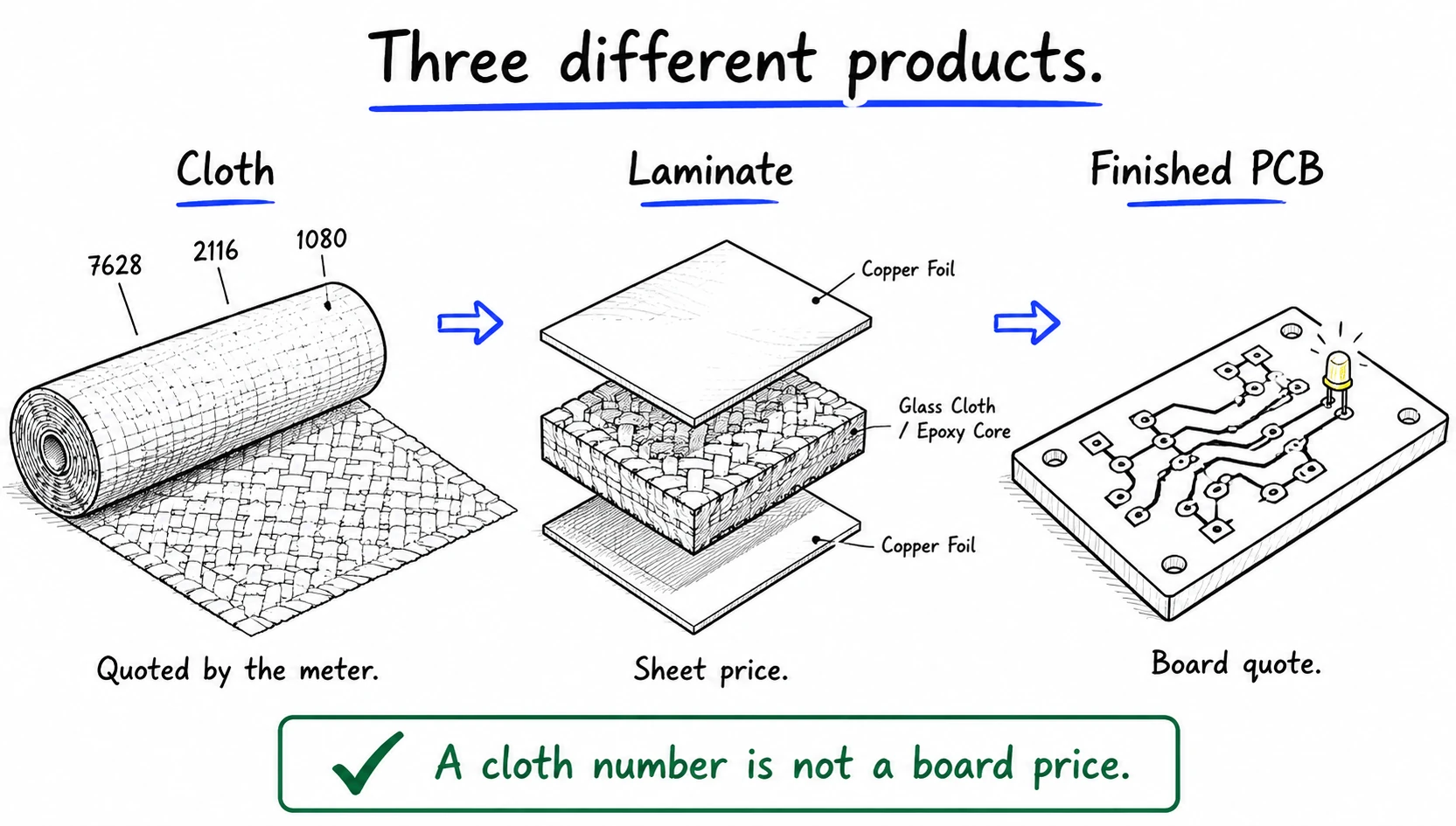 A cloth number, a laminate sheet, and a finished-board quote are not the same product.
“FR4 price” can mean three different things.
Mix them up, and a supplier notice looks either crazy or too small.
Here's the chain:
- Electronic yarn is woven into glass cloth.
- Glass cloth (7628, 2116, 1080) is sold by the meter. These styles are not the same price.
- Cloth plus resin plus copper becomes copper clad laminate.
- A finished PCB then adds fabrication, yield, testing, volume, and order terms.
| Supply-chain level | What you are quoting | Typical basis | Why you cannot mix them |
|---|---|---|---|
| Electronic yarn | Glass fiber yarn | RMB/tonne | Different yarns feed different fabrics |
| Electronic glass cloth | 7628, 2116, 1080 | RMB/meter | Style, source, and date change the number |
| FR4 prepreg / CCL | Laminate sheet | Sheet, area, or contract | Thickness, Tg, copper, and panel differ |
| Finished FR4 PCB | Fabricated board | Per board, panel, or area | Process, yield, and volume sit on top |
Is FR4 in shortage?
Some glass-cloth and laminate inputs were reported tight in 2026.
There is not one global stock number called “FR4 shortage.”
For buyers: the cloth number is the start. Then ask which material and which construction you are comparing.
How Much Did 7628, 2116, and 1080 Change?
All three common fabrics rose from late-2025 quotes through August 2026.
Thin 2116 and 1080 moved faster than 7628.
Shanghai Securities News published quotes from two leading suppliers:
- 7628: RMB 4.3–4.5/m on 10 Oct 2025 → RMB 7.3–7.7/m on 1 June 2026
- 2116: RMB 4.4–4.5/m → RMB 9.3/m
- 1080: RMB 4.5/m → RMB 9.7/m
Cailian Press, citing Zhuochuang, later reported mid-August indications:
- 7628: RMB 10.0–10.2/m
- 2116: RMB 12.7/m
- 1080: RMB 13.1/m
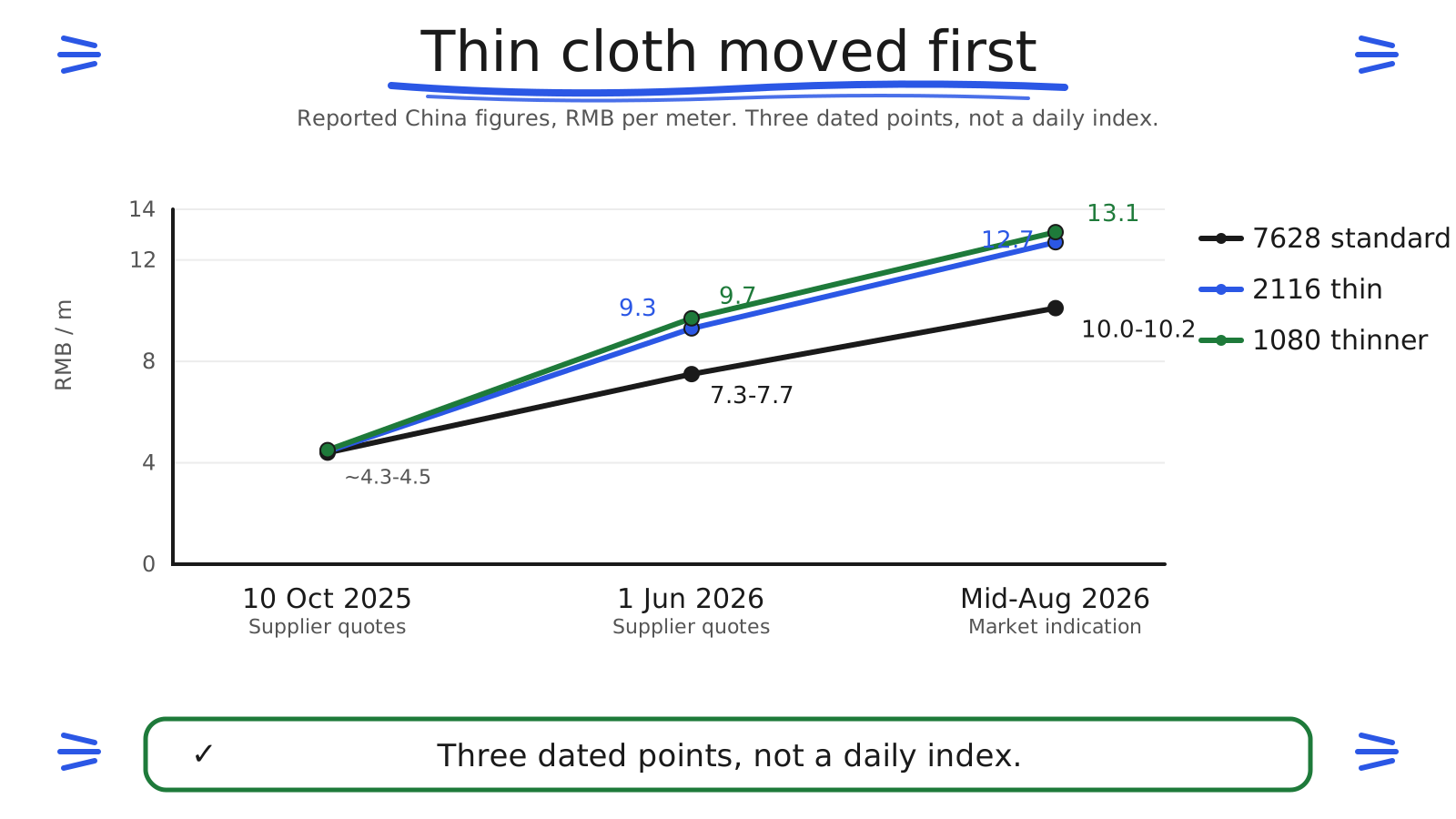 Thin 2116 and 1080 moved faster than standard 7628. These are reported points, not a daily index.
One warning: these columns are not one index.
October and June are named-supplier quotes. August is a market indication.
Use them as direction and ranking. Not as your next contract price.
Did glass cloth rise by more than 100%?
Some common-spec averages were reported about 100% above the Q3 2025 low by early June. Thin grades later moved more from the October quotes.
That is growth from a low base.
It is not year-on-year unless the same month and the same grade exist.
And it is not the increase on every FR4 laminate or finished PCB.
Why AI Demand Tightened 2116 and 1080 First
AI servers did not just add “more PCB demand.”
They changed the material mix:
- more layers
- thinner dielectrics
- lower-loss laminates
That pull hit 2116 and 1080 first. Ordinary 7628 sits farther from that demand.
A new furnace does not refill these grades the week it lights up.
You still need weaving, finishing, yield, and customer approval.
China Jushi started a Huai’an line in March 2026:
- 100,000 tonnes of electronic-grade glass fiber
- 390 million meters of electronic cloth
- about 30% thin or ultra-thin
- output released in batches
Xinhua also recorded the China Fiberglass Industry Association: high-end looms still depend on imports, and deliveries have stretched.
If you buy lighting boards, this is background. It is not a reason to send an AI-server RFQ to a single-sided aluminum PCB factory.
Why Did Standard 7628 Rise Too?
Because of a spillover shortage.
Mainstream FR4 still needed 7628.
Producers just had a stronger reason to spend yarn, loom time, and finishing on thinner, higher-value cloth.
Then three things happened at once:
- 7628 output grew more slowly
- consumer, auto, industrial, and standard-FR4 demand did not disappear
- CCL buyers ordered for continuity, not only for this week
Xinhua already described the shortage spreading from high-end grades to ordinary ones.
In August, Zhuochuang analyst Liu Yang told Cailian Press that leading producers had compressed conventional 7628. He described the industry as near zero inventory. That is an analyst read, not an official national stock figure.
Why did 7628 rise if AI boards use thinner cloth?
Because a product-mix shift can tighten a standard material indirectly.
7628 demand stayed. Shared capacity moved.
| Direct effect on thin cloth | Spillover on 7628 |
|---|---|
| More thin-dielectric demand | Shared resources leave ordinary cloth |
| Tighter yarn qualification | Standard output grows more slowly |
| Longer yield ramp | Buyers compete for allocation |
| Higher value per meter | Spot 7628 gets harder to buy |
7628 did not become an AI fabric. Its available supply tightened because other grades paid more.
Glass Cloth Was Not the Only FR4 Cost Driver
Glass cloth was the big 2026 mover.
It was not the only line on a CCL bill.
A laminate supplier also pays for:
- copper foil
- resin
- energy, yield, freight, and inventory
Copper foil is a separate number.
Cailian Press, citing SMM as of 3 August 2026:
- 18 μm CCL copper-foil processing fee: more than 30% above the start of the year
- 35 μm and 70 μm: about 15%
Those are processing fees, not the full foil price.
A July Kingboard notice, reported in the same piece, cited glass cloth and copper foil. That is one supplier, one date. Not a global FR4 index.
How long will FR4 stay tight?
Don't hang a purchasing plan on a month.
Easing needs qualified yarn, looms, yield, customer approval, and more normal inventories.
A capacity announcement is only step one.
Why Finished PCB Prices Do Not Rise One-for-One
A finished PCB quote is not a glass-cloth formula.
Two factories can see the same cloth market and still move differently.
| Quote variable | Why the pass-through changes |
|---|---|
| Grade, Tg, compliance | Different resin and source |
| Board / core thickness | Different cloth and resin content |
| Copper thickness | Material plus processing |
| Layer count | More laminate and more process |
| Panel utilization | Poor nesting makes inflation louder per board |
| Existing inventory | Can delay the increase |
| Spot / allocation | Urgent lots cost more |
| Quantity and timing | Setup and terms change the per-board hit |
| Yield and surface finish | Finished cost is more than CCL |
Does a 100% cloth increase mean PCB prices double?
No.
Glass cloth is one input to CCL.
CCL is one part of a finished board.
The 100% may also be measured from a 2025 low, not from your last order.
Are FR4 prices per sheet comparable?
Only when panel size, thickness, copper, grade, Tg, volume, source, and terms match.
A generic RMB/sheet headline is not a check against your board.
Quick example:
- Quote A: standard laminate in stock, good nesting
- Quote B: odd thickness, heavier copper, urgent material, poor panel
Same news headline. Different finished-board result.
Compare the same revision before you accept a new number. PCB material is part of that comparison.
What PCB Buyers Should Check Before Accepting a Price Revision
Name the material first.
Then compare the old quote and the new quote on the same file.
- Name the material. Cloth, CCL, copper foil, resin, or a named laminate family?
- Lock the comparison. Same Gerber, thickness, copper, Tg, quantity, finish, and delivery window.
- Ask the scope. New orders, open orders, or only some constructions?
- Separate price from allocation. A higher price does not guarantee material.
- Check validity. A market update is not a production-order quote.
- Don't auto-swap laminates. Engineering review first.
- Drop extras the design doesn't need. High-Tg, low-loss, and named brands cost more when they do no job.
- Plan repeats. Use a review mechanism. Don't assume a forever-fixed price.
- Save the file. Next review needs the same basis.
| Send this | Why it matters |
|---|---|
| Gerber / drawing + revision | Stops comparison across different designs |
| Material family / approved alts | Defines what can be sourced |
| Finished thickness + copper | Main construction cost |
| Quantity + repeat forecast | Allocation and per-board economics |
| Delivery window | Routine vs urgent |
| Compliance / reports | Stops a late spec change |
Lumina does not offer a price lock, a named FR4 brand list, or a standard FR4 lead time here.
Send the specification. Don't send “What % did FR4 rise?”
Does the Same FR4 Increase Apply to Aluminum PCB?
No. Not directly.
Conventional FR4 uses woven glass cloth and epoxy.
A standard single-sided aluminum PCB uses:
- copper circuit
- thermally conductive dielectric
- aluminum base
7628, 2116, and 1080 are not direct inputs in the same way.
| Cost exposure | Standard FR4 PCB | Standard single-sided aluminum PCB |
|---|---|---|
| 7628 / 2116 / 1080 | Direct input | Not the same structure |
| Copper foil | Direct | Direct |
| Dielectric | Glass/epoxy laminate | Thermally conductive dielectric |
| Base | Glass-reinforced laminate | Aluminum plate |
| Why you pick it | General electrical / mechanical use | LED heat spreading |
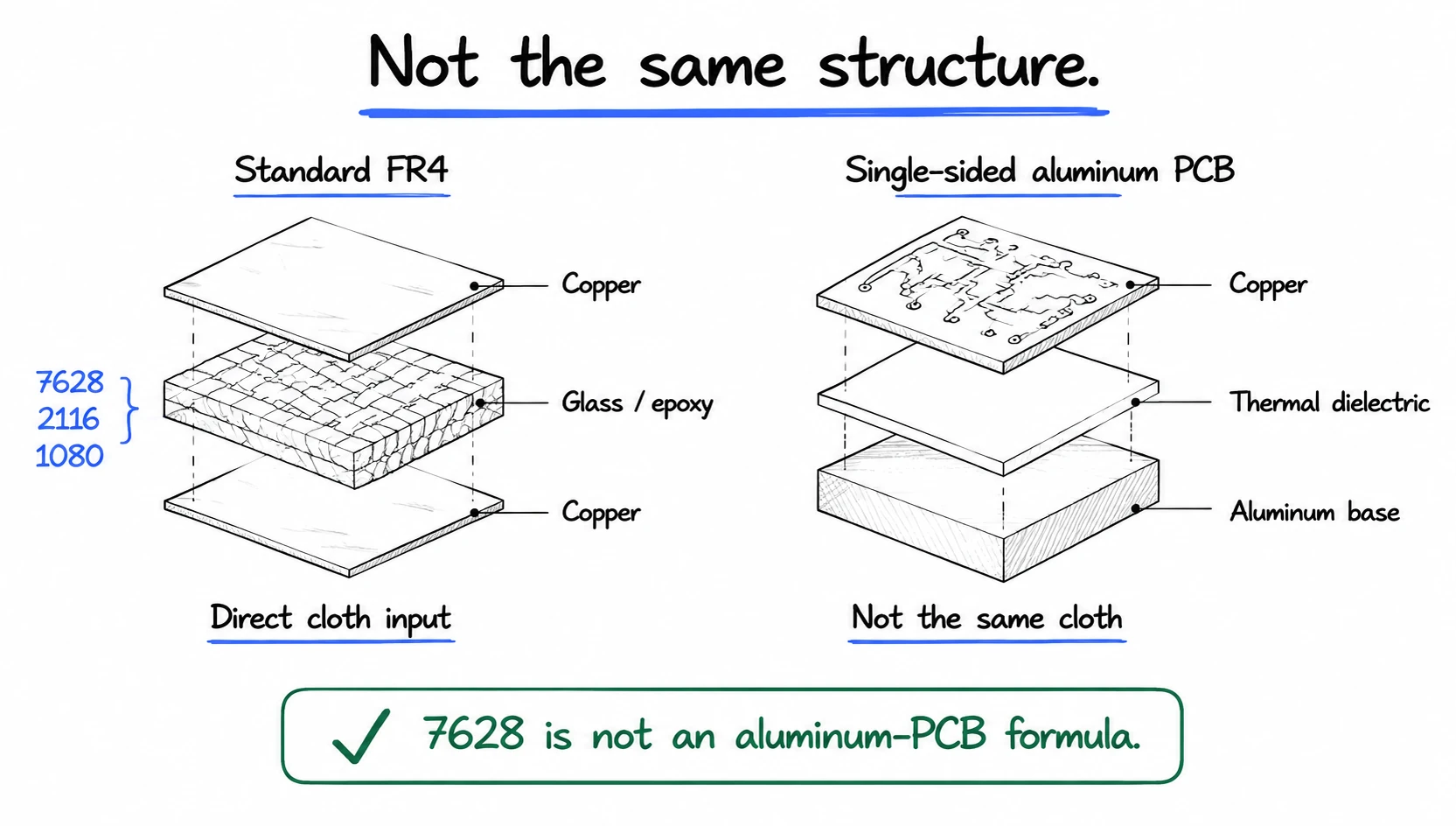 7628, 2116, and 1080 are not direct inputs in a standard single-sided aluminum PCB.
Don't paste a 7628 percentage onto an aluminum quote.
Aluminum PCB vs FR4 is a structure choice first.
Aluminum PCB can still move with copper foil, dielectric, aluminum, energy, freight, and yield. Check those cost factors on their own.
Lumina's main product is single-sided aluminum PCB for LED lighting.
FR4 is not a main product. Suitable volume can be evaluated.
We do not make multilayer FR4, double-sided aluminum, high-speed, or AI-server boards.
FR4 and aluminum PCB can share some cost pressure. They do not share the same glass-cloth formula.
[!TIP] Evaluating Alternatives to Mitigate FR4 Price Volatility?
For LED lighting applications, switching from FR4 to a single-sided aluminum substrate often improves heat dissipation while bypassing glass-cloth cost spikes. Lumina PCB operates 200,000 m²/month of dedicated single-sided aluminum PCB capacity for high-volume lighting manufacturers.
- Check Single-Sided Aluminum PCB Specifications & Production Lead Times
- Read our engineering breakdown: Aluminum PCB vs FR4 for LED Boards
Conclusion
FR4 glass cloth did rise through August 2026. Thin grades moved first. 7628 followed.
Send the Gerber or drawing, material type, finished thickness, copper thickness, quantity, and delivery window.
Compare that file to the last revision before you treat a cloth percentage as the board price.
Lumina can review practical single-sided aluminum PCB requirements for LED lighting. Suitable high-volume FR4 is evaluated separately. If you are comparing substrate costs or planning production for LED lighting boards, send your Gerber file or drawing to our engineering team for a direct factory quotation (prototypes in 1–3 days, bulk delivery from 7 days).
Need a quotation?
Send Gerber files and basic specifications. We reply within 1 business day.
Ask for Quote