Copper PCB vs Aluminum PCB: Which Metal Core Fits LED Lighting?

On This Page (Table of Contents)
For copper PCB vs aluminum PCB in LED lighting, aluminum PCB is usually the metal core that fits.
Copper PCB conducts heat better at the same size. It also weighs more and usually costs more to buy and machine. On a lamp, a linear module, or a panel, that extra conductivity often does not show up as a cooler LED.
Heat still has to cross the dielectric and leave through the housing. Henkel’s Thermal-Clad notes treat IMS performance as a system impedance problem. The metal name is only one layer in that path.
People often quote NIST’s 295 K table: copper about 400 W/m·K, aluminum about 235 W/m·K. Those numbers are for the bare metal. They are not the thermal conductivity of the finished PCB, and they do not mean the copper board runs 1.7 times cooler.
If heat is packed into a small footprint and the dielectric plus mounting path are already clean, copper PCB can be worth discussing. For everyday lighting volume, start with aluminum.
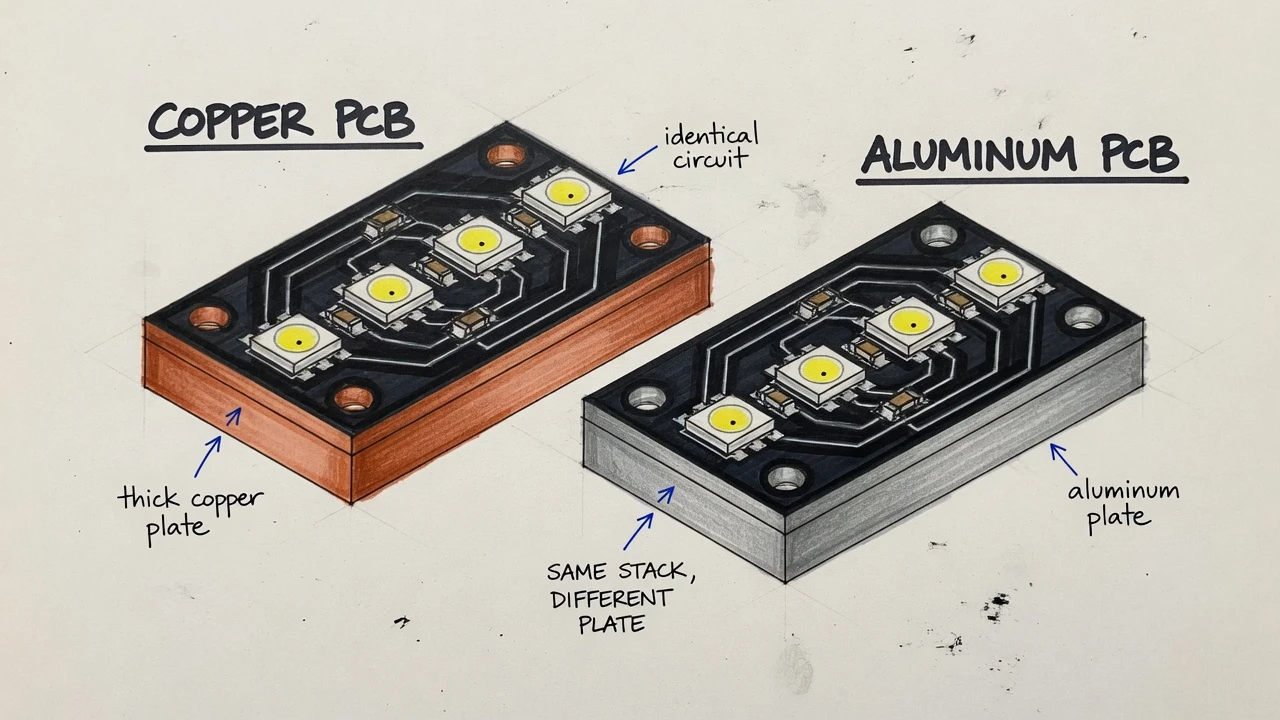 Same LED module stack. The visible difference is the metal plate under the dielectric.
Same Stack, Different Plate
Copper PCB and aluminum PCB use the same construction. Only the metal plate changes.
The board is circuit copper, a thermal dielectric, then a copper plate or an aluminum plate. The plate spreads heat and holds the board. It is not the circuit.
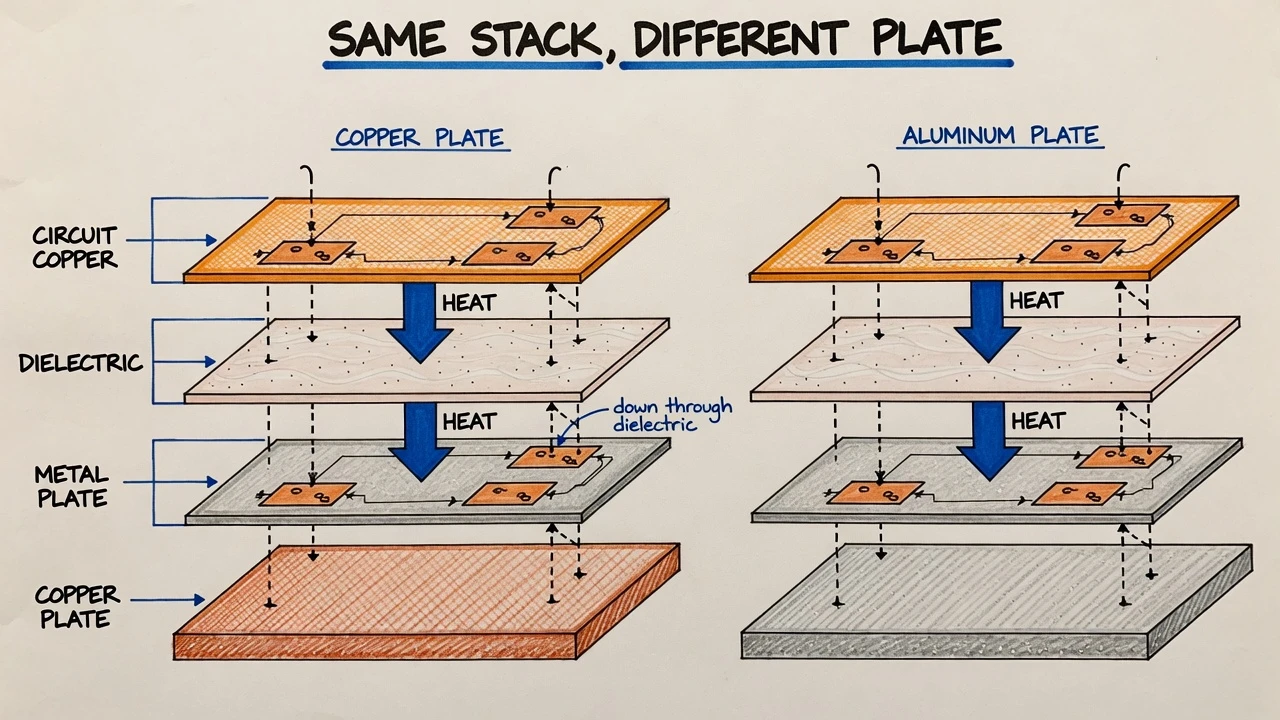 Circuit copper and dielectric stay the same. Only the base plate switches from copper to aluminum.
Ventec describes IMS as copper or aluminium clad with an epoxy insulating layer and copper foil. IPC-6012F treats metal-core boards as their own rigid-board type.
Once you see that, the buying question gets smaller. You are not choosing two different products. You are choosing which plate sits under the dielectric.
What Actually Changes Between Copper PCB and Aluminum PCB
Copper conducts better and weighs more. The finished LED board does not become a 400 W/m·K part.
NIST lists copper at about 400 W/m·K and 8.96 g/cm³, aluminum at about 235 W/m·K and 2.70 g/cm³. Same geometry, copper is roughly 1.7 times more conductive and 3.3 times heavier. A 100 × 100 × 1.5 mm plate is about 134 g in copper and about 40.5 g in aluminum. On a large lighting panel, you feel that in handling and shipping.
The aluminum in an IMS board is also an alloy. Ventec’s VT-4B7 sheet puts 5052-H32 at 138 W/m·K. That is already a long way from the pure-aluminum handbook number.
| Factor | Copper PCB | Aluminum PCB | What it means |
|---|---|---|---|
| Metal plate | Copper | Aluminum | This is the comparison |
| Bulk metal k | About 400 W/m·K (NIST) | About 235 W/m·K for pure Al | Copper conducts better at the same size |
| Density | About 8.96 g/cm³ | About 2.70 g/cm³ | Copper is about 3.3 times heavier |
| 100 × 100 × 1.5 mm plate | About 134 g | About 40.5 g | Weight shows up on large panels |
| Board-level heat | Better spreading in the plate | Often enough if dielectric and housing are right | The finished board is not 400 or 235 W/m·K |
| Process | Higher cutting load, more protection | Usual volume metal-core route | Neither follows FR-4 machining rules |
| Cost | Higher metal and process cost | Usual volume baseline | No honest “X times” price |
| LED fit | Concentrated heat after other levers are used | Most commercial lighting | Start with aluminum |
People specify copper PCB because 400 looks decisive. On lamp and module boards, temperature usually moves first with the dielectric and the housing contact.
Ventec’s VT-4A2H data makes that concrete. The same 2.2 W/m·K material, from 75 µm to 200 µm, has stated thermal impedance rising from 0.054 to 0.107 °C·in²/W. Change the dielectric thickness, and the board changes. Change only the plate, and a thick dielectric stays where it was.
The heat path is LED, solder, circuit copper, dielectric, metal plate, then TIM and housing. The last metal does not fix a loose mounting face.
Cost is not just the metal price either. A Bergquist / Henkel IMS paper says copper is more expensive than aluminum, harder to bond to the dielectric, and usually needs corrosion protection such as nickel. Punching also wants more circuit-to-edge room: two times material thickness on copper, versus one thickness plus 0.020 in on aluminum.
If a quote only says “copper PCB costs more,” ask what stack and what process work are in the number.
Why Aluminum Wins on Most LED Boards
Most lamps, linear modules, downlights, and panels spread heat across several LEDs into a metal housing. Aluminum PCB is usually enough.
It already conducts far better than FR4, and it stays light enough to ship and hang. Distributed LED loads rarely need the extra spreading of a copper plate. The layout and the housing have already done most of that work.
If the board is still hot, the plate is the last thing to change. Dielectric thickness and impedance come first. Then mounting pressure, flatness, TIM, and housing contact. Then LED spacing and copper pour.
A linear module with even spacing on a flat housing is the usual case. Heat is already spread before it reaches the plate. Paying for copper there rarely buys a temperature drop you can see.
A small COB in a tight cup is a different problem. The hot spot is local. KSG keeps copper PCB for that kind of concentrated heat, and for high-heat LED work where chip temperature is already tight.
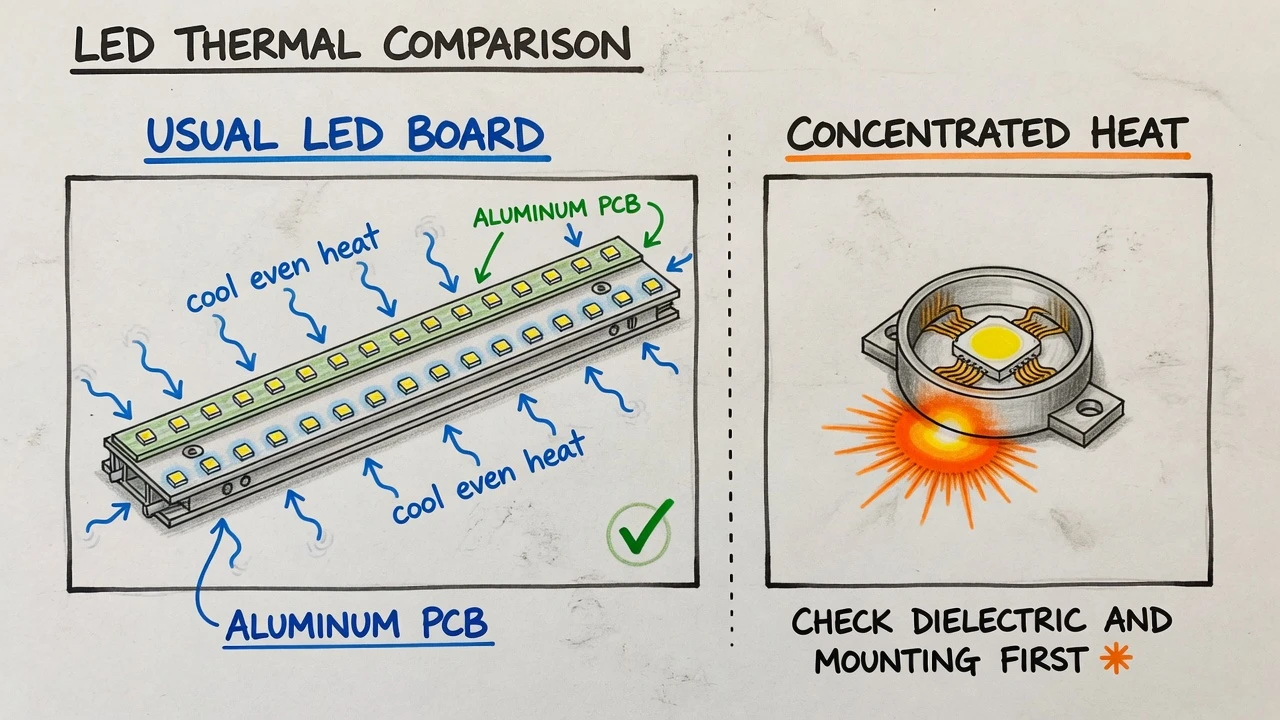 A spread-out lighting board usually stays on aluminum PCB. A tight hot spot is the case that may justify looking at copper PCB.
Copper PCB is worth the extra cost only after those other items have been checked, and only if leftover temperature still comes from spreading in the plate. If the bottleneck is the package, the dielectric, the TIM, or the housing, the copper plate adds mass and money without much return.
What to Put on the Quote
A useful quote needs the plate, the dielectric, the circuit copper, the isolation, and how the board mounts. “Copper PCB” or “aluminum PCB” is not a specification.
Send the drawing or Gerber, aluminum thickness if you have it, any dielectric or isolation note, circuit copper if specified, LED power and layout, the housing or TIM method, and whether this is a sample, a pilot, or a repeat run.
| Item | Why it matters |
|---|---|
| Metal plate and thickness | Sets the construction |
| Dielectric / isolation | Often the board-level thermal and electrical limit |
| Circuit copper | Electrical path, separate from the plate |
| LED power and layout | Shows whether heat is spread or concentrated |
| Mounting / housing | Often the larger thermal resistance |
| Quantity | Sample versus repeat production |
If the drawing already says copper PCB, still check whether a practical aluminum PCB can meet the thermal target. Board cost depends on size, stack, process, and quantity. The plate is only one of those.
For a new lighting design, sample the aluminum board in the real housing before a bulk order. That test beats a conductivity table.
If you need a single-sided aluminum PCB for LED lighting, send the drawing, LED power and layout notes, and how the board mounts to the housing.
Need a quotation?
Send Gerber files and basic specifications. We reply within 1 business day.
Ask for Quote