Aluminum PCB Dielectric Material: How to Choose

On This Page (Table of Contents)
Do not choose aluminum PCB dielectric material by W/m·K alone.
Start with your LED power, working voltage, insulation requirement, thermal path, and target cost. A higher thermal conductivity number is not always the best production choice.
Here is what to compare before quotation or sampling.
What Is the Dielectric Layer in an Aluminum PCB?
The dielectric layer is the insulating layer between the copper circuit and the aluminum base.
It has two jobs: it stops electrical current from reaching the aluminum base, and it transfers heat from the LED circuit into the metal base.
A typical single-sided aluminum PCB has three main layers:
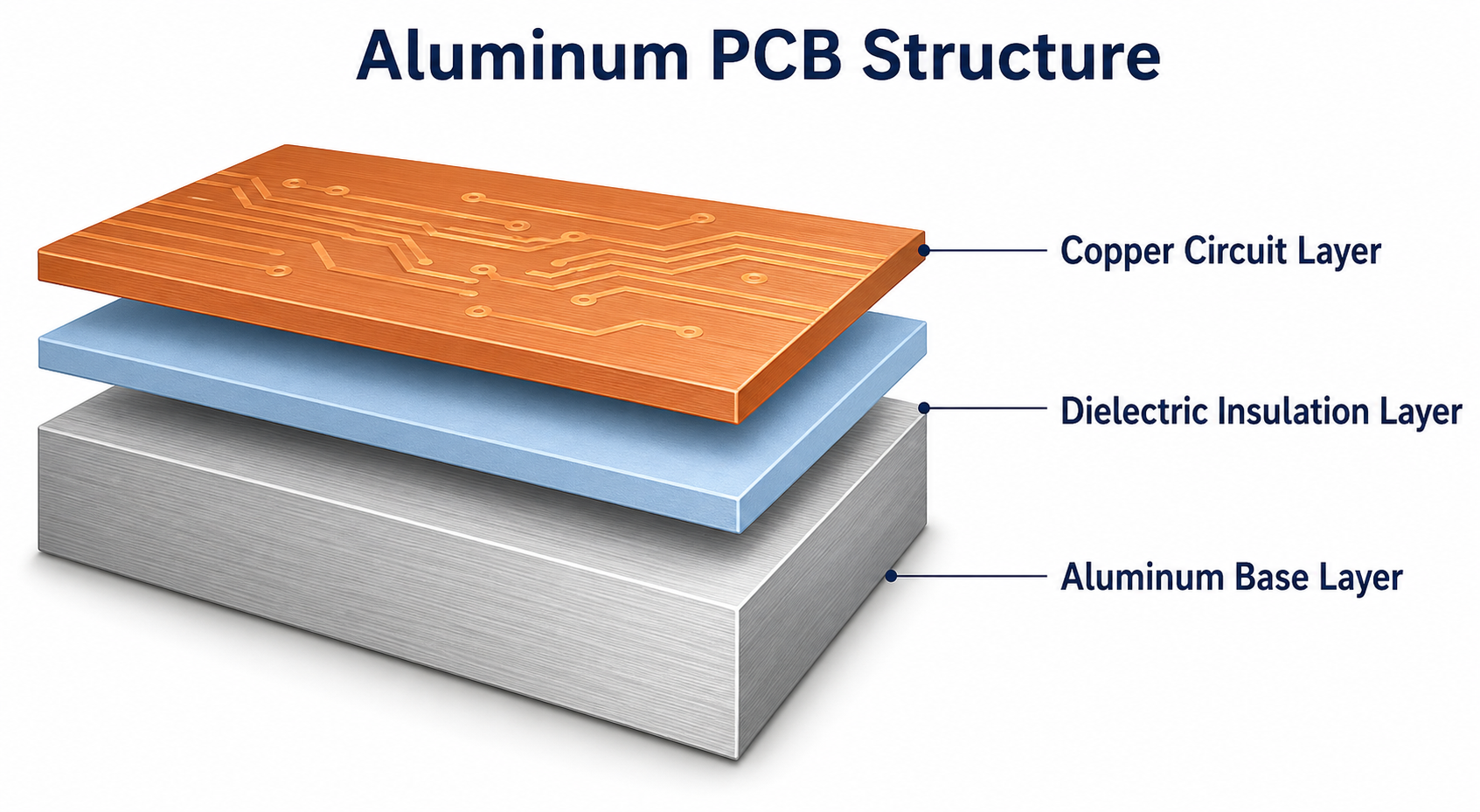
The copper layer carries current and provides LED solder pads. The aluminum base gives the board mechanical support and spreads heat. The dielectric layer sits between them—thin, but with a strong influence on both thermal performance and insulation safety.
That is why aluminum PCB quality is not decided by aluminum thickness alone.
Why Does Dielectric Material Matter for LED Lighting?
The dielectric layer sits directly in the heat path from your LED to the housing or heatsink.
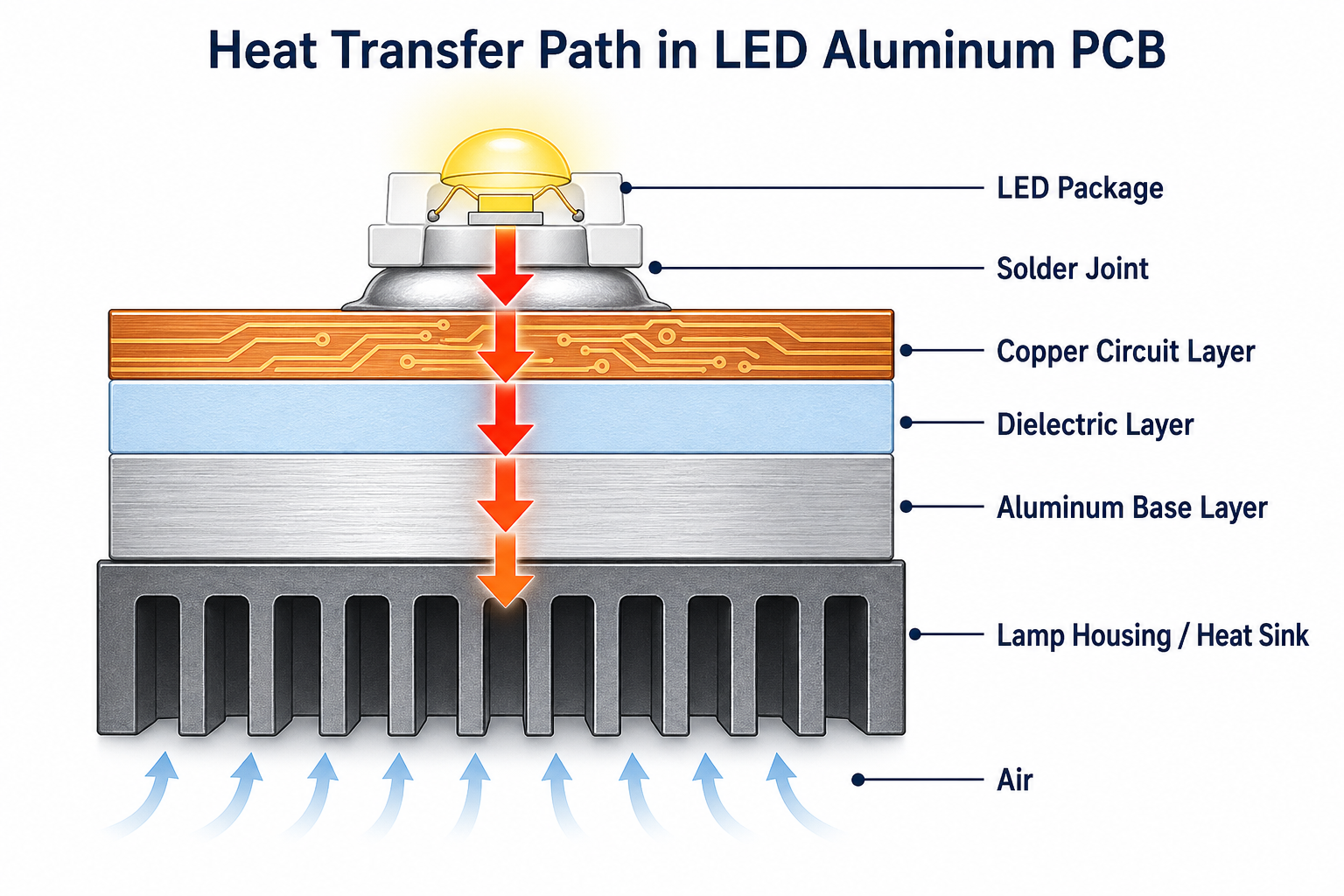
If this layer has high thermal resistance, heat builds up around the LEDs. That leads to lower light output, color shift, faster lumen depreciation, and shorter service life.
Cree LED's XLamp thermal management application note explains that elevated junction temperature reduces LED output and lifetime. The U.S. Department of Energy's LED thermal management brief identifies drive current, ambient temperature, and the thermal path as the key factors behind junction temperature.
But this does not mean every LED board needs expensive high-conductivity material.
The right choice depends on your actual LED power, board size, lamp structure, working environment, and cost target.
Does Higher Thermal Conductivity Always Mean a Better Aluminum PCB?
Not always.
Higher thermal conductivity helps heat move through the dielectric layer. But the final result also depends on dielectric thickness, copper thickness, board area, housing contact, and heatsink design.
A 2.0 W/m·K dielectric may not perform as expected if the layer is thick or the lamp housing has poor thermal contact. At the same time, a standard dielectric may be enough for low-to-medium power LED modules if the board has enough heat spreading area and the fixture has a proper metal housing.
So before chasing a higher W/m·K number, compare the full structure.
If your main question is still about board base thickness, see our guide on how to choose aluminum PCB thickness for LED lighting.
Key Factors to Compare Before Choosing Dielectric Material
The right choice balances thermal performance, insulation, cost, and production stability.
| Factor | Practical Meaning | What to Check |
|---|---|---|
| Thermal conductivity | Affects how easily heat passes through the dielectric layer | Confirm whether standard, mid-grade, or higher thermal material is really needed |
| Dielectric thickness | Affects both heat transfer and insulation margin | Do not choose the thinnest layer without checking voltage requirements |
| Breakdown voltage | Protects the circuit from shorting to the aluminum base | Provide working voltage and any Hi-Pot requirement |
| Copper thickness | Affects current capacity and heat spreading | Match copper thickness with current, LED power, and cost target |
| Aluminum thickness | Affects rigidity, structure fit, and heat spreading | Match board thickness with lamp housing design |
| Material availability | Affects lead time and repeat orders | Prefer stable material for bulk LED lighting production |
| Cost | Affects mass production competitiveness | Avoid over-specifying material when the product does not need it |
This table is a starting point. The final material should still be checked against your real LED design and application environment.
When Is Standard Dielectric Material Enough?
Standard dielectric material is often enough when LED power density is moderate and the lamp has a reasonable heat dissipation structure.
It commonly fits cost-sensitive LED lighting products where stable mass production matters more than using the highest material grade.
Standard dielectric may be the right fit for:
- Indoor LED modules
- Panel lights
- Ceiling lights
- Many linear LED boards
- Low-to-medium power downlights
- Cost-sensitive repeat orders
- Boards with enough heat spreading area
- Products without special thermal test requirements
In these projects, the goal is not to overbuild the PCB. The goal is to meet the real thermal and insulation requirement with a stable material that can be supplied repeatedly.
When Should You Choose Higher Thermal Conductivity Material?
Higher thermal conductivity material makes sense when heat is concentrated, difficult to remove, or critical to product lifetime.
Consider it for:
- High-power LED modules
- Dense LED layouts
- COB or concentrated light source boards
- Outdoor lighting
- Street lights and flood lights
- Sealed lamps with limited airflow
- Products working in high-temperature environments
- Projects with strict junction temperature or thermal test requirements
Even then, the PCB material is only one part of the system. LED package, soldering quality, thermal interface material, housing flatness, heatsink design, and airflow all affect the final temperature.
Dielectric Thickness vs Thermal Conductivity: Which Is More Important?
Both matter—and they should be checked together.
A thinner dielectric layer helps heat pass through more easily. But it must still provide enough electrical insulation.
For higher-voltage LED products, mains-related designs, outdoor lamps, or products with strict Hi-Pot requirements, insulation margin may matter more than chasing the thinnest possible layer.
So the practical question is not only "What is the thermal conductivity?" It should also be "What dielectric thickness and insulation performance does this structure provide?"
For a deeper comparison of dielectric construction options, see our guide to prepreg vs adhesive dielectric in aluminum PCB.
How to Match Dielectric Material to Your LED Application
| LED Application | Typical Need | Practical Direction |
|---|---|---|
| Small indoor LED module | Low to medium heat, cost control | Standard dielectric material is often enough |
| Panel light or ceiling light | Stable bulk production | Standard or mid-grade material depending on power |
| Linear LED board | Long board, flatness, assembly fit | Focus on board thickness, flatness, and stable dielectric |
| Downlight or spotlight | More concentrated heat | Mid-grade or higher thermal material may be useful |
| Outdoor lighting | Heat, humidity, long operating time | Check thermal performance and insulation margin |
| Flood light or street light | Higher power density | Higher thermal conductivity material may be needed |
| COB or dense LED array | Heat concentrated in small area | Higher thermal material or special thermal design should be checked |
This is not a fixed rule. It is a practical starting point before quotation. If LED power, board size, and housing design are clear, the factory can recommend a more suitable direction.
Common Mistakes When Choosing Aluminum PCB Dielectric Material
The most common mistake is choosing by one parameter only.
This leads to higher cost, unstable delivery, or a board that does not solve the real thermal problem.
Watch out for:
- Choosing the highest W/m·K value without checking cost
- Ignoring dielectric thickness
- Ignoring working voltage and Hi-Pot requirements
- Assuming thicker aluminum always solves heat problems
- Comparing aluminum PCBs only by board thickness
- Using high-grade material for a low-power product that does not need it
- Skipping sample testing before bulk production
- Changing material between repeat orders without rechecking performance
In bulk production, consistency matters. A material that is practical, available, and stable in production is often better than a higher-spec option that adds cost without clear value.
What to Confirm Before Requesting a Quote
Provide enough basic information for the factory to judge the dielectric material and stackup.
Before requesting a quote, prepare:
- Gerber file or drawing
- Board size
- Aluminum thickness
- Copper thickness
- Surface finish
- Quantity
- LED type and power
- Working voltage
- Application type
- Thermal conductivity requirement (if already specified)
- Hi-Pot or breakdown voltage requirement (if any)
- Sample or mass production plan
If you are not sure which material is suitable, provide the LED power, board size, and application environment first.
For new LED lighting projects, sample testing is recommended before bulk production.
Conclusion
The dielectric layer is a key part of aluminum PCB performance for LED lighting.
It provides electrical insulation and transfers heat from the copper circuit layer to the aluminum base. The best dielectric material is not always the highest-spec material. It is the one that fits your real LED design, real operating condition, and real production target.
If you need aluminum PCBs for LED lighting production, send us your Gerber file, board thickness, copper thickness, surface finish, quantity, and application details. We can help check a practical production option before sample testing or mass production.
FAQ
What is the dielectric layer in an aluminum PCB?
The dielectric layer is the insulating layer between the copper circuit and the aluminum base. It provides electrical insulation and helps transfer heat into the metal base.
Why is the dielectric layer important for LED lighting?
It is part of the LED heat path. Its thermal resistance can affect LED temperature, brightness stability, and long-term reliability.
Is higher thermal conductivity always better?
Not always. Higher thermal conductivity can help, but the final choice also depends on dielectric thickness, voltage requirement, cost, housing design, and production stability.
Does every LED aluminum PCB need high thermal conductivity material?
No. Many standard LED lighting boards work fine with practical standard dielectric materials when power density is moderate and the heat dissipation structure is reasonable.
When should I consider higher thermal conductivity dielectric material?
Consider it for high-power LEDs, dense LED layouts, COB modules, outdoor lighting, sealed fixtures, flood lights, street lights, or projects with strict thermal test requirements.
What information is needed to choose the right dielectric material?
Gerber files, board size, aluminum thickness, copper thickness, LED power, working voltage, quantity, application environment, and any thermal or insulation requirements.
Need a quotation?
Send Gerber files and basic specifications. We reply within 1 business day.
Ask for Quote