Turnkey PCB Assembly: What LED Aluminum PCB Buyers Should Confirm Before RFQ

On This Page
Turnkey PCB assembly means one supplier manages the build — from design files and BOM through fabrication, assembly, inspection, and delivery.
But the real question is not “Can one supplier do it?” It’s “Which steps are actually included before you approve the RFQ?”
A turnkey quote may cover PCB fabrication, component sourcing, SMT assembly, inspection, testing, packaging, and shipping. The scope varies by supplier and by project. When it’s unclear, you get quote gaps, silent component substitutions, and lead-time surprises.
What Is Turnkey PCB Assembly?
Turnkey PCB assembly is a service model.
One supplier manages most or all of the PCB production workflow.
The buyer does not need to coordinate every separate vendor.
That can include bare boards, components, SMT assembly, testing, and delivery.
But the supplier only takes responsibility for the defined build package.
Here is the main point:
"Turnkey" is not a magic word.
It does not mean every service is automatically included.
It is a scope that should be written clearly in the quotation or statement of work.
A typical turnkey PCB assembly flow may look like this:
Design files -> PCB fabrication -> Component sourcing -> SMT assembly -> Inspection/testing -> Packaging -> Delivery
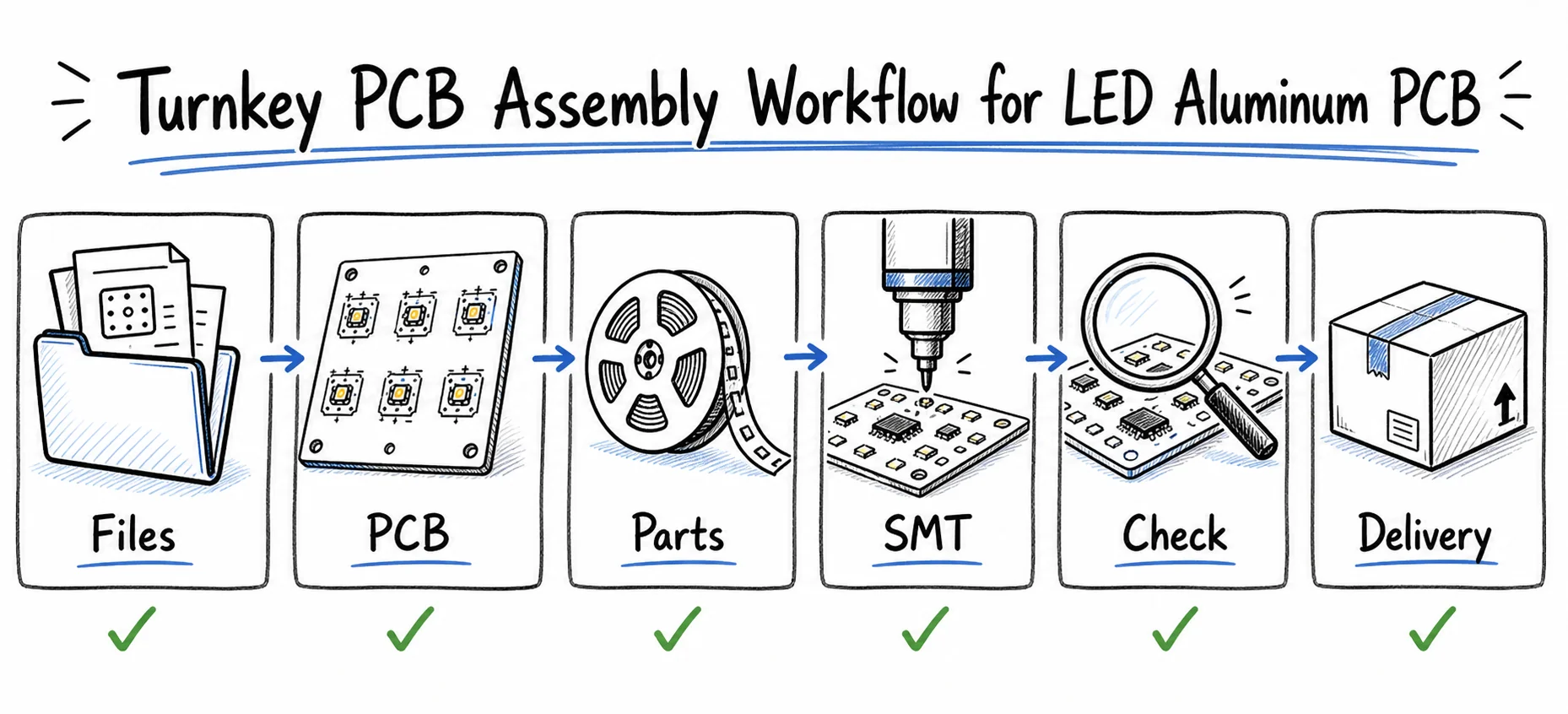 A turnkey PCB assembly quote should define each step from files and PCB fabrication to assembly, inspection, and delivery.
For LED lighting projects, this workflow often connects aluminum PCB fabrication for LED lighting with component preparation and SMT assembly for LED PCB projects.
That connection matters.
The bare board specification and assembly process affect each other.
Don’t compare two turnkey quotes until you know whether they include the same responsibilities.
What Is Usually Included in Full Turnkey PCB Assembly?
Full turnkey PCB assembly often includes more than soldering components onto a board.
In many projects, it can include document review.
Full turnkey assembly covers more than just soldering; it includes documentation review, component procurement, and final testing. Industry standards such as IPC-A-610 and IPC J-STD-001 often guide these processes.
Confirm the exact acceptance requirements for your order — and don’t assume “full turnkey” means the same thing from every supplier.
| Service item | Common meaning | Buyer should confirm |
|---|---|---|
| File review | Supplier checks fabrication and assembly inputs | Whether DFM / DFA feedback is included |
| PCB fabrication | Bare PCB is produced or coordinated | Material, thickness, copper, surface finish, and panel rules |
| BOM review | Supplier checks parts list | Exact MPNs, alternates, lifecycle, and sourcing rules |
| Component sourcing | Supplier purchases components | Authorized sources, substitutions, lead time, and MOQ |
| SMT / THT assembly | Components are mounted and soldered | Side, component count, package risk, and special handling |
| Inspection | Board and assembly are checked | Visual, AOI, X-ray, or other inspection scope |
| Testing | Electrical or functional checks are performed | Test method, fixture, criteria, and who supplies test setup |
| Packaging and shipping | Finished boards are packed and delivered | ESD packing, labels, carton rules, and shipping term |
From a factory point of view, the most important turnkey boundary is responsibility.
If the supplier sources the components, the supplier needs clear rules. If the buyer supplies critical parts, the buyer needs to mark them clearly in the BOM. If functional testing is expected, the test method and acceptance criteria must be provided before the quote is finalized.
In short: full turnkey can reduce coordination work, but only when the scope is specific.
Full Turnkey vs Partial Turnkey vs Consigned Assembly
The difference between full turnkey, partial turnkey, and consigned assembly is mainly who supplies and controls the components.
More supplier responsibility can reduce buyer workload. More buyer control can reduce substitution risk for sensitive or customer-approved parts.
| Model | Who sources components | Buyer control | Lead time impact | Best fit |
|---|---|---|---|---|
| Full turnkey | Supplier sources most or all parts | Lower day-to-day control | Can be faster if BOM is clean and parts are available | Buyers who want one supplier to coordinate the build |
| Partial turnkey | Buyer supplies selected parts; supplier sources the rest | Medium control | Depends on both buyer-supplied and supplier-sourced parts | LED projects with approved LEDs, drivers, or connectors |
| Consigned assembly | Buyer supplies most or all parts | Highest control | Can be delayed if supplied parts are late or short | Projects with strict sourcing control or already purchased parts |
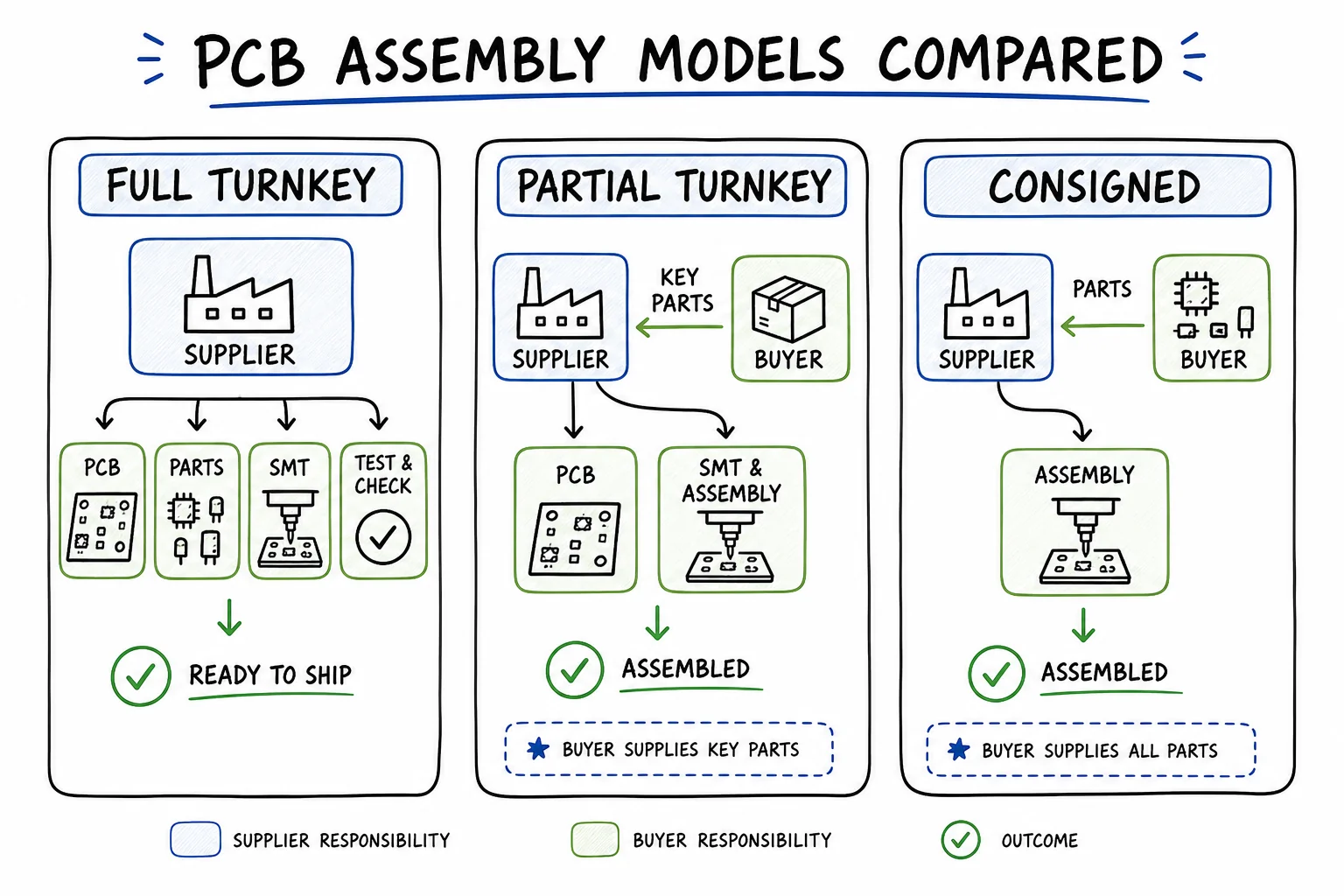 The main difference between full turnkey, partial turnkey, and consigned assembly is who controls component sourcing.
For LED lighting projects, partial turnkey is often worth considering.
For example, a buyer may already have approved LED chips, drivers, or connectors. In that case, the buyer can supply those critical parts while the supplier coordinates the aluminum PCB and assembly workflow.
This model can keep source control where it matters while still reducing the workload of managing every production step.
The bottom line: choose the model based on sourcing responsibility, not only on the word “turnkey.”
Why Turnkey Assembly Can Help LED Aluminum PCB Projects
Turnkey coordination can help LED aluminum PCB projects because several details are connected.
Board specification matters.
LED orientation matters.
Solderability, thermal path, and SMT process also matter.
This is where generic PCBA advice becomes too broad.
An LED aluminum PCB project is not just a bare board plus components. The copper circuit, dielectric layer, aluminum base, surface finish, LED package, solder paste, and reflow process all affect production stability.
In practice, communication gaps can happen when one supplier makes the bare aluminum PCB and another supplier handles assembly.
For example:
- the board drawing may not show LED polarity clearly
- the CPL rotation may not match the assembly drawing
- the surface finish may not match the assembly schedule
- the thermal pad design may need more inspection attention
- the buyer may expect a lighting test that was never included in the quote
Turnkey-style coordination can reduce these gaps when the supplier reviews the file package as one production workflow.
This does not mean every LED aluminum PCB project needs a full EMS package.
For many lighting projects, the useful part is simpler: a defined aluminum PCB fabrication + SMT assembly workflow, with clear confirmation of sourcing, inspection, testing, and delivery boundaries.
If you are still comparing terminology, this overview of LED PCB vs aluminum PCB can help separate the application name from the board structure.
What Files Should Buyers Send for a Turnkey PCB Assembly Quote?
A reliable turnkey PCB assembly quote needs board data, component data, assembly instructions, test requirements, quantity, and schedule details.
If the file package is incomplete, the supplier has to guess. Guessing usually creates back-and-forth, quote exclusions, or risk margins.
| File / information | Why it matters | Buyer note |
|---|---|---|
| Gerber package | Defines copper, solder mask, silkscreen, and outline | Include the latest revision only |
| NC drill file | Defines drilled holes and slots | Check plated and non-plated hole notes |
| ODB++ or IPC-2581 | Gives richer manufacturing data when available | IPC-2581 can carry board and assembly manufacturing data |
| Fabrication notes | Defines board requirements | Include aluminum PCB thickness, copper, surface finish, and tolerance notes |
| BOM | Defines components to source or assemble | Include reference designators, MPNs, descriptions, package, quantity, and alternates |
| CPL / pick-and-place file | Defines XY location, rotation, and side | Make sure LED polarity and rotation are checked |
| Assembly drawing | Shows placement, orientation, labels, and special instructions | Important for LEDs, connectors, and marked components |
| Test requirements | Defines what must be verified | Include fixture, method, voltage/current, and pass/fail criteria if needed |
| Quantity and schedule | Affects pricing, sourcing, and production planning | Separate sample, pilot, and mass production quantities |
| Packaging and shipping needs | Affects final handling and logistics | Confirm ESD packing, labels, carton rules, and shipping term |
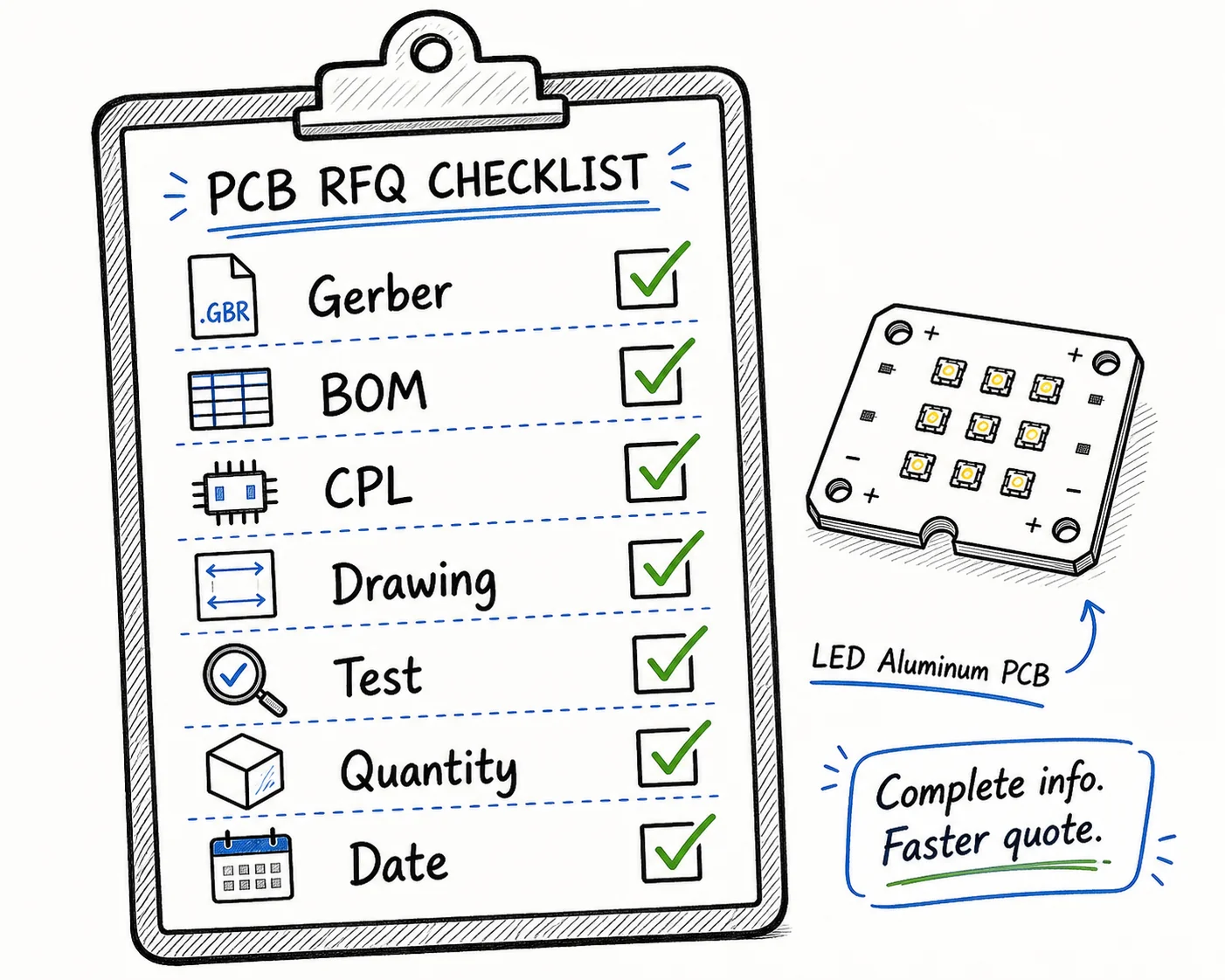 A complete RFQ package helps the supplier quote the real turnkey PCB assembly scope with fewer assumptions.
For LED aluminum PCB projects, also include:
- aluminum PCB thickness
- copper thickness
- surface finish
- LED polarity and orientation notes
- LED power or operating condition if relevant
- lighting or functional test requirements
- target delivery date
The better your file package, the cleaner the RFQ. A supplier can only quote the real scope when the files show the real work.
What Affects Turnkey PCB Assembly Cost?
Turnkey PCB assembly cost is not just SMT labor.
It usually combines bare board production, component sourcing, assembly setup, inspection, testing, packaging, logistics, and lead-time pressure.
| Cost driver | Why it changes the quote | Buyer control |
|---|---|---|
| PCB fabrication specification | Material, size, copper, thickness, surface finish, and panel use affect cost | Confirm board specs before RFQ |
| Component procurement | Part price, MOQ, availability, and lifecycle affect total cost | Provide exact MPNs and approved alternates |
| SMT setup | Stencil, programming, feeder setup, and production preparation add cost | Keep file revisions stable |
| Component count and package mix | More parts and smaller packages increase assembly work | Send clear BOM and CPL files |
| Inspection and testing | AOI, X-ray, ICT, functional, or lighting tests add time and fixtures | Define the required test scope |
| Packaging and logistics | ESD packing, labels, cartons, and shipping method affect final cost | Provide shipping and packing requirements |
| Urgent lead time | Expedited sourcing or production can add premiums | Share realistic schedule needs early |
For LED lighting buyers, board cost can be a major part of the decision.
If you are comparing quotation structure, this article on aluminum PCB cost factors explains how board size, specification, finish, utilization, and production requirements can affect price.
Turnkey assembly does not automatically lower cost. It can reduce coordination work and help avoid duplicated handling, but the final quote still depends on the specification, BOM, tests, packaging, and schedule.
Component Sourcing Risks Buyers Should Confirm
When a supplier sources components, you still need to approve exact parts, substitution rules, and sourcing expectations.
A BOM that says “LED, white, 2835” is not enough for controlled production. The supplier needs the exact manufacturer part number, package, quantity, reference designator, and approved alternates.
Watch out for:
- Generic descriptions — make sure exact MPNs and manufacturers are specified, not just "LED, white, 2835." Wrong brightness, package, or footprint is a common result.
- Unapproved substitutions — define a written approval rule so no part can be silently swapped.
- Long lead-time parts — confirm availability and delivery dates before production starts.
- Obsolete or NRND parts — check lifecycle status to avoid dead ends in sourcing.
- Non-authorized sources — specify source requirements and documentation to reduce counterfeit risk.
- MOQ or price breaks — confirm procurement quantities early, since they directly affect the total turnkey quote.
If you want to control specific LEDs, drivers, connectors, or optical parts directly, that’s fine — it just means the project becomes partial turnkey instead of full turnkey. Define which parts are fixed, which may use approved alternates, and which substitutions need written sign-off.
LED Aluminum PCB Assembly: What Needs Special Attention?
LED aluminum PCB assembly needs extra care because electrical function, LED orientation, soldering quality, and heat transfer are connected.
A mistake in any one of these areas can affect yield or final lighting performance.
| Checkpoint | What can go wrong | Buyer file / instruction needed |
|---|---|---|
| LED polarity | LEDs may be mounted in the wrong direction | Clear polarity marks in silkscreen, CPL, and assembly drawing |
| LED orientation | Rotation mismatch can affect assembly or optical layout | Verified CPL rotation and assembly drawing |
| Thermal path | Heat may not transfer as expected | Board stack, LED thermal pad, dielectric, and housing information |
| Surface finish | Poor solderability can affect yield | Confirm OSP, HASL, or other finish before assembly schedule |
| Solder paste and stencil | Too much or too little paste can affect joints and voiding | Assembly notes for special packages if needed |
| Reflow profile | Metal-core boards can behave differently in heating | Supplier should review stack and component mix |
| AOI inspection | Presence, polarity, and placement defects may be missed without clear rules | Inspection criteria and marked components |
| Functional or lighting test | LED strings may not be verified under the expected condition | Test voltage/current and pass/fail requirement |
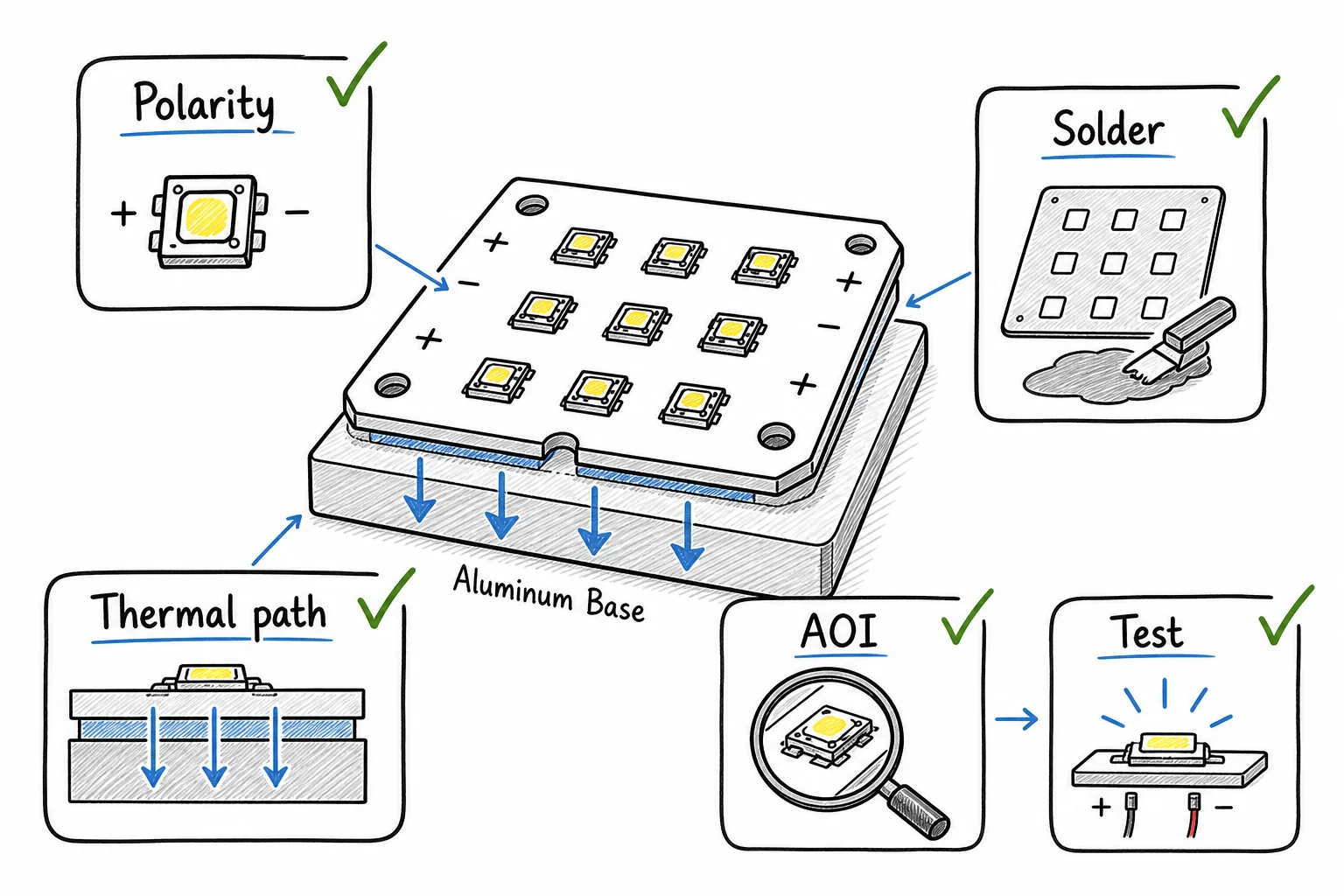 LED aluminum PCB assembly needs clear polarity, controlled soldering, thermal path review, inspection, and test requirements.
An aluminum PCB board guide explains how the copper layer, dielectric layer, and aluminum base work together in LED lighting applications.
LED polarity and orientation should never be left to guesswork.
Before production, make sure your footprint, silkscreen, CPL, assembly drawing, and inspection notes all tell the same story.
When Turnkey PCB Assembly Is a Good Fit
Turnkey PCB assembly is a good fit when you want fewer suppliers and clearer responsibility.
For repeat production, it can make coordination smoother from sample to bulk order.
It is especially useful when the file package is mature enough for review.
Turnkey is a good fit when:
- you want fewer suppliers and one defined workflow for the build
- your BOM and files are stable enough for the supplier to quote and plan with fewer assumptions
- the project moves from sample to repeat order and process consistency matters
- board fabrication and SMT assembly need to be reviewed together (common for LED aluminum PCBs)
- testing and packaging needs are already defined
For LED lighting projects, turnkey-style support can be helpful when you want the aluminum PCB and SMT assembly reviewed together.
It helps keep the board specification, LED orientation, assembly requirements, and production schedule aligned.
When Turnkey May Not Be the Best Fit
Turnkey is not always the right model.
If the buyer must control every component source directly, consigned or partial turnkey assembly may be safer.
Turnkey may also be risky when the quote package is incomplete. If the BOM has no MPNs, the CPL is missing, or test requirements are unclear, the supplier cannot price the real work accurately.
Be careful when:
- customer-approved components cannot be substituted
- critical parts have already been purchased
- long lead-time parts are not available
- testing or packaging expectations are outside the confirmed scope
- the buyer expects box-build services that were not discussed
- the assembly drawing does not show polarity or orientation
The bottom line:
Turnkey works best when responsibility is clear. If responsibility is unclear, the project may look easier at the quotation stage but become harder during production.
How Lumina Can Help With LED Aluminum PCB + SMT Scope Review
Lumina’s confirmed focus is single-sided aluminum PCB / MCPCB production for LED lighting projects.
For projects that need aluminum PCB fabrication plus SMT assembly support, Lumina can review the file package.
Then we can help confirm whether the project fits a defined board + assembly workflow.
The right way to approach this is file-based.
Send the actual production information first:
- Gerber files
- BOM with MPNs and quantities
- CPL / pick-and-place file
- assembly drawing
- aluminum PCB specification
- LED polarity and orientation notes
- test requirements if needed
- sample or production quantity
- target delivery date
Then the scope can be confirmed.
The review should clarify whether component sourcing is included, whether you’re supplying any parts, and what inspection, testing, and packaging are covered — before the quote is finalized.
Lumina should not be treated as an unlimited EMS or box-build supplier unless those services are confirmed for the specific project. The safer and more useful promise is narrower: review whether the project fits an LED aluminum PCB fabrication + SMT assembly workflow, then quote the confirmed scope.
Conclusion
Turnkey PCB assembly can reduce coordination work, but only when the RFQ defines the real scope.
For your LED aluminum PCB project, the most important checks are component responsibility, quote files, board specification, LED polarity, assembly requirements, inspection, testing, packaging, and lead time.
The best turnkey quote is not the one with the broadest promise.
It is the one where both buyer and supplier understand exactly what is included.
If you are preparing an LED aluminum PCB project, send your Gerber files, BOM, CPL / pick-and-place file, assembly drawing, quantity, LED polarity/orientation notes, testing needs, and delivery target. Lumina can review whether your project fits a defined LED aluminum PCB fabrication + SMT assembly workflow before quotation.
Need a quotation?
Send Gerber files and basic specifications. We reply within 1 business day.
Ask for Quote