Single Layer PCB Board: Specs to Confirm for LED Aluminum PCBs

On This Page (Table of Contents)
A single layer PCB board has one conductive copper layer.
For LED lighting orders, this usually means a single-sided aluminum PCB or MCPCB, not a complex multilayer board.
The important part is not the name. Confirm the stackup, copper thickness, dielectric thermal conductivity, surface finish, panel utilization, and assembly scope before quotation.
What Is a Single Layer PCB Board?
A single layer PCB board uses one conductive copper layer to form the circuit pattern.
That usually means the design is routed on one side of the board. In supplier pages and quote discussions, you may also see it called a single sided PCB or a single layer printed circuit board.
The idea is simple:
- one conductive copper layer
- one main routing side
- lower routing complexity
- simpler fabrication compared with double-layer or multilayer boards
This type of board is often used for simple circuits, LED modules, basic power boards, consumer electronics, and prototypes.
Here is the practical point:
A single layer PCB is not chosen because it is always better. It is chosen when the circuit does not need extra routing layers.
If the layout is simple, one layer can keep the board easy to manufacture and easier to control in cost-sensitive production.
If the layout is crowded, one layer can become a problem very quickly.
Single Layer PCB vs Single Sided PCB: What Should Buyers Confirm?
In most buying conversations, single layer PCB and single sided PCB are used almost interchangeably.
But buyers should not rely only on the label.
The first term describes the copper layer count. The second describes where the circuit pattern sits. In many RFQs, both are simply pointing to a low-complexity board routed on one side.
Still, different suppliers may use the wording slightly differently.
Before RFQ, confirm these items:
- Is there only one copper layer?
- Which side carries the circuit pattern?
- Which side has components?
- Are plated-through holes required?
- Are jumpers allowed?
- Are there backside markings or assembly exceptions?
The fabrication drawing is more reliable than the wording alone.
If the drawing clearly states material, layer count, copper thickness, surface finish, and assembly side, the supplier can quote with fewer assumptions.
What Stackup Should an LED Aluminum PCB Quote Show?
An LED aluminum PCB quote should show more than the layer count.
It should make the stackup clear: copper circuit layer, thermally conductive dielectric, and aluminum base.
A typical single-layer FR-4 board also has one copper layer, but it uses an FR-4 insulating substrate. That is useful context for the keyword, but it is usually not the main buying question for LED aluminum PCB orders.
A single-sided aluminum PCB, also called an MCPCB or IMS board in many technical contexts, uses a metal base, a thermally conductive dielectric layer, and a copper circuit layer.
Sources such as NCAB's IMS overview describe IMS boards as a metal-base PCB structure where the insulation layer must provide electrical isolation and thermal transfer. Cree's LED thermal guidance also treats the PCB as part of the LED thermal path, not just a wiring carrier (Cree LED thermal management PDF).
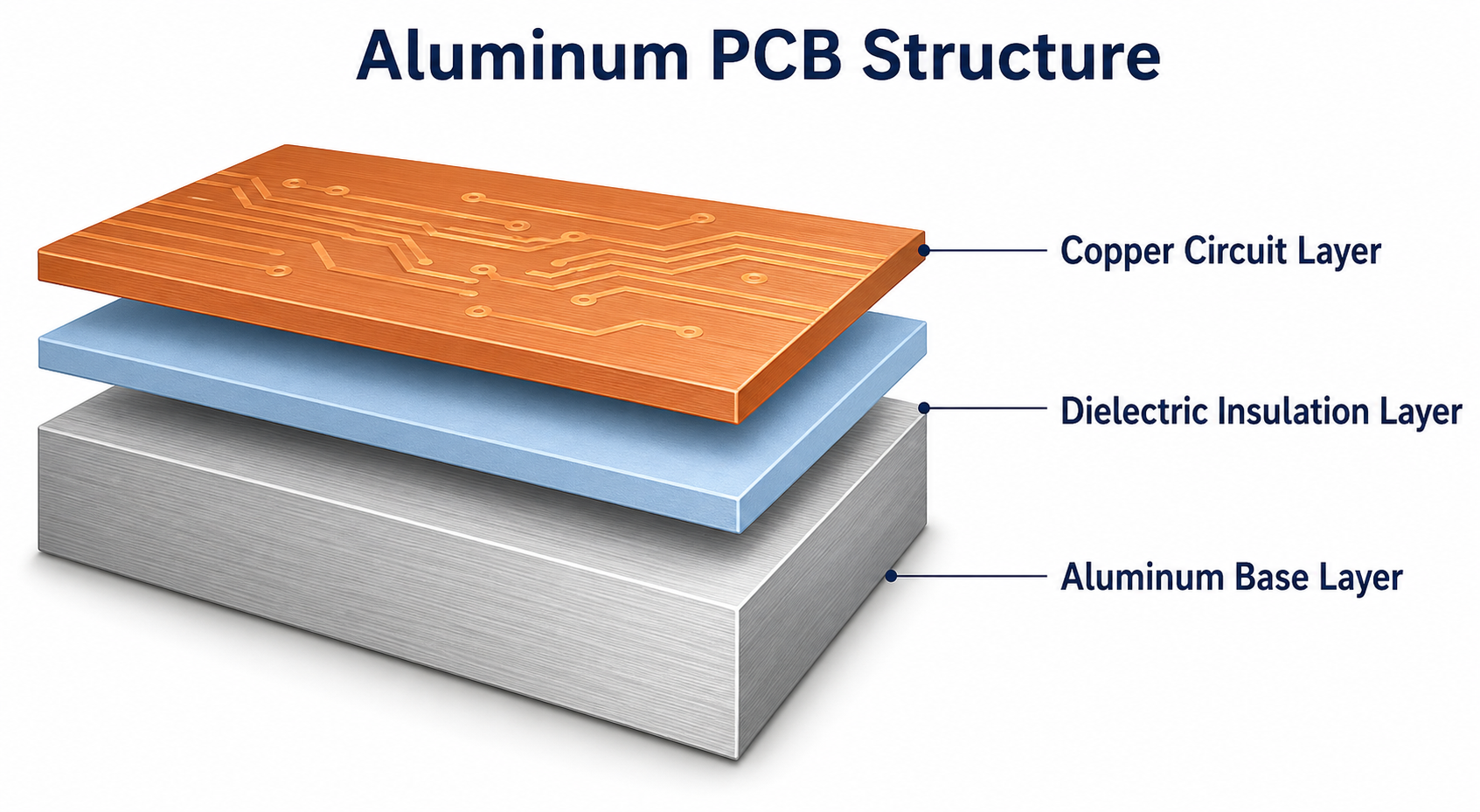 A typical single-sided aluminum PCB stackup includes a copper circuit layer, dielectric insulation layer, and aluminum base layer.
For LED lighting, the practical point is the aluminum PCB stackup, not FR-4. A single-layer FR-4 board uses FR-4 as the insulating substrate — fine for simple circuits, but it gives you no meaningful thermal path for LEDs. A single-sided aluminum PCB puts a thermally conductive dielectric between the copper and the aluminum base, which is why it dominates LED production. Double-layer PCBs come into play only when the routing is too crowded for one layer.
Confirm the structure instead of only saying "single layer PCB."
For buyers, the key details are:
- base material
- copper thickness
- dielectric thermal conductivity
- dielectric thickness
- aluminum thickness
- solder mask
- surface finish
For standard LED aluminum PCB projects, Lumina often treats practical specifications as more important than chasing the highest possible material rating. For example, a cost-sensitive LED board may use a standard copper and dielectric baseline if it fits the drawing, power level, and production target.
If you are comparing structures for an LED board, see LED aluminum PCB fabrication as the more relevant service path.
Why Single-Sided Aluminum PCBs Are Common in LED Lighting
Single-sided aluminum PCBs are common in LED lighting because the PCB is part of the heat path.
It is not only a carrier for traces.
LEDs convert part of their input power into heat. If that heat is not managed, LED output, color stability, voltage behavior, and lifetime can be affected. This is why LED thermal design documents, including the U.S. DOE LED thermal management guide, focus heavily on junction temperature and heat flow.
In a single-sided aluminum PCB, the heat path is usually:
- LED package
- copper circuit layer
- thermally conductive dielectric
- aluminum base
- luminaire body or heat sink
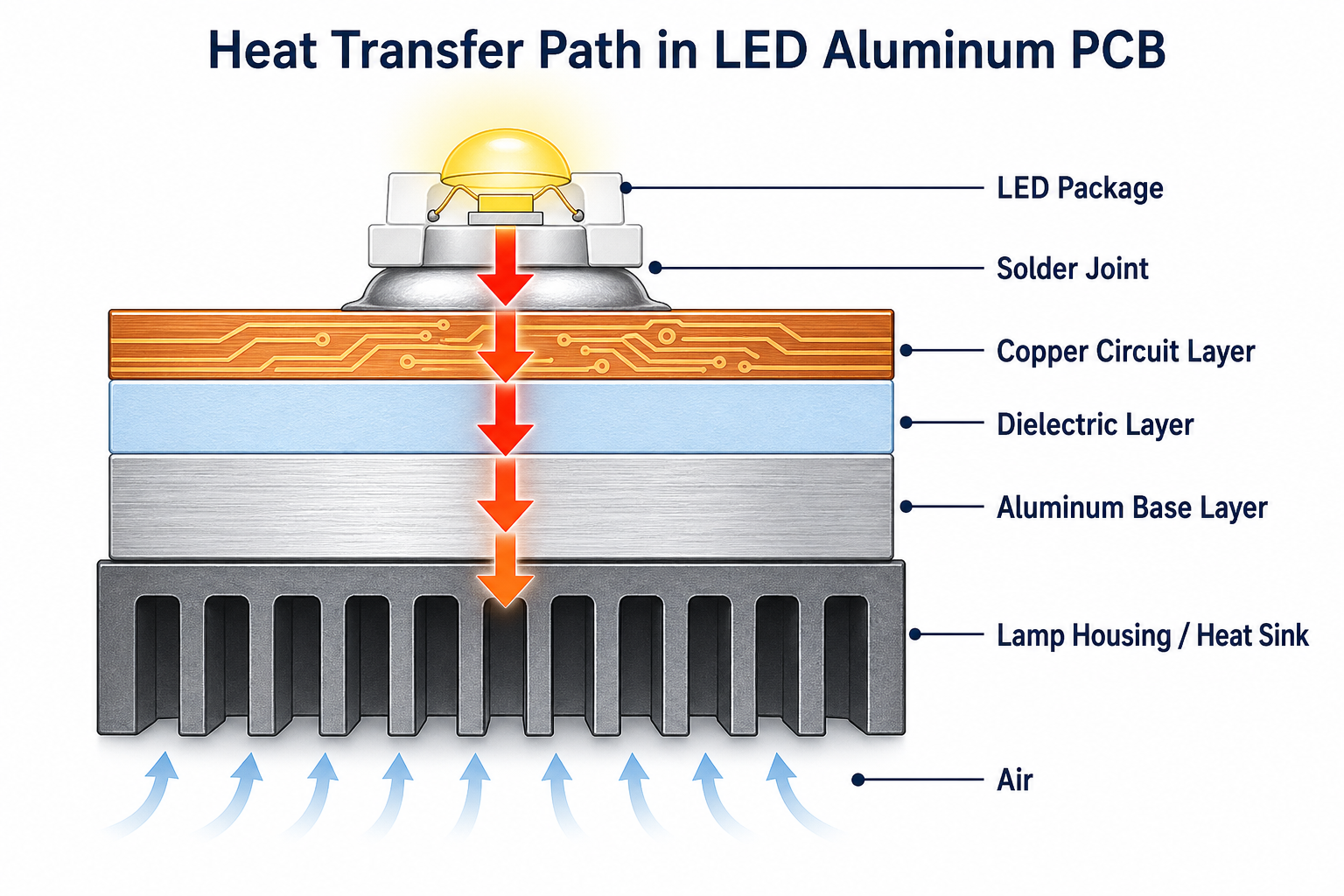 In an LED aluminum PCB, heat moves from the LED package through the copper, dielectric, aluminum base, and fixture body.
Each layer has a job.
The copper layer routes current and helps spread heat from the LED footprint.
The dielectric layer electrically insulates the copper from the aluminum base while passing heat downward.
The aluminum base spreads heat into the fixture structure.
What does this mean for buyers?
If your LED board has a simple circuit but meaningful heat output, a single-sided aluminum PCB is often the normal starting point. You may not need a more complex PCB structure if the thermal path, board size, copper, dielectric, and fixture design are suitable.
But this should be confirmed from the drawing and application.
Which Specs Should Buyers Confirm Before Ordering?
Confirm the specs that change heat performance, cost, soldering, and production stability.
This is the most useful part of the article for real LED aluminum PCB orders.
| Spec to Confirm | Why It Matters | Buyer Note |
|---|---|---|
| Copper thickness | Affects current capacity and cost | Match it with the circuit load |
| Dielectric thermal conductivity | Affects heat transfer from copper to aluminum | Do not over-spec without need |
| Dielectric thickness | Affects thermal resistance and insulation | Confirm based on application |
| Aluminum thickness | Affects structure and heat spreading | Match the lamp housing and design |
| Surface finish | Affects soldering, storage, and cost | OSP and HASL may have different cost logic |
| Panel utilization | Affects unit cost | Poor utilization may need extra charge |
| Silkscreen / black legend | Adds process requirements | Confirm if black legend is required |
| SMT assembly scope | Changes quote package | Send BOM and pick-and-place if needed |
For many LED lighting projects, the single-sided aluminum PCB decision depends on three things:
- Can the circuit route cleanly on one side?
- Do the thermal specs match the LED power and fixture?
- Can the design be produced consistently in quantity?
In practice, a simple LED module, lamp board, or light engine often works well as a single-sided aluminum PCB.
The advantage is not only lower cost.
A simpler board can also reduce layout ambiguity, simplify inspection, and support repeat production.
From a factory point of view, simple repeat LED boards are usually easier to stabilize when the stackup and quote assumptions are clear from the beginning.
When Should Buyers Move to Double-Layer or Multilayer PCB?
Consider double-layer or multilayer PCB when one copper layer creates routing, size, power, signal, or reliability problems.
Cost should not be the only reason to stay with one layer.
Single layer boards become restrictive when traces cannot cross cleanly. Designers may need larger board area, jumpers, or awkward routing paths.
That can create hidden production problems.
Technical design guides often point to routing density, power distribution, signal integrity, EMI, and reliability as reasons to use more layers. For example, IPC-2221 is a general printed board design standard that covers design considerations beyond simple layer count.
| Constraint | Why Single Layer Struggles | What Another Layer Helps Solve |
|---|---|---|
| Crowded routing | Traces cannot cross freely | More routing channels |
| Fine-pitch parts | Escape routing becomes difficult | Cleaner fanout and placement |
| Board size limit | One-sided routing may need more area | More compact layout |
| Power distribution | No solid plane structure | Better power and ground routing |
| EMI or signal concerns | Return paths may be less controlled | Better reference and routing options |
| Production workarounds | Jumpers can add process risk | Cleaner manufacturing flow |
For LED aluminum PCB buyers, this does not mean every project should move to double-layer.
It means one layer should be used when it is genuinely clean and stable.
If the design needs too many workarounds, a double-layer board may cost more on paper but reduce risk in production.
A simple way to think about it:
Use one layer when it keeps the design simple. Do not use one layer when it makes the design messy.
What Affects Single Layer PCB Board Cost?
Single layer PCB board cost changes with board area, panel utilization, material, copper thickness, finish, quantity, lead time, testing, and assembly scope.
For aluminum PCB, the dielectric and metal stackup also matter.
A single layer board is usually simpler than a double-layer or multilayer board. But that does not mean every single layer quote is the same.
The main cost drivers are still real manufacturing inputs.
| Cost Factor | Why It Affects Quote | Buyer Action |
|---|---|---|
| Board size | Larger area uses more material and panel space | Provide exact dimensions |
| Panel utilization | Poor nesting can raise unit cost | Share panel or array requirements if known |
| Copper thickness | Heavier copper uses more material and processing effort | Match copper to current needs |
| Base material | FR-4 and aluminum PCB have different material structures | Confirm material before quote |
| Dielectric requirement | Aluminum PCB thermal dielectric affects performance and cost | Specify thermal needs if known |
| Surface finish | OSP, HASL, ENIG, and other finishes use different processes | Choose based on soldering and storage needs |
| Quantity | Setup cost spreads across more units | Share sample, pilot, and mass order quantities |
| Lead time | Urgent orders may affect scheduling | Confirm delivery expectations early |
| SMT assembly | BOM, placement, soldering, and inspection add scope | Send assembly files if needed |
For Lumina's standard cost-sensitive LED aluminum PCB projects, the quotation baseline often starts from practical production assumptions, such as standard copper, standard thermal conductivity, OSP finish, and reasonable panel utilization.
But the final quote still depends on the drawing.
For example, extra black silkscreen, lead-free HASL, low panel utilization, urgent delivery, or assembly scope can change the price.
This is why fixed public pricing can be misleading.
The better approach is to send a complete quote package and let the factory review the actual board.
For a deeper cost discussion, see aluminum PCB cost factors.
What Should Buyers Send Before RFQ?
For a useful RFQ, send the manufacturing definition, not only a schematic.
The quote package should tell the factory what to build, how to build it, and whether assembly or testing is included.
According to common fabrication and assembly file requirements, buyers should prepare Gerber files, drill data, board outline, fabrication drawings, material requirements, and assembly files when needed. PCBWay's assembly file requirements also show how BOM and pick-and-place data help define assembly scope (PCBWay assembly file requirements).
Here is a practical checklist.
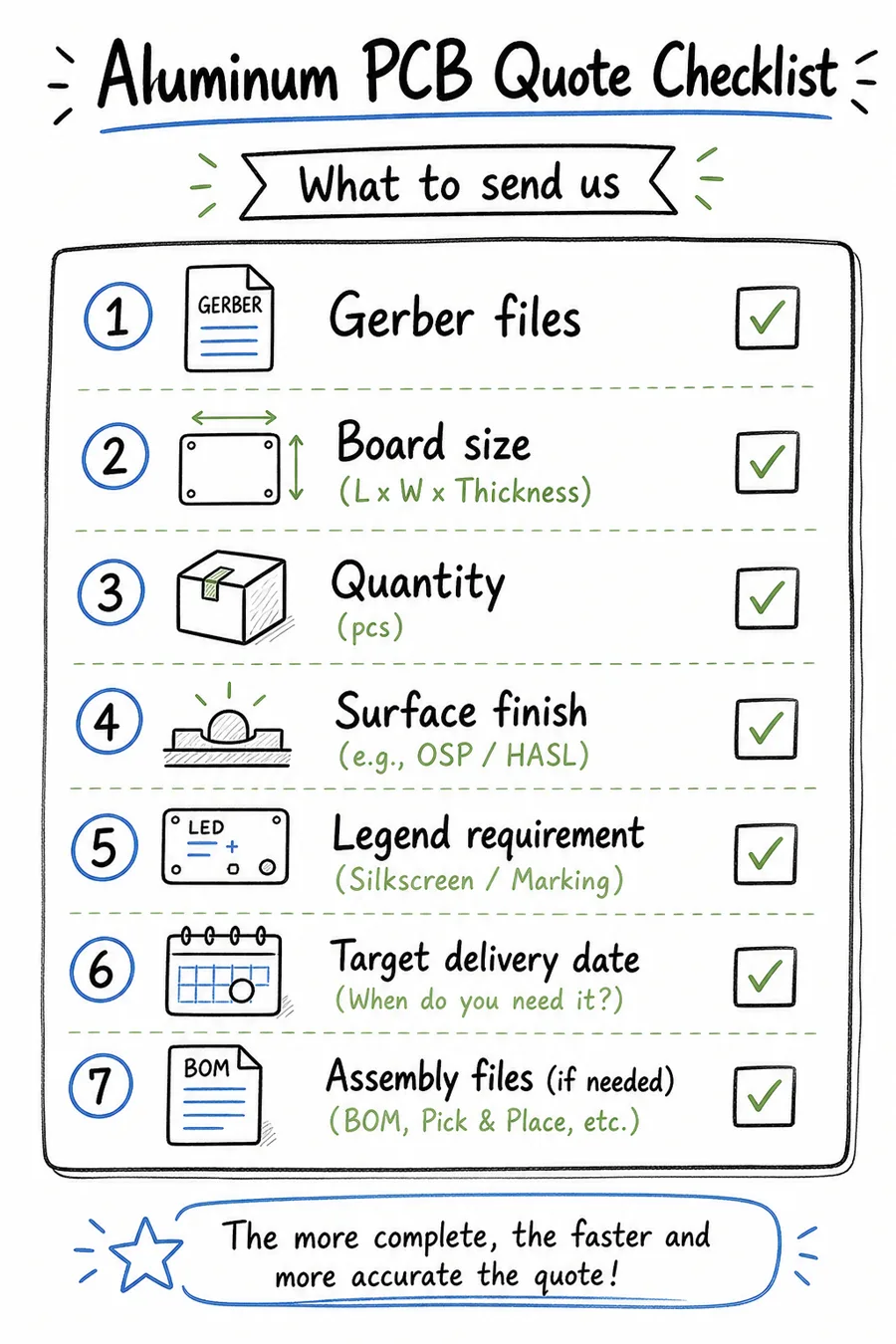 A complete RFQ package helps the factory review the board structure, quantity, finish, schedule, and assembly scope before quotation.
| File or Specification | Bare Board Quote | Assembly Quote | Buyer Note |
|---|---|---|---|
| Gerber files | Yes | Yes | Defines copper, solder mask, silkscreen, and board layers |
| NC drill file | Yes | Yes | Defines holes and drilling data |
| Board outline | Yes | Yes | Needed for size and routing |
| Fabrication drawing | Yes | Yes | Add thickness, copper, finish, slots, tolerances |
| Stackup / material notes | Yes | Yes | Critical for aluminum PCB / MCPCB |
| Quantity | Yes | Yes | Separate sample, pilot, and mass production quantities |
| Lead time | Yes | Yes | Helps schedule production realistically |
| BOM | No | Yes | Needed for component sourcing or assembly |
| Pick-and-place file | No | Yes | Defines XY position, rotation, and side |
| Assembly drawing | No | Yes | Helps confirm polarity, orientation, and process notes |
| Testing requirements | If needed | If needed | Electrical test, AOI, functional test, or other checks |
For aluminum PCB / LED projects, add these details when possible:
- aluminum base thickness
- dielectric thermal conductivity
- dielectric thickness
- copper thickness
- LED power or application
- surface finish
- solder mask and silkscreen requirements
If you need assembled LED boards, connect the RFQ with SMT assembly for LED aluminum PCB.
And if your project includes PCB fabrication, component sourcing, and assembly, it may overlap with turnkey PCB assembly quote preparation.
The bottom line: better files create better quotes.
Before You Request a Quote
Before requesting a quote, do not only say "single layer PCB board."
That phrase is useful for search and early discussion, but it is not enough for a factory quote.
For LED aluminum PCB orders, the factory needs to understand the actual structure, material, finish, quantity, and assembly scope.
Before quotation, confirm:
- base material
- stackup
- copper thickness
- dielectric requirement
- surface finish
- routing limits
- assembly scope
- quantity and lead time
These details help the supplier check whether the board fits standard single-sided aluminum PCB production, or whether the drawing needs a different structure.
If routing is crowded, heat requirements are unclear, or quote assumptions differ between suppliers, ask for a file review before production.
Need a single-sided aluminum PCB for LED lighting?
Send your Gerber files, fabrication drawing, quantity, and SMT assembly requirements. Lumina can review the stackup and help confirm the practical specs before quotation.
Need a quotation?
Send Gerber files and basic specifications. We reply within 1 business day.
Ask for Quote