LED PCB Dielectric Thickness: 3 Steps to Choose

On This Page (Table of Contents)
Choose dielectric thickness in this order: voltage first, heat second, cost third.
For most standard LED aluminum PCBs, 75–100 μm is the practical range.
High-power or high-voltage boards may need a different stackup. But that starts with checking voltage—not picking the thinnest option for heat transfer.
What Is Dielectric Thickness in an Aluminum PCB?
Dielectric thickness is the thickness of the insulating layer sandwiched between the copper circuit and the aluminum base.
That layer has two jobs at the same time:
- Transfer heat from the LED circuit into the aluminum base
- Provide electrical insulation between copper and aluminum
A thinner dielectric helps heat move faster. A thicker one gives you more insulation margin.
That is the core tradeoff—and why the right answer is always a balance.
The real question is not "Which thickness is best?" It is:
Which dielectric thickness clears the insulation requirement, while keeping heat transfer, cost, and production stable?
Why Does Dielectric Thickness Matter for LED Lighting?
LEDs are sensitive to heat. If heat cannot leave the LED efficiently, junction temperature climbs.
That leads to lower light output, color shift, and shorter service life.
The dielectric layer sits right in the middle of that heat path. A thicker layer adds thermal resistance. A thinner layer reduces resistance, but may compromise insulation margin for higher-voltage designs.
So the sequence matters:
- Check voltage first
- Then check thermal need
- Then look at cost and material availability
What Is a Common Dielectric Thickness for LED Aluminum PCBs?
For most standard LED lighting, 75–100 μm is widely used.
This range works because it balances:
- Insulation safety
- Thermal performance
- Material availability
- Production stability
- Cost control
It is especially practical for mainstream LED products running at standard voltage and moderate power.
But it is not a universal answer. Some designs need thinner. Some need thicker. The right call depends on your actual voltage, LED power, lamp structure, and production target.
Does Thinner Dielectric Always Mean Better Heat Dissipation?
In general, yes—thinner dielectric reduces thermal resistance.
But the thinnest option is not always the right choice.
Going very thin can improve heat transfer while also raising material cost, reducing insulation margin, or requiring special procurement. For low-voltage LED modules or high-power designs, thin dielectric may make sense. For standard LED lighting projects, it usually does not buy you much.
Use the thinnest dielectric that still clears your insulation, reliability, and production requirements. Do not choose thin just because a datasheet makes it look attractive.
Does Thicker Dielectric Mean Better Safety?
A thicker dielectric does provide a higher breakdown voltage, which improves your insulation margin.
But thicker is not automatically better.
If your working voltage is already covered by a standard thickness, going thicker only adds thermal resistance and cost. A standard LED downlight rarely needs a very thick dielectric. A high-voltage industrial lighting design might.
Match dielectric thickness to your actual voltage class—not the thickest option by default.
How to Choose Dielectric Thickness: A Practical 3-Step Method
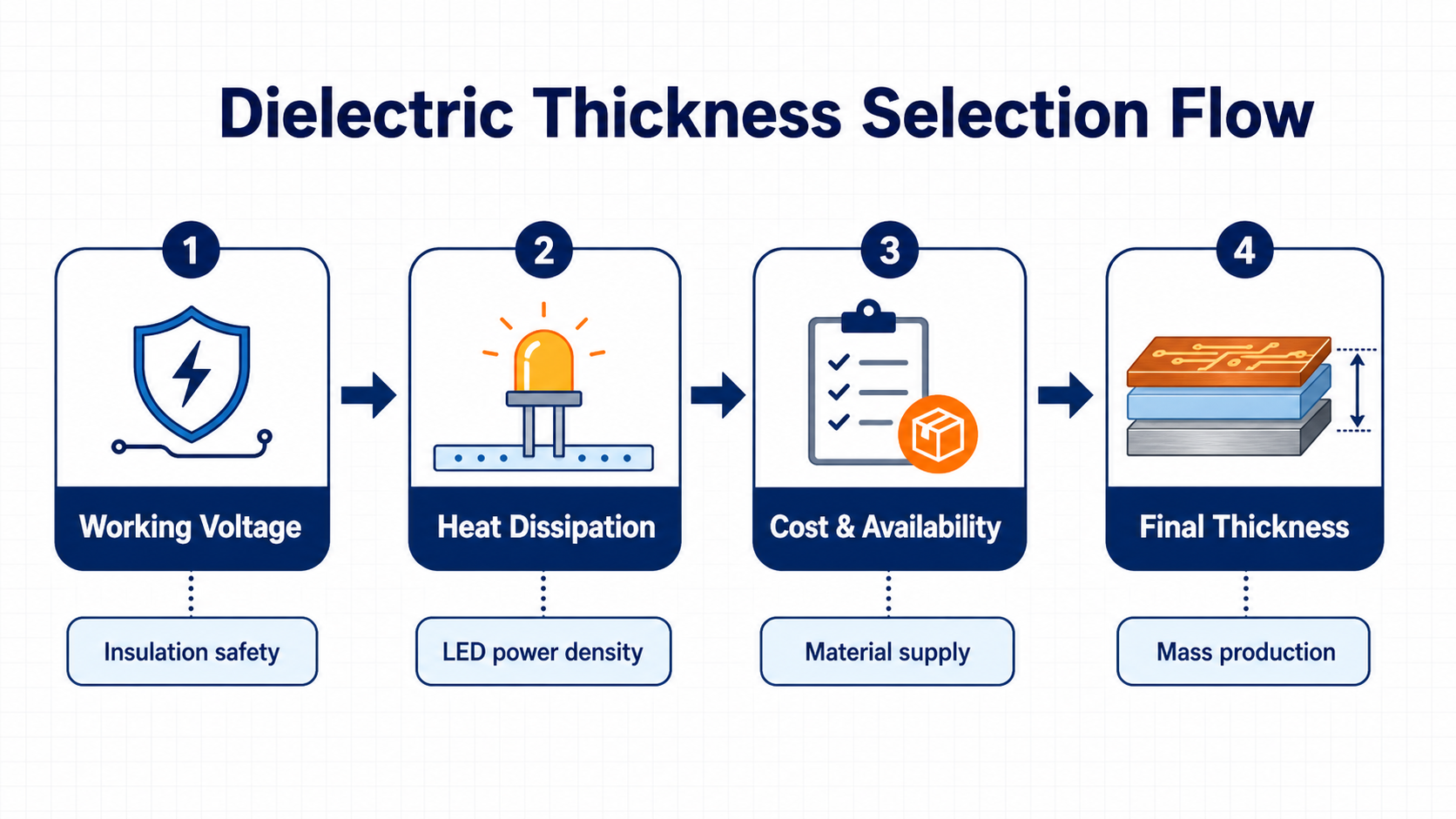
Use voltage, thermal needs, and cost to narrow down the practical dielectric thickness range.
Step 1: Check the Working Voltage First
Working voltage sets the minimum insulation requirement. This is where you start.
If the dielectric is too thin for your voltage class, the board will fail insulation or Hi-Pot tests.
For low-voltage LED products, thinner dielectric is often acceptable. For 120–230V AC lighting, 75–100 μm is commonly used. For higher-voltage or reinforced-insulation designs, you may need to go thicker.
| Working Voltage Situation | Practical Direction | What to Confirm |
|---|---|---|
| Low-voltage LED module | Thinner dielectric may be possible | Check insulation requirement and LED power |
| Standard AC LED lighting | 75–100 μm is often practical | Confirm safety margin and production test needs |
| Higher-voltage lighting | Thicker dielectric may be needed | Confirm voltage class and insulation standard |
| Unclear requirement | Do not guess | Send voltage, power, and application details to the factory |
Voltage sets the safety floor. Thermal design comes after that.
Step 2: Check the Heat Dissipation Need
After voltage, look at LED power and heat density.
A low-power board may not need thin dielectric at all. A high-power board may benefit from it—either through a thinner layer or a higher-conductivity material.
For most standard LED lighting, a 75–100 μm dielectric with suitable thermal conductivity is enough. But if LED power is high, the layout is dense, or the fixture has poor heat dissipation, the choice becomes more critical.
In that case, don't just ask for "an aluminum PCB." Provide LED power, board size, lamp structure, and expected working conditions. That gives the factory what it needs to recommend the right material.
To see how dielectric thickness and thermal conductivity interact with your real board layout, test your strip or board dimensions with our free LED Junction Temperature & MCPCB Thermal Calculator.
Step 3: Check Cost and Production Availability
Once voltage and heat requirements are clear, cost becomes the final filter.
Standard dielectric thicknesses are easier to source and deliver more consistent production performance. Special thin or thick materials often cost more and add lead time.
For bulk LED lighting orders, this matters. A material that looks ideal on paper may not be the best choice for repeat production. A practical standard dielectric is often better than a high-spec option that adds cost without a real performance gain.
This is why most LED lighting projects stay in the 75–100 μm range—not because it is always the highest-performance option, but because it is the most stable one.
Practical Comparison: Thin, Standard, and Thick Dielectric
| Dielectric Choice | Practical Benefit | Possible Risk | Best Fit |
|---|---|---|---|
| Thin dielectric | Better heat transfer | Less insulation margin; may cost more | Low-voltage or high-power LED designs |
| Standard 75–100 μm | Balanced performance, cost, and availability | Not ideal for every extreme design | Most standard LED lighting projects |
| Thick dielectric | More insulation margin | Higher thermal resistance and cost | Higher-voltage or special safety designs |
| Higher-conductivity material | Improves heat transfer without only reducing thickness | Higher material cost | Higher-power LED products |
Do not compare thickness alone. Compare thickness, thermal conductivity, insulation requirement, and cost together.
Common Mistakes When Choosing Dielectric Thickness
Mistake 1: Choosing the Thickest Dielectric "Just to Be Safe"
Thicker dielectric can improve insulation margin. But it also increases thermal resistance.
If your project does not need extra insulation margin, going thicker only adds cost and reduces heat transfer. For standard LED lighting, "safer" does not mean "thicker." It means meeting the required insulation level with a stable, practical material.
Mistake 2: Choosing the Thinnest Dielectric for Heat Dissipation
Thinner dielectric helps heat transfer—but it must still meet your electrical insulation requirements.
If the board is used in a higher-voltage LED product, the thinnest option may not be safe. This is exactly why you check voltage before optimizing thermal performance.
Mistake 3: Only Looking at Thermal Conductivity
Thermal conductivity matters, but it is not the whole picture.
A high-conductivity dielectric can still underperform if it is too thick for the design target. A lower-conductivity material may be perfectly fine if the thickness, LED power, and lamp structure all align.
Compare the full stack:
- Dielectric thickness
- Dielectric thermal conductivity
- Copper thickness
- Board thickness
- Lamp housing heat dissipation
- LED power density
Mistake 4: Copying a High-End Spec for a Standard LED Product
Many online specs are written for demanding or high-performance designs.
That does not mean every LED lighting product needs those specs. For cost-sensitive production, over-specifying material raises cost without improving the product in any meaningful way. A practical spec beats an impressive-sounding one—especially for repeat orders.
What to Provide Before Requesting a Quote
If you already know the dielectric thickness, include it in your RFQ.
If you are not sure, provide the application details instead. A supplier can recommend a more practical option when the basic information is clear.
For an accurate quote, provide:
- Board drawing or sample
- Board size and total thickness
- Copper thickness
- Dielectric thickness (if already specified)
- Thermal conductivity requirement (if any)
- Working voltage
- LED power or power density
- Surface finish
- Quantity
- Application type (downlight, panel light, street light, flood light, etc.)
Here is a simple RFQ example:
Application: 20W LED downlight
Working voltage: 230V AC
Board thickness: 1.0 mm or 1.5 mm
Copper thickness: 12 μm or 25 μm
Dielectric thickness: please recommend standard option
Surface finish: OSP or HASL
Quantity: 5,000 pcs
Drawing: attached
More information leads to a more useful quote—and fewer back-and-forth emails.
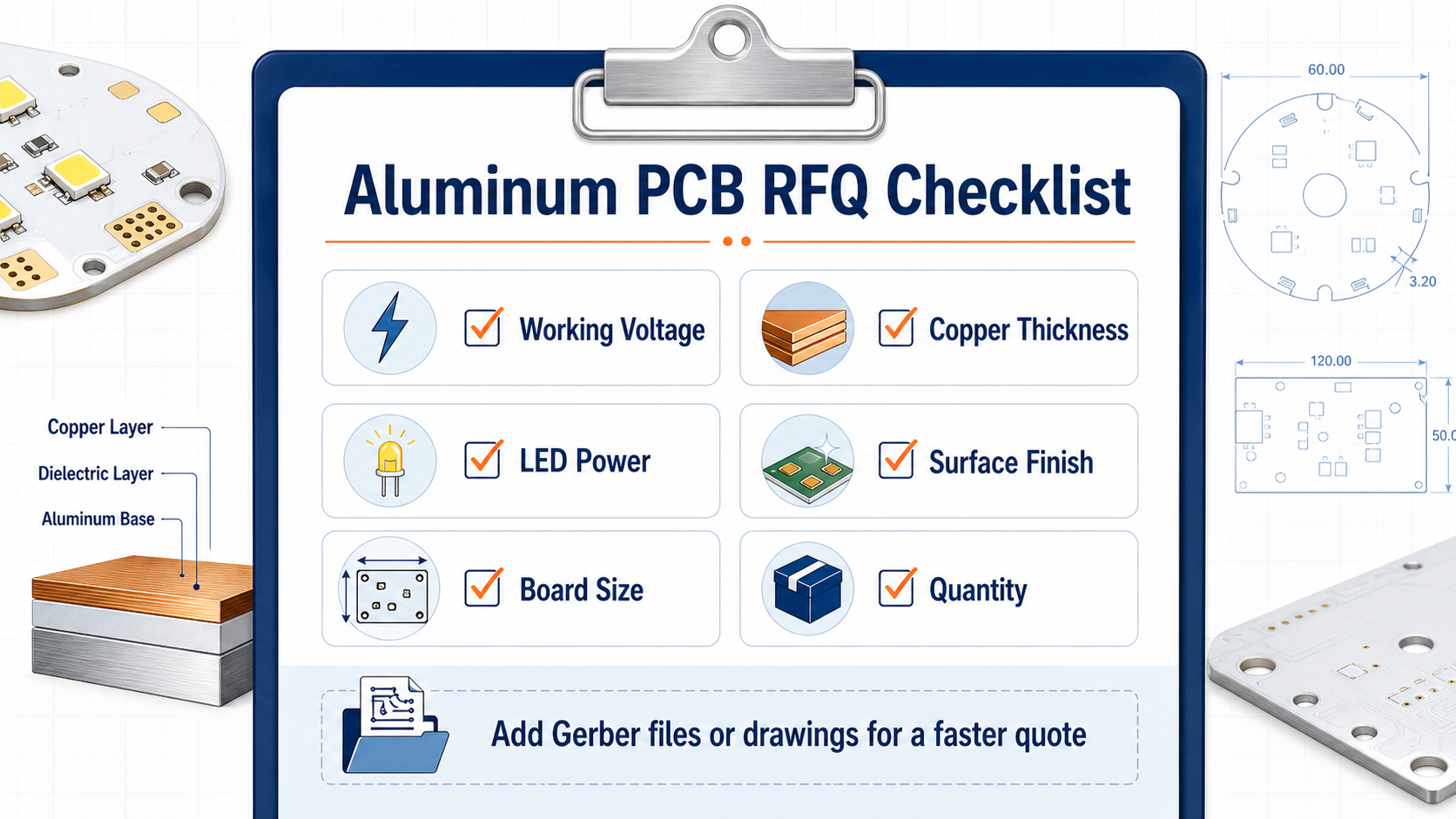
Providing voltage, power, board size, copper thickness, and quantity helps suppliers recommend a practical dielectric thickness.
When Is a Standard Dielectric Thickness Enough?
A standard thickness is often enough for common LED lighting products, including:
- Downlights
- Panel lights
- Ceiling lights
- Strip light modules
- Basic commercial lighting boards
For these projects, the goal is stable production and reasonable cost. The board must meet electrical and thermal requirements—but it does not need special high-end material to get there.
The better choice is always the one that fits the product, not the one that looks strongest on paper.
FAQ
What is the standard dielectric thickness for LED aluminum PCBs?
For most standard LED lighting projects, 75–100 μm is a common and practical range. It balances insulation safety, heat transfer, material availability, and cost.
Is thinner dielectric better for LED heat dissipation?
Usually, thinner dielectric reduces thermal resistance. But it still needs to meet the required insulation level and production requirements—so it is not always the right choice.
Is thicker dielectric safer?
A thicker dielectric usually provides more insulation margin. But if your working voltage is already covered by a standard thickness, going thicker only adds thermal resistance and cost.
Does dielectric thickness affect PCB price?
Yes. Standard dielectric thicknesses are more cost-effective because materials are easier to source and production is more stable. Special thin or thick materials increase cost and lead time.
How do I know which dielectric thickness my LED board needs?
Start with your working voltage. Then check LED power and heat dissipation needs. Finally, factor in cost, quantity, and material availability. If you are not sure, send your drawing, voltage, LED power, and target quantity to the factory for a practical recommendation.
Should I specify dielectric thickness in the RFQ?
If you already know the requirement, yes. If you are not sure, provide the application details instead—working voltage, LED power, board size, copper thickness, surface finish, and quantity are usually enough for the supplier to recommend a standard option.
Conclusion
Dielectric thickness for LED aluminum PCBs is always a balance between insulation, heat transfer, cost, and production stability.
For most standard LED lighting, 75–100 μm is a practical starting point.
But the final choice should reflect your working voltage, LED power, lamp structure, and production target. Do not go thinnest just for heat dissipation. Do not go thickest just to feel safe.
Choose the thickness that clears insulation requirements first—then keeps thermal performance, cost, and supply chain stable.
If you are planning an LED lighting project, send us your drawing, working voltage, LED power, board size, copper thickness, surface finish, and target quantity. We can help confirm a practical dielectric thickness before mass production.
Need a quotation?
Send Gerber files and basic specifications. We reply within 1 business day.
Ask for Quote