BOM Sourcing for LED PCB Assembly: Who Buys the Parts

On This Page (Table of Contents)
Here’s the simple version. BOM sourcing for LED PCB assembly is who buys each line. It is not a hunt for a cheaper 2835.
People throw around full turnkey, partial turnkey, and consigned/kitted like those words settle it. They don’t. They are commercial labels. They are not IPC classes.
You also don’t have to consign every LED. In our LED aluminum board work, we often buy the LEDs. You give us the model, wattage, and lumen — plus CRI and whatever else the lamp actually needs. We make a sample. You confirm it. Then we run bulk against that spec.
Resistors, capacitors, and connectors are the easy part. Those we can usually buy.
What you cannot skip is writing the split into the RFQ. Leave it vague and you already know the ending: the next lot looks different, someone buys an “equivalent” LED, or SMT stops while both sides argue who was supposed to buy the part.
What Goes Wrong When LED BOM Sourcing Is Vague
It usually fails in three ways:
- The wrong LED identity is purchased
- An unapproved substitute arrives
- A shortage stops the line
Look at this BOM line: “2835 LED, 4000 K, or equivalent.”
It looks finished. It is not a part you can buy. A factory can still pick almost any 2835 in a wide 4000 K window.
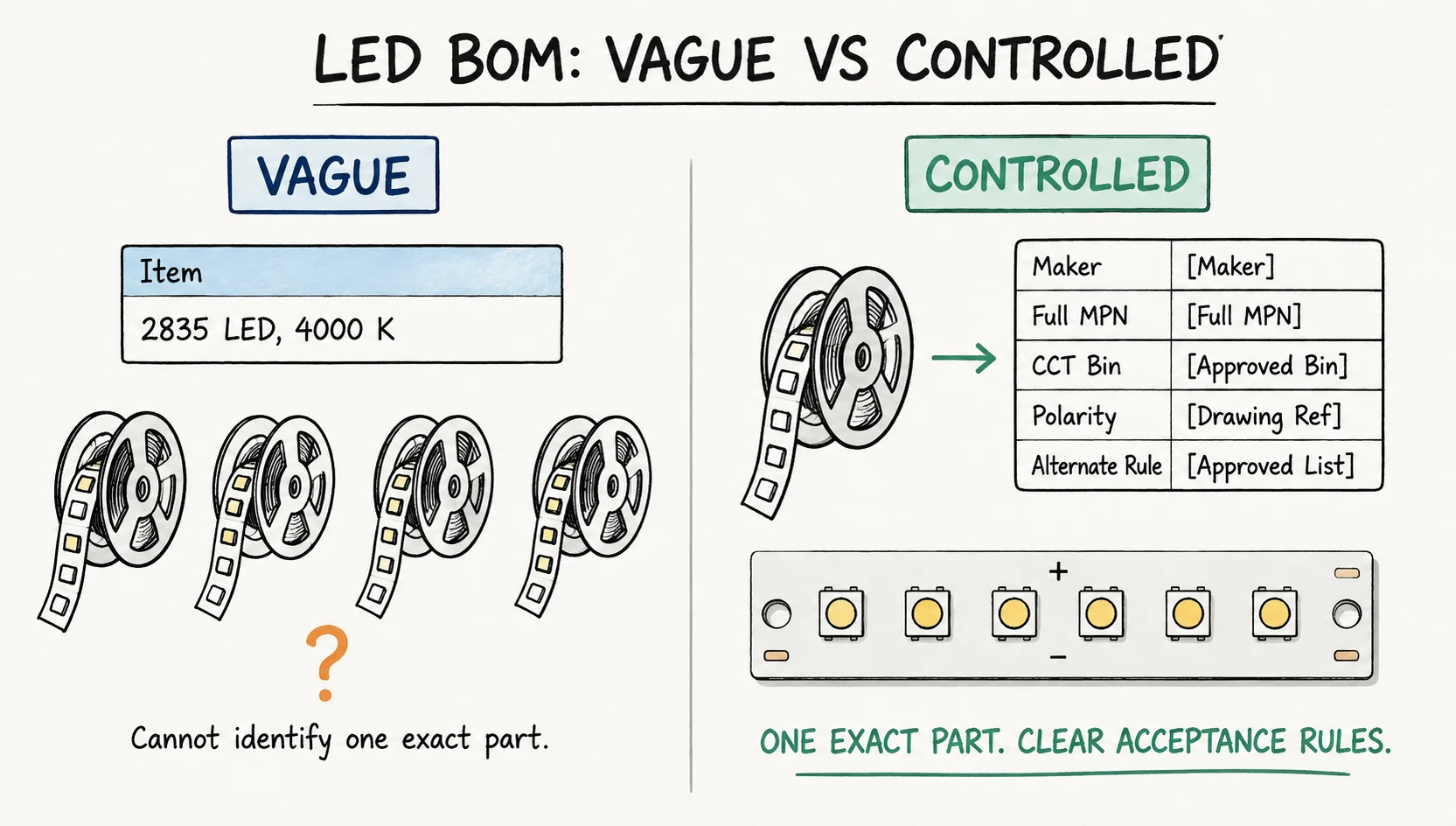 A package and 4000 K do not identify one purchasable LED.
That’s why LED binning exists. Production varies around the datasheet average. Lumileds DS307 bins luminous flux, color, and forward voltage as separate codes. A family name does not lock those codes.
And this does not stay in purchasing. Mixed bins change color and brightness on the lamp. Swap a driver without review, and the board can behave differently. Cheap out on the board stack-up, and the heat path changes. The reel label can still be “right” while the fixture looks off.
Kit problems belong here too. Opened moisture bags, missing reel labels, leftover reels from last month — those are not QC surprises. Nobody defined them in the RFQ.
If you don’t say who buys the LED and which identity is allowed, the factory is guessing.
Full Turnkey vs Partial Turnkey vs Consigned: Who Owns the Risk
These three labels only answer who procures material.
They do not mean photometric sign-off. They do not mean certification. They do not mean the factory can substitute whatever it finds.
| Model | Customer typically provides | Factory typically provides | Main exposure |
|---|---|---|---|
| Full turnkey | Design package and approvals | Parts, often the bare board, assembly | Substitution rules and traceability |
| Partial turnkey | Named parts plus the design package | Remaining parts and assembly | Mixed handoff |
| Consigned / kitted | The kit | Assembly labor and the agreed process | Kit completeness, moisture damage, shortages |
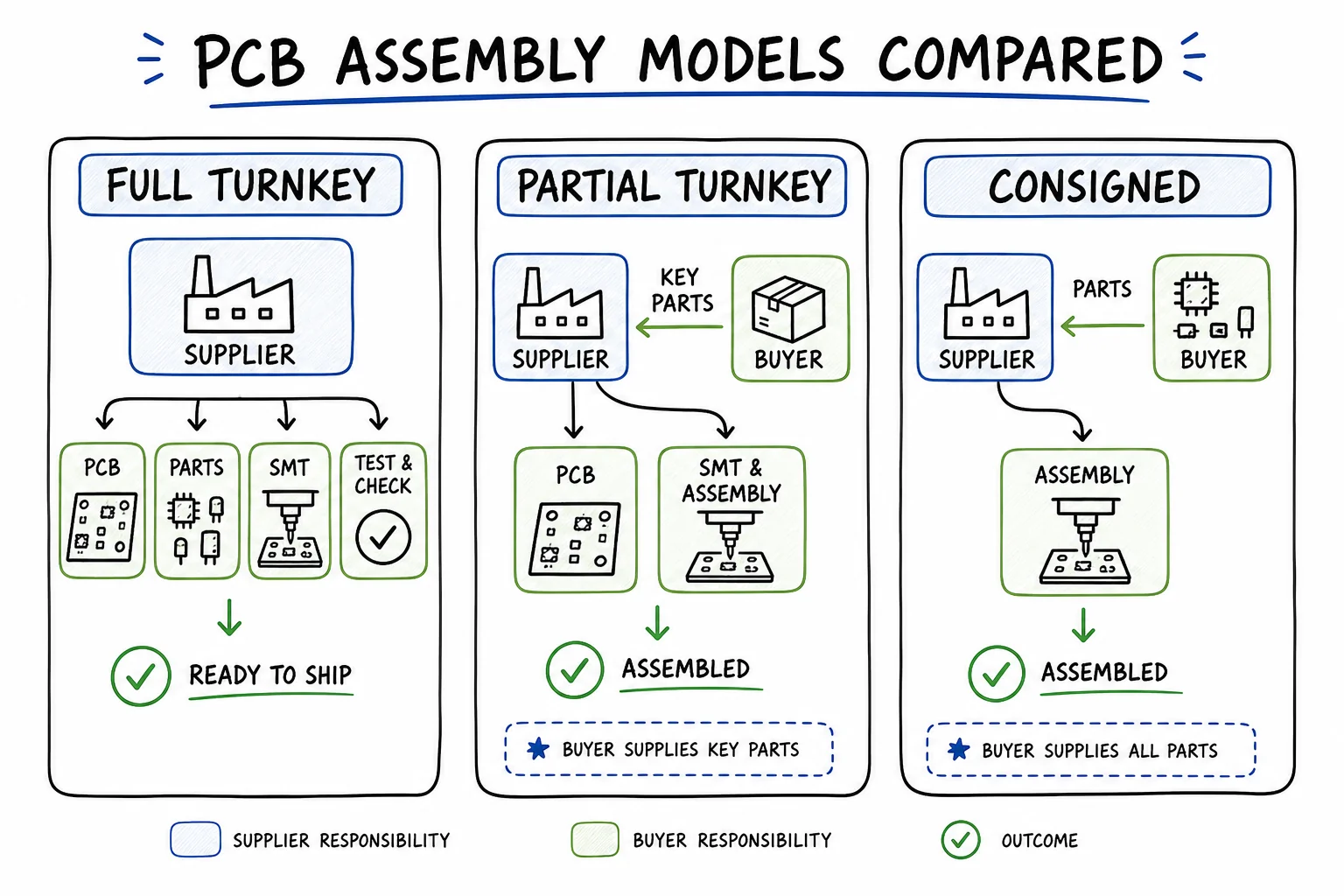 Who procures the board and parts. Test and packing still need a written scope.
One more language trap. Kitted is how the material arrives. Consigned is who owns it, and who pays if it is short or damaged.
Ask two assemblers what “partial turnkey” means and you may get two answers. One will call it consignment. Another will say “combo.” Don’t trust the word. Mark the BOM.
Is partial turnkey the same as consignment? Not reliably. Ask who buys each line.
IPC-D-326A already said the quiet part. Procurement requirements “shall be specified in detail.” State whether the assembler buys all material, or identify what you will supply.
A turnkey label also does not let anyone mix LED bins, buy from an unnamed source, or change dielectric, copper, or finish to hit a board price.
If you want the service-scope question — what assembly, test, and packing include — that’s turnkey PCB assembly. This page stays on who buys the parts.
Pick the model for responsibility. Then still mark every line that can change the lamp.
Which Parts Should You Supply Yourself
Do this line by line. You do not have to consign LEDs.
When we buy the LEDs, the path is boring on purpose:
Lock the spec. Make a sample. Confirm it. Then run bulk.
Skip the sample and you will argue about color later.
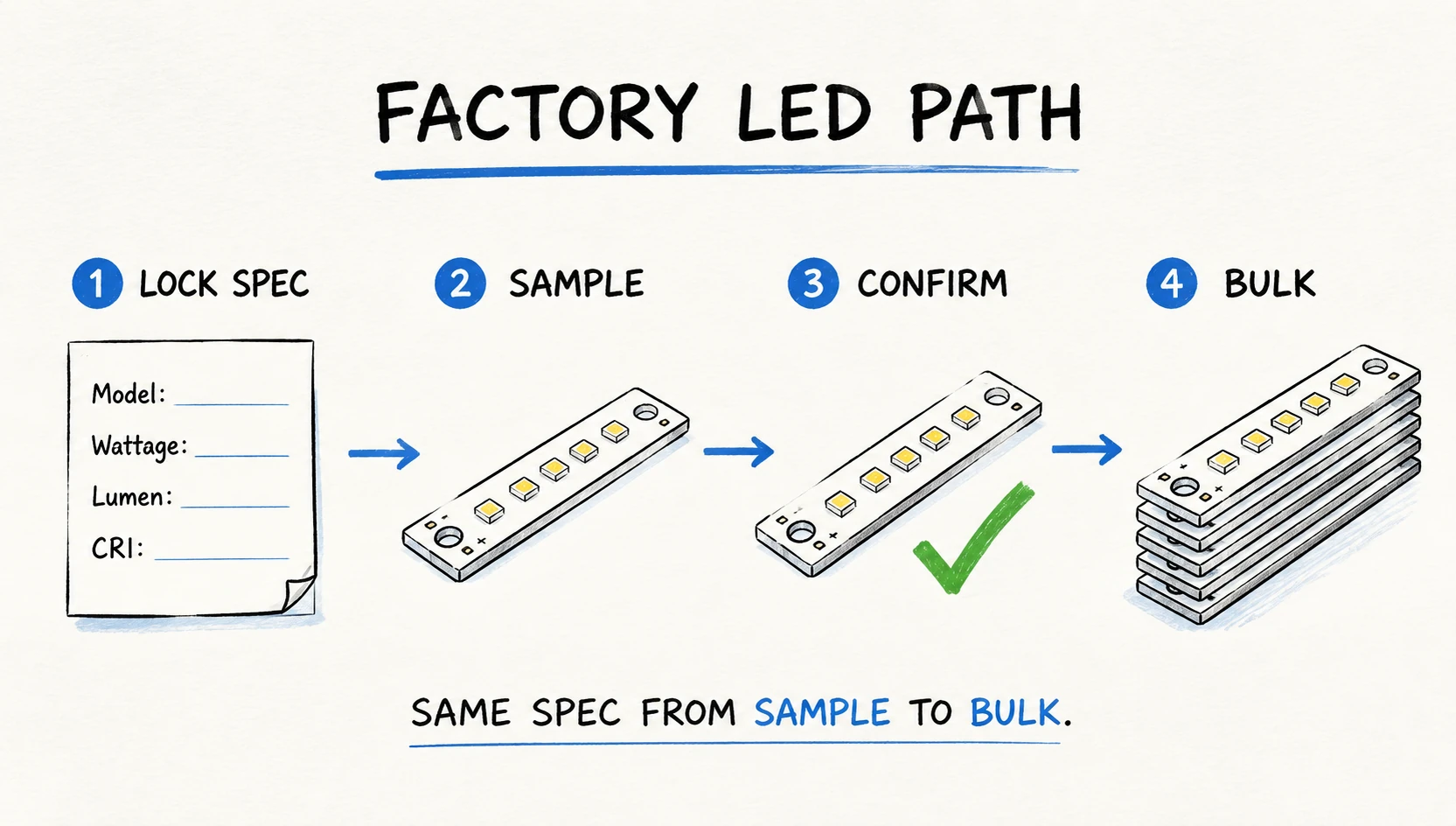 Lock the spec, confirm a sample, then run bulk on the same identity.
Two paths both work:
- You already have approved reels. Send them in original packaging, with manufacturer, MPN, bin/lot labels, and the moisture-barrier bag still sealed.
- You want the factory to buy. Lock the spec and confirm a sample first.
Should you always consign LEDs? No. Consign when you already have the reels. If we buy them, lock the spec and confirm a sample. “Factory sourced 2835” is not a locked identity.
Resistors, capacitors, and connectors are a different conversation. Those we can usually buy, as long as the MPN or a short approved list is clear.
Keep the odd ones unless they are named: programmed devices, proprietary optics, customer-owned inventory. Drivers depend on the part. If it is allocation-protected or already your approved IC, keep it or write the MPN.
If you consign anything, send a counted quantity, agreed spare, original packaging, and a rule for shortages and process loss. Loose LEDs in an opened bag are not a kit.
There is no IPC rule that you must supply the LEDs yourself.
| Ref | Part | Identity | Who buys | Substitute |
|---|---|---|---|---|
| D1–D24 | LED 2835 | Agreed spec (model, wattage, lumen, CRI, etc.) | Factory after sample sign-off, or customer reels | No |
| U1 | LED driver | Exact orderable MPN | Named on the BOM | No, ECO only |
| R1–R8 | 10 kΩ 0603 | Listed MPN or short AVL | Factory | AVL only |
| J1 | Connector | Listed MPN | Factory | AVL only |
| PCB | Single-sided aluminum | Released stack-up and drawing rev | Factory | No dielectric, copper, or finish change |
That’s an example, not a template. If a line can change how the lamp looks, either send the approved reels or lock the spec and confirm a sample. If it is a resistor, capacitor, or connector with a clear MPN, the factory can usually buy it.
Why an LED Cannot Be Sourced as “2835, 4000 K”
Package plus a nominal CCT is a search filter. It is not an order code.
The spec at the top of this article is enough to buy against. Package and color temperature alone still leave room to buy the wrong part.
Lumileds DS307 says the quiet part: production varies around the datasheet averages, so they bin flux, color, and forward voltage separately.
Some order codes are even wider. Bridgelux DS246 has an ordering suffix 00-0-0 that “denotes the full distribution of flux, forward voltage, and color bin.”
Can you specify 2835, 4000 K, 80 CRI?
Only if a wide distribution is fine. If the next lot has to look like the last one, that line is not enough.
Two more things show up on aluminum LED boards.
Color may be targeted at a high solder-point temperature, while flux and Vf are binned at 25 °C. Bridgelux’s Gen2 SMD 3030 sheet bins flux and Vf at 25 °C and hot-targets color at 85 °C. Don’t compare bins across those conditions.
A tight bin also sits on a thermal path. Change the dielectric or copper, and the LED can look different in the fixture even though the reel label matches.
If you need the spreadsheet columns — manufacturer, MPN, notes — that’s the BOM list for PCB assembly. This page only cares about the buying consequence: write a purchasable identity, then decide who may buy it.
How to Write Approved Alternates Without “Or Equivalent”
If a substitute is allowed, name the exact manufacturer part number. If it is not, say so.
“Or equivalent” is an open purchase order.
IPC-2588 puts approved sources in an approved vendor list (AVL): matching manufacturer part numbers tied to each BOM item. It does not force one Excel layout. It also does not make every 2835 pad an approved LED.
An LED alternate needs more than the same footprint. Compare it against the locked spec, plus Vf, package, and whether mixed bins are allowed.
A driver alternate can change dimming and protection. The board is a controlled item too. Changing dielectric thickness, copper, or finish is not a purchasing shortcut.
Does full turnkey mean the factory can substitute parts?
No. Full turnkey means they may purchase. Substitution still needs a named alternate or a written change.
You can put this on the RFQ:
Do not substitute D1–D24 or U1. Alternates only from the listed MPNs. Aluminum PCB stack-up is frozen to drawing rev X.
Need the columns behind that sentence? Use the BOM list.
What to Send With the RFQ Besides the BOM
The BOM is not the sourcing instruction.
IPC-D-326A already told you what to add: state whether the assembler buys all material, or identify what you will supply.
Send this with the quote:
- Who buys each BOM line, including the bare board
- The locked LED spec; bin or CAT code if lots must match closely
- Approved alternates, or no substitution without written approval
- Customer-furnished list with quantity, spare, packaging, moisture and lot labels
- Handling notes for moisture-sensitive LEDs
- Released board drawing revision, quantity, and delivery target
Gerber and pick-and-place still belong in the PCB assembly quote and PCB file guides. Don’t paste those checklists here.
What should you send besides the BOM?
The BOM, who-buys-what, the LED spec, any consigned-material list, and the board revision.
Files without a sourcing split are not a complete RFQ.
If the factory is going to buy the LEDs, make the sample path obvious: lock the spec, make a sample, confirm it, then run bulk.
What to Check When You Consign LEDs or Accept Factory Reels
From the bag to placement, keep the identity: MPN, bin or CAT code, reel/lot, seal date, moisture status.
Don’t mix leftover reels from another lot unless the spec allows a defined kit.
Cree’s characterization notes say the LEDs on one reel usually share one flux bin and one chromaticity bin. Last month’s leftover reel is not how you finish this kit.
Lumileds DS264 is why the bag matters. Moisture-barrier bags and reels carry part numbers with CAT codes for flux, color, and forward-voltage bins, plus a unique lot number for traceability.
Opened bags are a different failure. Cree’s soldering and handling notes tell you to check the humidity-indicator card, record open time, and stay inside MSL floor life. IPC/JEDEC J-STD-033 exists for the same reason: moisture plus reflow can damage the device.
That’s why consigned LEDs should travel in original packaging.
One honest limit belongs here.
The same LED supplier and the same model can still show a slight difference from batch to batch. That is common. A confirmed sample reduces surprise. It does not create zero variation. We cannot honestly promise the next lot will be optically identical.
If the lamp is sensitive to color match, confirm a sample from the lot you will actually run. Don’t mix leftover reels to finish a kit. Incoming bin control also does not cancel a bad thermal path or uneven LED current.
If you consign LEDs, is the factory still responsible for color?
The factory must not mix, damage, or substitute the agreed identity. It is not responsible for unlabeled or mixed reels you sent. And nobody should sell “sample approved” as a lifetime color match.
Buying or consigning only changes who pays for the parts. It does not remove labels, sealed bags, sample confirmation, or lot-to-lot variation.
Conclusion
BOM sourcing is a written split of who buys which line, plus a locked LED spec.
Lock the spec before anyone buys the LED. Make a sample and confirm it before bulk. Let the factory buy resistors, capacitors, and connectors when the MPN is clear.
Don’t write “or equivalent” on the lamp’s optical parts. Don’t mix leftover LED reels. Don’t expect two batches from the same supplier to be identical.
Preparing a single-sided aluminum PCB for LED PCB assembly? Send the Gerber files, a BOM with who-buys-what marked, the LED spec, quantity, and any customer-furnished material. We can review a practical aluminum PCB assembly split from those files.
Need a quotation?
Send Gerber files and basic specifications. We reply within 1 business day.
Ask for Quote