
On This Page (Table of Contents)
There is no single best aluminum PCB manufacturer in China.
You get a fair price and stable supply only by matching your order volume and board specs to the right factory tier.
- 5 to 50 sample boards fit online portals like JLCPCB (from $4 for 5 metal-core pieces) or PCBWay.
- Automotive or multilayer metal-core boards belong at listed Tier-1 plants like Kinwong or Olympic Circuit that handle
IATF 16949programs. - Hundreds to thousands of square meters of LED boards belong at dedicated industrial-park plants using
12–35 µmcopper stock and punch dies (~$420 die cost, ~300 m² break-even).
Most online "Top 10" supplier lists hide this split.
They lump sample shops, automotive giants, and raw laminate mills into one table as if every factory wants the same drawing.
Step 1. Match Your Order to the Right Tier of Chinese Aluminum PCB Supplier
Sort Chinese suppliers into four clear roles before sending out Gerber files.
Material mills, sample portals, automotive fabs, and lighting-board plants sell completely different products.
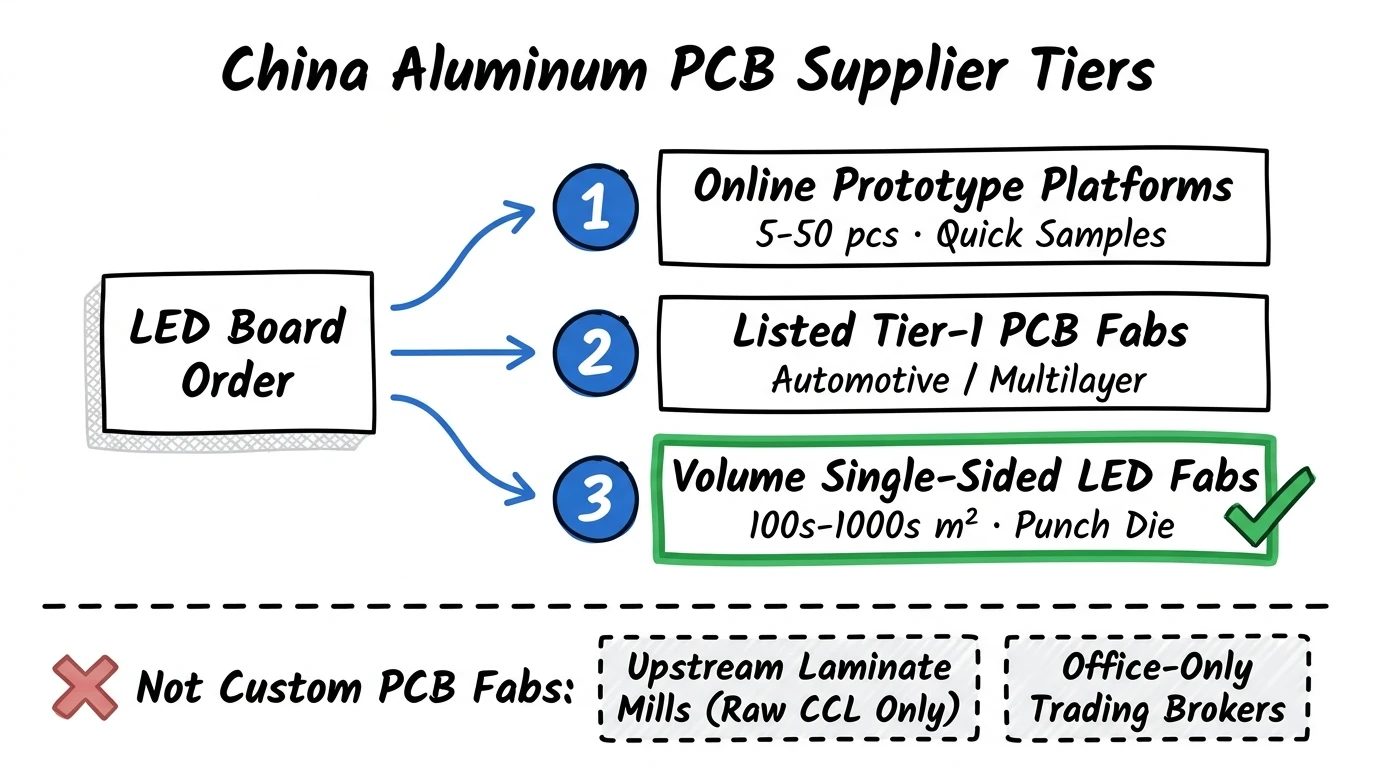 Figure 1. Matching order volume and board complexity across China's aluminum PCB supply roles while separating raw laminate mills and trading brokers.
Clear up one common mistake from search rankings first.
Shengyi Technology, Ventec, Kingboard Laminates, and TCLAD make raw aluminum copper-clad laminates and dielectric films. (TCLAD acquired Henkel's Bergquist Thermal Clad business in May 2021.)
These mills sell uncut sheets to PCB shops. They do not etch custom LED boards from your Gerber file, even though wider groups like Kingboard and Shengyi also operate separate PCB subsidiaries.
Take raw laminate mills off your RFQ list. That leaves three manufacturing tiers, plus trading brokers in the middle.
| Supplier Role | Representative Examples | Pricing & Tooling Model | Best-Fit Orders | When to Look Elsewhere |
|---|---|---|---|---|
| Upstream Laminate Mills | Shengyi, Ventec, TCLAD, Kingboard Laminates | Bulk raw laminate sheets (e.g., 1040 × 1240 mm standard sheets) | Factory-level raw material supply | Any custom bare PCB order from Gerber files |
| Online Standardized Platforms | JLCPCB, PCBWay, ALLPCB | Per-piece online packs (JLCPCB metal-core from $4 / 5 pcs) | 5–50 piece R&D validation and quick turns | Repeatable commercial LED volume with custom die punching |
| Listed Tier-1 & Engineered PCB Fabs | Kinwong, Olympic Circuit, Shennan, Victory Giant | Program-based OEM quoting with system and qualification overhead | Automotive lighting (IATF 16949), telecom metal-base boards, copper-core, multilayer IMS | Price-sensitive commercial bulbs, tubes, and panels |
| Dedicated Volume Single-Sided LED Fabs | Lumina PCB | Per-m² quoting, no fixed MOQ, ~$420 punch die (~300 m² break-even) | Hundreds to thousands of m² of single-sided LED boards + optional SMT | Double-sided/multilayer aluminum, copper-core, or flex boards |
Lumina PCB operates strictly in that fourth lane.
Our shop focuses on high-volume single-sided aluminum PCB fabrication, populated LED boards, and optional turnkey assembly (bare board plus components and SMT).
No multilayer aluminum PCBs, double-sided aluminum PCBs, or multilayer rigid boards leave our line. Copper-core and flex circuits also sit outside our scope.
If your drawing needs plated through-holes on aluminum or IATF 16949 paperwork, a listed Tier-1 plant will serve you better.
Lock your supplier tier before comparing prices. A $4 prototype pack tells you nothing about volume pricing, and automotive overhead makes no sense on a 10 W bulb board.
Step 2. Compare Quotation Logic From $4 Prototypes to Per-Square-Meter Volume
Compare volume factory quotes on square-meter sheet yield, copper thickness, and outline tooling.
Do not anchor your target price on per-piece sample deals.
Online portals keep tiny prototypes cheap by combining matching designs onto shared panels.
Eurocircuits' panel-pooling guide explains how shared panels split setup costs across buyers.
Look at JLCPCB's live material matrix (updated November 10, 2026) as a real benchmark.
Their standard one-layer aluminum option locks in 1 oz copper, 1 W/m·K dielectric, HASL finish (JLCPCB currently does not support OSP on aluminum PCBs), and V-CUT panelization. Metal-core pricing starts at $4 / 5 pcs, separate from the $2 / 5 pcs FR-4 offer.
That setup works well for 5 or 10 test pieces.
Once a bulb or tube board scales to hundreds of square meters per month, a direct lighting plant prices the job around sheet yield and line speed.
1. Three Material Specs That Move Your Square-Meter Quote
Confirm both nominal and actual copper weight.
Upstream copper and laminate cost pressure has pushed foil weights thinner across volume LED boards.
Online portals default to 1 oz (35 µm), while volume lighting shops mostly run nominal 12 µm (1/3 oz) foil for indoor bulbs and panels. Incoming sheets often measure 10–11 µm.
We also run 25 µm and 35 µm for heavier current loads. Never write "standard copper" on an RFQ without giving the exact micron number.
Confirm the upstream laminate thermal grade.
Most bare PCB fabrication shops, including ours, do not run in-house thermal conductivity lab tests. Thermal grades follow the upstream copper-clad laminate rating.
Standard volume lighting uses 0.6–0.8 W/m·K stock, though many market listings label general boards as 1.0 W/m·K. We quote 0.6–0.8 W/m·K honestly for cost-sensitive runs. When a project needs 1.0 W/m·K, we source rated commercial laminate backed by upstream reports where available.
Check nominal vs. actual aluminum PCB thickness tolerances too, since mills supply to nominal sheet gauges.
Match surface finish to your SMT schedule.
In high-volume single-sided LED fabrication, OSP typically keeps pads flat and lowers unit cost when boards enter automatic placement right after delivery.
Lead-free HASL costs slightly more, yet protects solderability during longer storage or hand touch-up.
2. CNC Routing vs. Stamping Dies (~300 m² Break-Even)
How the factory cuts finished boards from the master sheet moves unit cost just as much as base material.
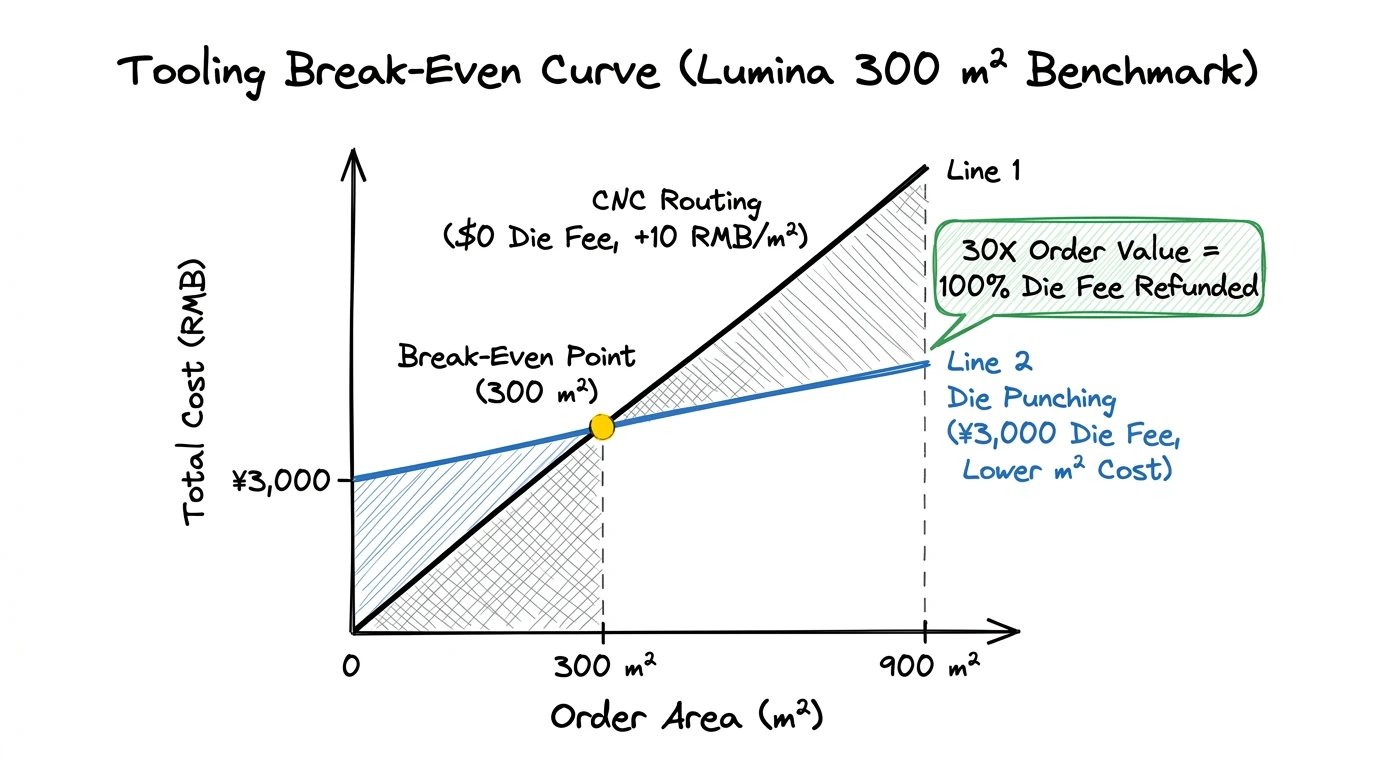 Figure 2. Comparing CNC routing fees against a dedicated ~$420 stamping die across cumulative order volume.
Samples and trial lots use CNC routing with zero upfront die charge.
In our shop, CNC routing adds roughly $1.40 USD / m² over die punching on holed boards. Simple hole-free strip boards can price close to parity.
Once a single board outline reaches 300 m², opening a single-sided punching die (~$420 USD) hits break-even.
Under our tooling policy, 100% of that die fee is refunded after bulk orders reach 30 times the die cost (~$12,600 USD). Repeat orders also carry lifetime die maintenance and replacement at zero extra charge.
See the full tooling math in our guide to aluminum PCB CNC routing vs. die punching break-even.
3. Build Time vs. Real Factory Lead Times
Check lead-time definitions carefully before booking production.
As JLCPCB's quote page states, "build time" covers physical shop production only. It excludes export trucking, sea transit, and destination customs.
Direct-factory lead times shift with order volume, board geometry, material stock, and shop load.
- Small prototypes (material on hand) can finish in as fast as 1 day for urgent small lots, with standard turnaround depending on quantity and shop load.
- Small batches (under
50 m²) take about 5 days off-season and 10 days in peak season. - Large production runs take about 7 days off-season and 15–20 days in peak season, extending when new dies or bulk laminates are required.
Before comparing two quotes, ask each supplier to split one-time tooling (CNC or punch die) from recurring $/m² pricing. Confirm copper weight in microns (12 / 25 / 35 µm) on the same sheet.
Step 3. Screen Out Generic FR-4 Shops and Office-Only Trading Brokers
A low square-meter quote creates real risk if the vendor outsources stamping or runs out of a commercial office.
Screen candidates on two tracks: metal-core shop controls and verifiable site identity.
1. Four Metal-Core Process Questions That FR-4 Shops Miss
Etching circuits on aluminum looks similar to FR-4 wet processing. Mechanical cutting and dielectric isolation follow different rules.
TCLAD's design guide (Rev. 2021-DG02-010) warns that secondary mechanical steps require dedicated clearances to protect traces and prevent edge shorts.
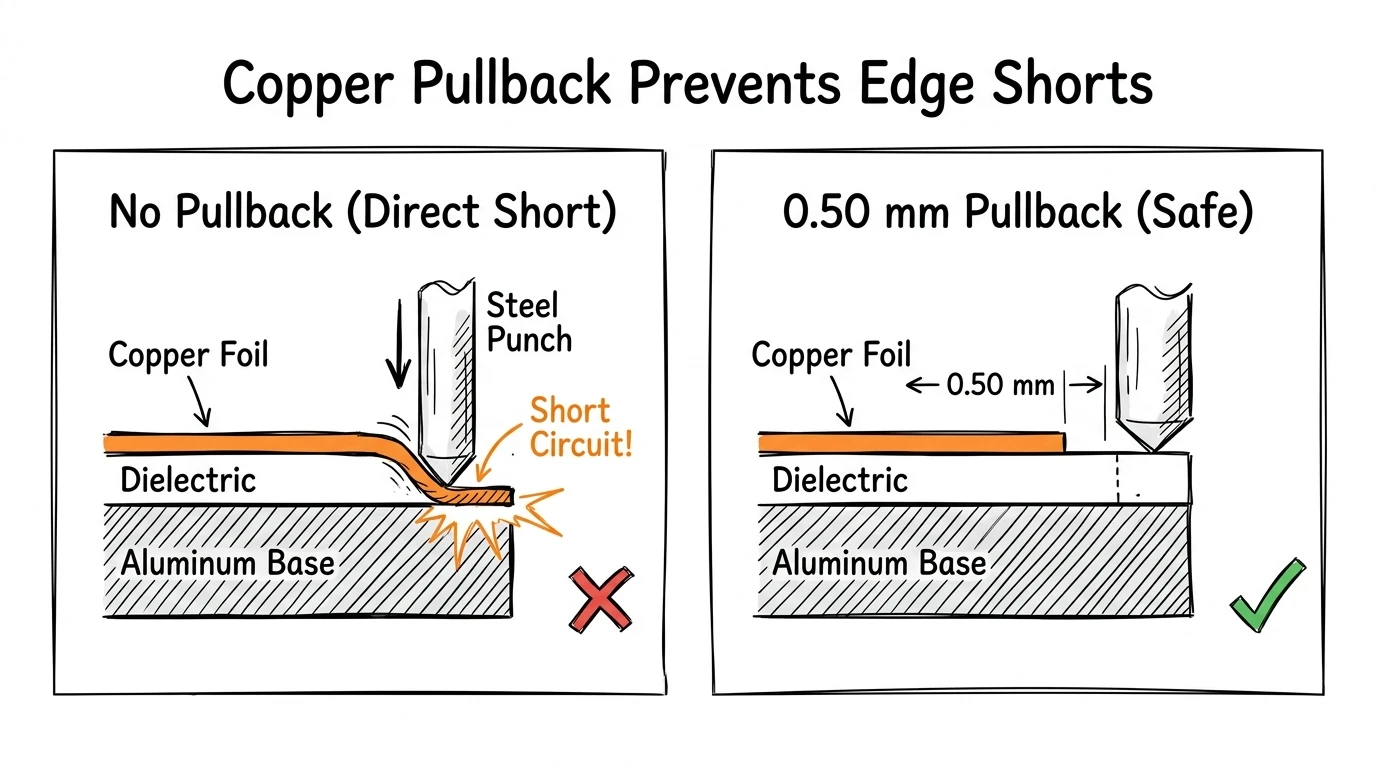 Figure 3. Maintaining 0.5 mm copper-to-edge clearance and controlling punch direction prevents burr bridging to the aluminum substrate.
Put four technical questions in your screening email.
1. How do you control punching burrs and edge isolation?
On our stamping lines, clean edges rely on 6%–8% die clearance (of board thickness) and punching with the aluminum side facing up.
Die blades get reground every 30,000–50,000 strokes, and finished boards pass through high-pressure horizontal water washing.
Paired with a 0.5 mm copper pullback from the board edge, this stops burr shorts without inventing extra brush deburring steps.
2. What finished-board breakdown voltage do you achieve?
Raw laminates often list ~3,000V or higher on datasheets. After etching and punching, finished single-sided aluminum PCBs typically hold 800–1200V in practice.
Our shop does not run Hi-Pot testing by default. When a buyer requests it, we provide limited spot checks rather than 100% bulk screening. Question any vendor quoting raw sheet kV ratings as a finished-board guarantee.
3. Which upstream laminate grade backs your thermal rating?
Bare aluminum PCB shops rarely run in-house thermal conductivity tests. Thermal ratings follow the upstream copper-clad laminate datasheet.
The real issue is vendors quoting 1.0 W/m·K while shipping standard 0.6–0.8 W/m·K sheets. Ask which laminate grade the shop buys and whether an upstream ASTM D5470 material report is available. Avoid vendors still citing retired IPC-4104 HDI specs as proof of aluminum PCB thermal conductivity.
4. Which white solder mask do you run, and is SMT in-house?
LED boards need white LPI masks built for lead-free reflow color retention.
Taiyo PSR-4000 LEW1, for example, rates its Y reflectance near 82 at 20 µm on copper in published datasheets.
In-house SMT also reduces blame-shifting if moisture causes reflow blistering.
HASL boards bake at 105°C–120°C for 2–4 hours. OSP boards cannot take prolonged 105°C+ heat and allow only brief 60°C–80°C (1–2 hours) drying right before placement.
2. Match China's Industrial Geography Against Live Video Walkthroughs
China's aluminum PCB plants sit across coastal and inland zones rather than one city.
The 2025 China Printed Circuit Association (CPCA) Manufacturer Guide lists 1,857 PCB manufacturing entries led by Guangdong (51%), Jiangsu (11%), Jiangxi (11%), Zhejiang (7%), and Anhui (5%).
Those figures count registered companies rather than aluminum output share. CPCA also names Xinfeng High-tech Industrial Park among China's active inland PCB clusters.
Pollution rules and wastewater permits push wet etching lines into equipped industrial parks. Sales teams often keep showrooms closer to lighting hubs like Guzhen, Zhongshan or business districts in Shenzhen.
A Guzhen or Shenzhen showroom address does not automatically mean a middleman. A polished website photo does not prove a real factory either.
Verify three points together before sampling.
- Verify entity linkage. Compare the contracting company on your proforma invoice against the manufacturing plant inside the industrial park; if export sales and factory operations use separate affiliated entities, confirm the relationship clearly before paying.
- Confirm physical lines. Ask for the exact industrial-park address, monthly capacity, and counts of imaging, stamping, and solder-mask lines.
- Book a 15-minute live video walkthrough. Have the salesperson walk onto the active floor to show imaging lines, press tonnage plates, solder-mask machines, and stacked laminates.
As a concrete reference, Lumina PCB's single-sided aluminum PCB operations date back to 2011, with Zhongshan Luming Technology Co., Ltd. handling export sales and online operations alongside our self-owned Jiangxi production base.
Our 200,000 m²/month plant runs at No. 6 Helitai Road, High-Tech Industrial Park, Xinfeng County, Ganzhou, Jiangxi with 2 automatic imaging lines, 2 automatic punch presses, and 2 automatic solder-mask lines.
We also operate Lumina Guzhen Showroom at No. 53 Caoxing West Road, Guzhen Town, Zhongshan to meet fixture buyers face to face.
| Verification Step | Typical Broker Red Flag | What a Direct Volume Factory Shows | Buyer Check Before Sampling |
|---|---|---|---|
| Entity & Location | Commercial tower address claimed as "own factory" | Industrial-park production base + downstream sales showroom clearly explained | Verify contracting entity linkage, factory address, and park location |
| Equipment & Process | Vague "100% Hi-Pot / brush deburring" claims; no tooling math | Live automatic imaging, punch presses, solder-mask lines, 0.5 mm pullback | Run a 15-minute live video check during production hours |
| Thermal, Copper & Voltage | Labels standard stock "1.0 W/m·K" or quotes "standard copper" and 3,000V raw sheet specs | Separates 0.6–0.8 from 1.0 W/m·K upstream laminate grades (no fake in-house thermal tests), specifies 12 / 25 / 35 µm, and states 800–1200V limits (Hi-Pot spot checks on request only) | Confirm upstream laminate grade, micron foil thickness, and on-request Hi-Pot rules |
| Compliance & Quality | Uses raw laminate UL file number as finished-PCB UL proof | Clear material-level compliance options (RoHS / REACH) + sample-to-bulk QC | Confirm pre-quote compliance scope and real reflow test plan |
Step 4. Qualify Commercial LED Factories Without Overpaying for Unneeded Badges
Pay for factory-wide IATF 16949 or standalone UL PCB recognition only when your OEM contract or destination law requires them.
For commercial LED bulbs, downlights, tubes, and panels, pre-quote compliance checks, a real 245°C reflow trial, and AQL inspection control risk without inflating board price.
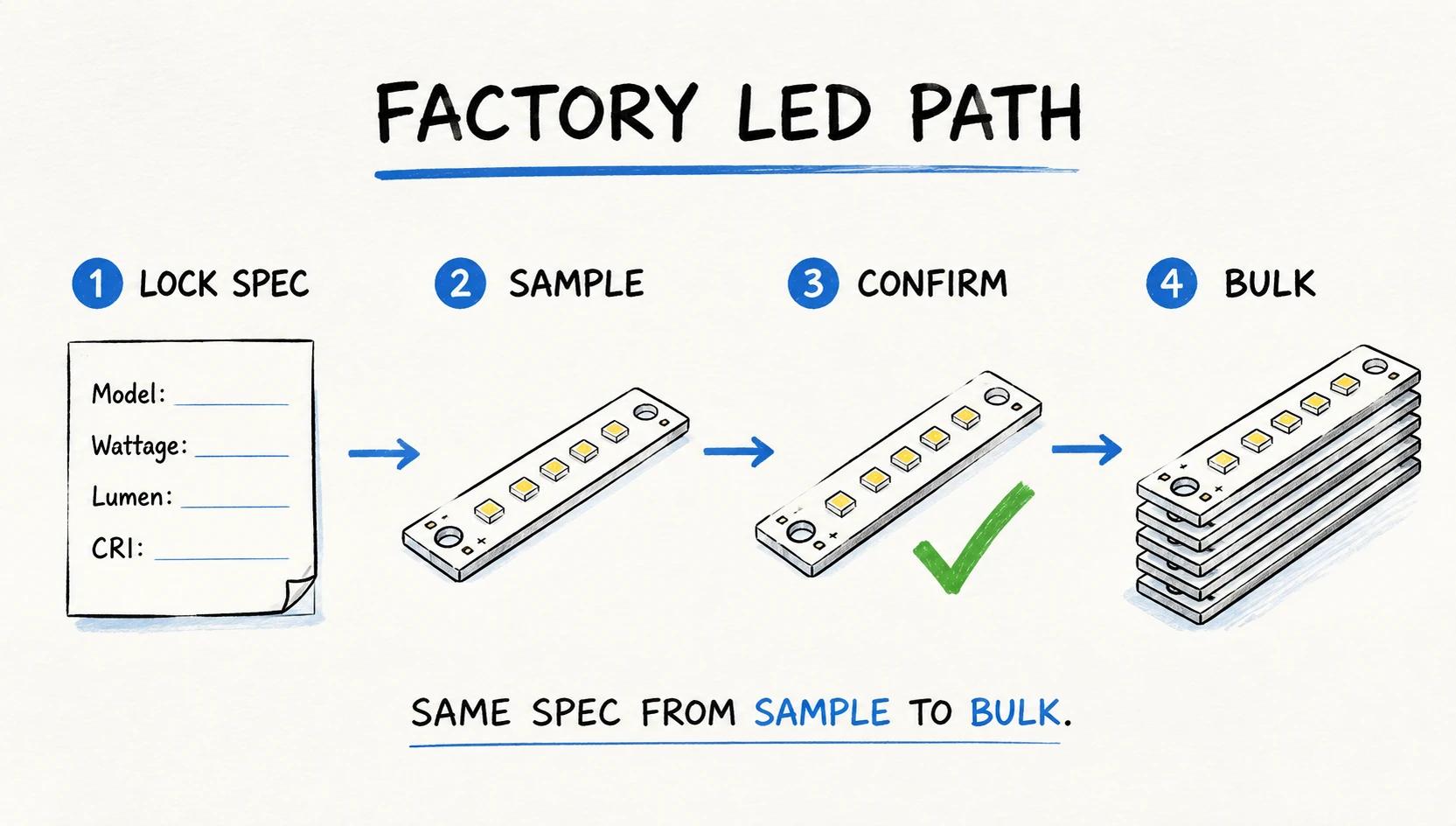 Figure 4. Moving safely from production-representative samples and reflow testing to locked bulk repeat orders.
Separate three approvals before disqualifying a factory.
- Automotive QMS (
IATF 16949). Under IATF Rules 6th Edition Q&A (Nov. 2024), this applies strictly to automotive manufacturing and adds PPAP overhead that indoor lighting does not need. - UL laminate vs. finished-board recognition. Under UL's PCB compliance framework, recognized laminate (
QMTS2/QMJU2) is not a recognized finished board (ZPMV2). Check your luminaire safety file first. - Destination rules on bare boards. Per India BIS exemption rules for bare LED aluminum PCBs and MeitY's October 2026 CRO guidance (Q17), unpopulated bare boards sit outside finished-luminaire registration unless notified separately.
A 3-Step Physical Qualification Path for Commercial LED Orders
When your commercial LED order carries no mandatory factory-badge clauses, run three physical checks instead.
1. Confirm material compliance before quoting.
EU RoHS Directive 2011/65/EU regulates each homogeneous material separately, so a laminate sheet report alone does not cover solder mask or finish.
Lumina PCB does not compete on factory certification badges. Send your target-market RoHS or REACH list before quoting, and we will verify matching files upfront.
2. Test samples on your own SMT line.
Start with quick-turn LED PCB prototyping, where sample fees are usually waived for overseas buyers (buyers cover shipping).
Run boards through your actual 240°C–245°C lead-free reflow oven to check blistering and white-mask color retention. Measure finished thickness with a micrometer and spot-check dielectric withstand (Hi-Pot) or insulation resistance.
3. Scale via sample, small batch, and repeat order.
Standard bulk terms are 30% deposit and 70% balance before shipment.
Pair ISO 2859-1 (AQL sampling plans) with IPC-A-600 visual criteria on incoming lots. Specify AOI screening upfront if your board layout requires it.
For recurring single-sided aluminum PCB runs, email your Gerber files and monthly square meters to sales@luminapcb.com or WhatsApp +86 191 2915 9296.
Include copper thickness (12 / 25 / 35 µm) and surface finish (OSP or HASL) for an accurate square-meter quote. You can also book a 15-minute live video walkthrough of our Xinfeng shop floor before sampling.
Frequently Asked Questions (FAQ)
Are Kingboard, Shengyi, Ventec, and TCLAD PCB fabrication factories?
No. Shengyi, Ventec, TCLAD (which acquired Henkel's Bergquist Thermal Clad business in May 2021), and Kingboard Laminates make raw copper-clad laminates and dielectrics.
They do not etch custom bare LED boards from your Gerber file.
Even though wider groups like Kingboard and Shengyi also operate separate PCB subsidiaries, buyers sourcing etched lighting boards need a fabrication plant rather than a laminate mill.
Why do many Chinese aluminum PCB suppliers list a showroom in Zhongshan or Shenzhen while their plant is in Jiangxi?
Wet-chemical etching requires environmental approvals and wastewater treatment plants. Those rules push production lines into equipped industrial parks such as Xinfeng High-tech Industrial Park in Jiangxi.
Downstream showrooms stay in Guzhen, Zhongshan or Shenzhen to remain close to lighting fixture buyers. Verify that the contracting company, industrial-park site, and live shop floor match before ordering bulk runs.
Does a "1.0 W/m·K" quote or UL-recognized laminate guarantee a UL-certified 1.0 W/m·K finished board?
No. Both claims need separate checks.
Many commercial listings label standard 0.6–0.8 W/m·K stock as 1.0 W/m·K. Bare PCB shops follow upstream laminate ratings rather than testing thermal conductivity in-house. Ask which laminate grade is used and whether an upstream ASTM D5470 material report is available.
Under UL's PCB compliance rules, recognized laminate (QMTS2 / QMJU2) does not equal a recognized finished board (ZPMV2). Check your end-product safety file before paying for extra factory badges.
What specs should I send for an accurate per-square-meter factory quote?
Send your RS-274X Gerber files, finished board thickness, and expected monthly square meters.
Specify copper weight in microns (12, 25, or 35 µm), surface finish (OSP or HASL), and dielectric grade (0.6–0.8 or 1.0 W/m·K).
Attach your BOM if you want optional in-house SMT quoted alongside bare boards. Ask the factory to price CNC routing and a dedicated stamping die (~$420 USD, refunded after 30× cumulative orders) separately.
Need a quotation?
Send Gerber files and basic specifications. We reply within 1 business day.
Ask for Quote