Ceramic PCB vs Aluminum PCB: When to Use Each One

On This Page (Table of Contents)
A ceramic PCB uses a ceramic insulating substrate, usually alumina or aluminum nitride, instead of FR-4 or a metal-core stackup.
It can be useful when an LED design needs higher thermal performance, better temperature stability, lower CTE, or stronger electrical insulation.
But it is not the default choice for every LED board.
For many LED lighting projects, an aluminum PCB or MCPCB is still the more practical first option. It can offer enough heat spreading with lower cost, easier sourcing, and better repeat-order stability.
Use ceramic when the design has a real thermal, thermal-cycling, or CTE problem. Use aluminum PCB when it can meet the heat, reliability, cost, and production target without adding unnecessary process risk.
What Is a Ceramic PCB?
A ceramic PCB is a circuit board built on a ceramic insulating substrate.
Instead of using an organic laminate like FR-4, the board uses ceramic material as the base. Conductors are then formed on, bonded to, or plated onto that ceramic surface.
In buyer conversations, you may see several names:
- ceramic PCB
- ceramic PCB board
- ceramic printed circuit board
- ceramic circuit board material
These terms are often used loosely.
The name alone is not enough. The substrate material and construction method matter more.
For example, CeramTec describes alumina and aluminum nitride substrates as electronic circuit carrier materials. These ceramics can provide electrical insulation, thermal performance, and dimensional stability for demanding electronics.
That makes ceramic PCB different from both FR-4 and aluminum PCB.
FR-4 is an organic laminate.
Aluminum PCB is usually an insulated metal substrate, with copper, a thermally conductive dielectric layer, and an aluminum base.
Ceramic PCB uses the ceramic itself as the insulating substrate.
Ceramic PCB is not a "better PCB" by default. It is a different board structure for a different set of limits.
Ceramic PCB vs FR-4 vs Aluminum PCB
FR-4 is the general-purpose option — low cost, broadly available, but it has no real thermal advantage for LEDs. Aluminum PCB / MCPCB is the practical thermal option for most LED boards: copper, thermal dielectric, and an aluminum base that moves heat away from the LEDs efficiently. Ceramic PCB is the specialized option for tougher thermal and reliability demands — higher cost, narrower supplier base, but capable of handling scenarios that exceed what the aluminum dielectric layer can do.
For LED lighting, cost, sourcing, processing, board size, assembly, and heat sink design also factor into the choice — not just thermal conductivity on paper.
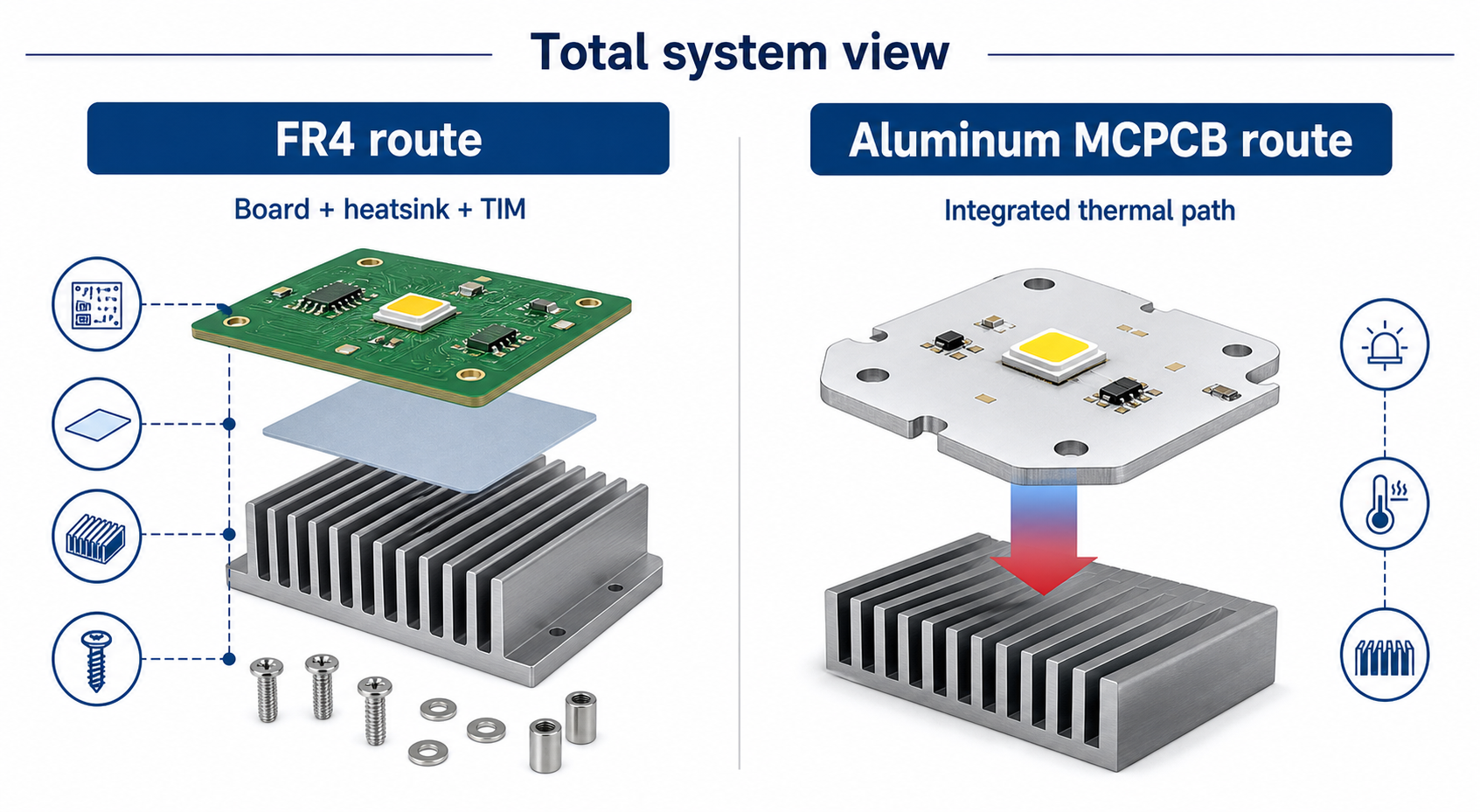 FR-4 and aluminum MCPCB solve LED thermal design in different ways. For many LED boards, aluminum MCPCB is the more direct thermal route.
Sources such as Cree LED's PCB thermal management guidance treat the PCB as part of the LED thermal path. That is the right way to think about this decision.
The PCB also sits inside the heat path between the LED package and the fixture body.
For many LED boards, aluminum PCB gives a strong improvement over FR-4 because the metal base spreads heat away from the LEDs.
But aluminum PCB still has a dielectric layer between the copper circuit and the metal base. That layer must transfer heat while maintaining electrical insulation.
When that dielectric layer becomes the bottleneck, ceramic starts to become more interesting.
Common Ceramic PCB Materials
Alumina is the common workhorse. It delivers strong insulation, a mature production base, and moderate ceramic thermal performance — useful when extreme heat removal is not the only goal and you need a stable, widely-sourced substrate. Source notes cite it around 24 W/mK for typical grades.
Aluminum nitride is the higher-performance option. Much higher thermal conductivity (around 170 W/mK from supplier data) and a CTE closer to chip materials, which matters when both heat removal and thermomechanical stress need to be controlled at the same time.
Treat those numbers as examples, not universal promises. Actual values depend on material grade, supplier, thickness, conductor system, and process route. Do not choose ceramic material by the highest number on a datasheet. Choose it based on what the board needs to survive in the real product.
Ceramic PCB Manufacturing Routes Buyers May See
Ceramic PCB is not one single process.
That is why supplier pages can feel confusing.
In supplier pages, you may see terms like thick film, DBC, DPC, LTCC, HTCC, or AMB. These describe different ways to create conductors, copper layers, or multilayer structures on ceramic materials.
| Route | What It Usually Means | Where It Fits |
|---|---|---|
| Thick film | Conductive or resistive pastes are printed and fired on ceramic | Dense printed circuits, sensors, some power and industrial applications |
| DBC / DCB | Thick copper is directly bonded to ceramic | Power modules and high thermal load assemblies |
| DPC | Copper is plated onto ceramic | Fine-line ceramic circuits, vendor-dependent capability |
| LTCC / HTCC | Ceramic layers are co-fired into multilayer structures | Packages, RF, high-reliability, or compact integrated structures |
| AMB | Copper is brazed to ceramic with active metal bonding | Power module substrates, EV and inverter-related power electronics |
For example, Rogers describes direct bonded copper as a way to bond thick copper to ceramic for power electronics. NGK describes AMB substrates as copper-bonded ceramic substrates for power modules.
This does not mean a normal LED lamp board needs those processes.
The term "ceramic PCB" can point to several different manufacturing paths.
Cost, lead time, minimum feature size, copper thickness, and supplier options can all change significantly depending on the route.
So the more useful question is not:
"Can you make ceramic PCB?"
A more useful question is:
"What ceramic structure does this LED design actually require?"
When Aluminum PCB / MCPCB Is Enough
Aluminum PCB is enough when it can keep the LED board within its thermal and reliability target at a practical cost.
That is the most common situation for standard LED lighting products.
In many LED modules, lamps, light engines, and panel lights, the main need is not an exotic substrate. The need is a stable metal-core board that moves heat into the fixture structure.
An aluminum PCB does this with a simple stackup:
- copper circuit layer
- thermally conductive dielectric
- aluminum base
- lamp housing or heat sink
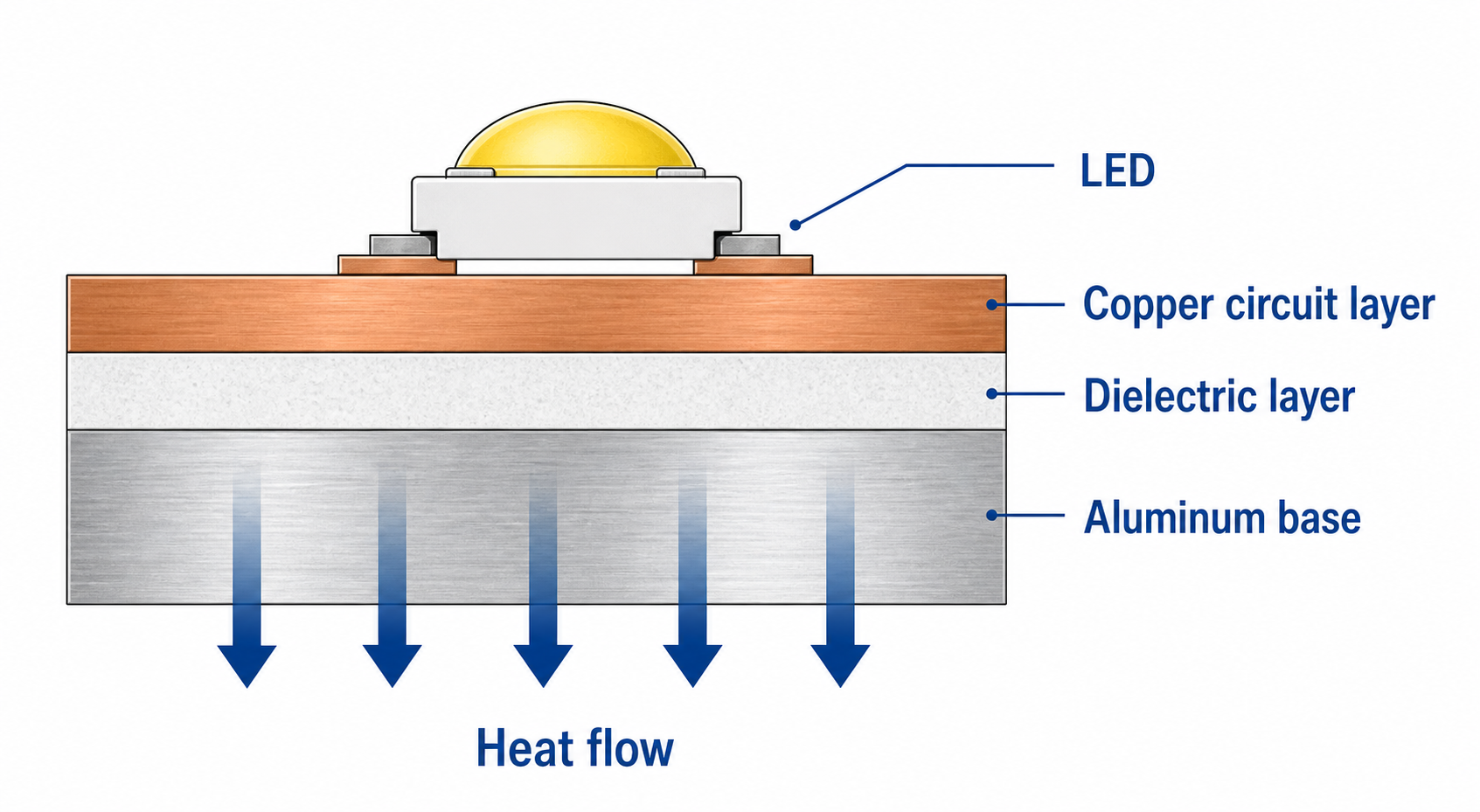 An aluminum MCPCB moves heat from the LED through the copper layer, dielectric layer, and aluminum base.
ams OSRAM's PCB technologies document for LED applications describes IMS boards as widely used for LED applications, especially where cost and thermal performance need to be balanced.
Ceramic may perform better in some severe conditions. But if aluminum PCB already keeps junction temperature, solder reliability, and production cost under control, ceramic can add cost without solving a real problem.
In practice, aluminum PCB is often the better fit when:
- the LED power density is moderate
- the board size gives enough heat-spreading area
- the fixture body or heat sink is designed well
- the order is cost-sensitive
- stable repeat production matters
- the project does not have severe thermal cycling or CTE stress
For most LED lighting projects, this is where to start:
Can a practical aluminum PCB fabrication for LED lighting meet your target?
If yes, start there.
When Ceramic PCB Makes Sense
Ceramic PCB makes sense when aluminum PCB is no longer solving the real limit.
That limit is usually thermal, mechanical, or reliability-related.
Here are the cases where ceramic becomes worth evaluating.
High Power Density
If the LED package is compact and the heat is concentrated in a small area, the MCPCB dielectric layer may become a bottleneck.
Better aluminum PCB design may help.
But if the board still runs too close to the thermal limit, ceramic becomes worth reviewing.
High Operating Temperature
Ceramic materials can handle higher temperature environments better than many organic PCB materials.
That is useful when the board sits in a demanding fixture, compact module, or high-temperature application.
Do not jump to ceramic only because the product is "high power." Check whether the whole heat path is actually failing first.
CTE and Solder Joint Stress
CTE mismatch can become a problem when the LED package, board, and solder joint expand at different rates during heating and cooling.
This is especially important for ceramic-based LED packages or products exposed to thermal cycling.
OSRAM's LED application material also points to substrate choice as a factor in thermomechanical stress. This is one reason ceramic may be selected for tougher package-board combinations.
Reliability-Critical Designs
If failure cost is high, or the product runs under severe thermal cycling, ceramic may be justified even when it costs more.
This is not the normal path for every LED lamp.
It is a material choice for projects where the reliability requirement makes the added cost and sourcing effort worthwhile.
Ceramic PCB is worth considering when the design has a real limit that standard MCPCB cannot solve cleanly.
Cost, Lead Time, and Handling Trade-Offs
Ceramic PCB usually brings more process control and more handling risk than a standard aluminum PCB.
That does not make it bad.
Treat it as a specialized choice.
Ceramic substrates can be sensitive to chipping, cracking, edge stress, and corner geometry. Supplier design guides, such as the CoorsTek thick-film ceramic substrate design guide, discuss chips, cracks, surface imperfections, corner radii, inspection methods, and process capability.
Those details matter because they affect yield.
And yield affects cost and delivery.
| Factor | Why It Matters | Buyer Note |
|---|---|---|
| Material grade | Different ceramics have different thermal and mechanical properties | Do not treat all ceramic PCB as one product |
| Board shape | Sharp corners and difficult outlines can increase risk | Keep geometry practical when possible |
| Singulation method | Ceramic separation can affect chipping and edge quality | Confirm early for complex shapes |
| Tolerance | Tight tolerance can raise process difficulty | Use tight tolerance only where needed |
| Supplier base | Ceramic processes are more specialized | Lead time and alternatives may be narrower |
| Handling | Ceramic can be more brittle than metal-core boards | Packaging, assembly, and rework need care |
This is where aluminum PCB often wins.
For standard LED lighting production, aluminum PCB is usually easier to source, easier to repeat, and easier to keep within a cost target. If cost is the main concern, review the main aluminum PCB cost factors before changing substrate material.
That is why ceramic should be tied to a clear technical reason, not a general belief that "higher performance is better."
Practical Decision Rule
Start with the thermal and reliability target, not the material name.
That shift helps prevent over-specification.
If your LED board can meet its junction temperature, insulation, solder reliability, cost target, and delivery target with aluminum PCB / MCPCB, that is usually the practical choice.
If the design still struggles after normal improvements, then ceramic is worth evaluating.
Normal improvements may include:
- better board size or copper layout
- suitable dielectric thermal conductivity
- better contact to the lamp housing
- improved thermal interface material
- stronger heat sink design
- cleaner LED placement and heat spreading
| Situation | More Practical First Step |
|---|---|
| Standard LED lamp board with manageable heat | Aluminum PCB / MCPCB |
| Cost-sensitive LED module for repeat production | Aluminum PCB / MCPCB |
| High-power compact LED board near thermal limit | Review MCPCB design first, then evaluate ceramic if needed |
| Severe thermal cycling or CTE stress | Ceramic may be worth evaluating |
| Specialized high-reliability power module | Ceramic substrate route may be more suitable |
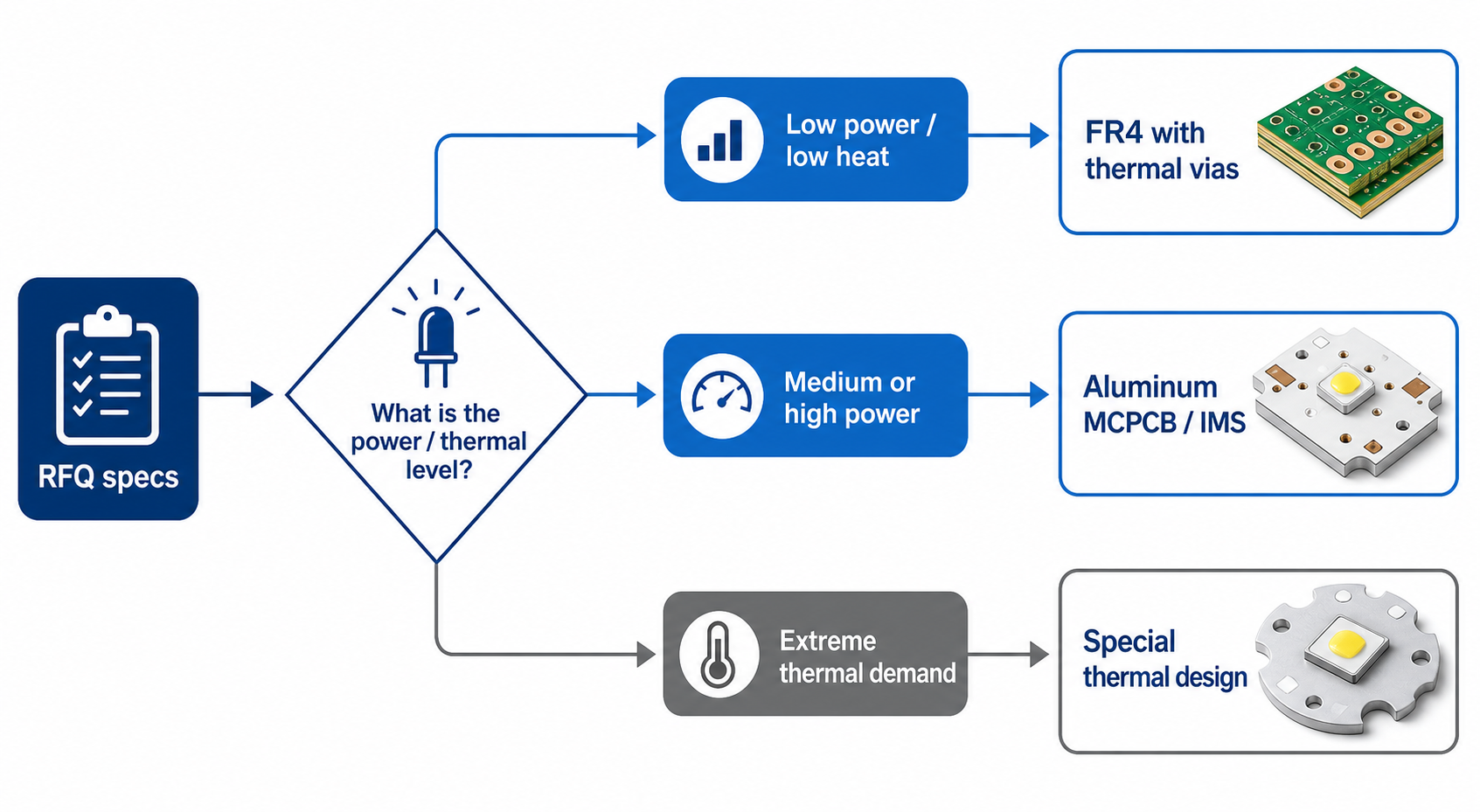 Start with the power and thermal level, then choose the simplest PCB structure that can meet the target.
The right choice is the structure that solves the actual constraint.
Conclusion
Ceramic PCB and aluminum PCB are not competing versions of the same board.
They solve different problems.
Ceramic PCB is useful when a project needs stronger thermal stability, lower CTE, high insulation, or better performance under severe heat and reliability stress.
Aluminum PCB / MCPCB is usually the more practical first choice for LED lighting boards that need stable heat spreading, cost control, and repeat production.
For most LED projects, the best next step is not to choose ceramic by default. It is to check whether the drawing, LED power, fixture structure, and thermal target can be handled by a practical aluminum PCB design.
If you are comparing substrate options for an LED board, send your drawing, sample photo, quantity, and thermal requirements. Lumina can help review whether a practical aluminum PCB / MCPCB structure is enough for your project, or whether the design should be evaluated with a specialized ceramic substrate supplier.
Need a quotation?
Send Gerber files and basic specifications. We reply within 1 business day.
Ask for Quote