LPI vs Screen Printing Solder Mask: A Practical Buying Guide

On This Page (Table of Contents)
Most LED aluminum PCB buyers do not need LPI solder mask.
But many still ask for it.
Why?
Because LPI sounds more precise.
And "more precise" sounds safer.
Screen printing is often the practical solder mask choice for LED boards with normal pad spacing.
LPI is useful when the board needs fine solder mask dams, tight registration, or dense layout areas.
So the better question is not:
"Is LPI more advanced?"
The better question is:
"Does this LED aluminum PCB actually need LPI?"
In many cases, the answer is no.
This guide shows when LPI is worth it, when screen printing is enough, and what to send before quotation.
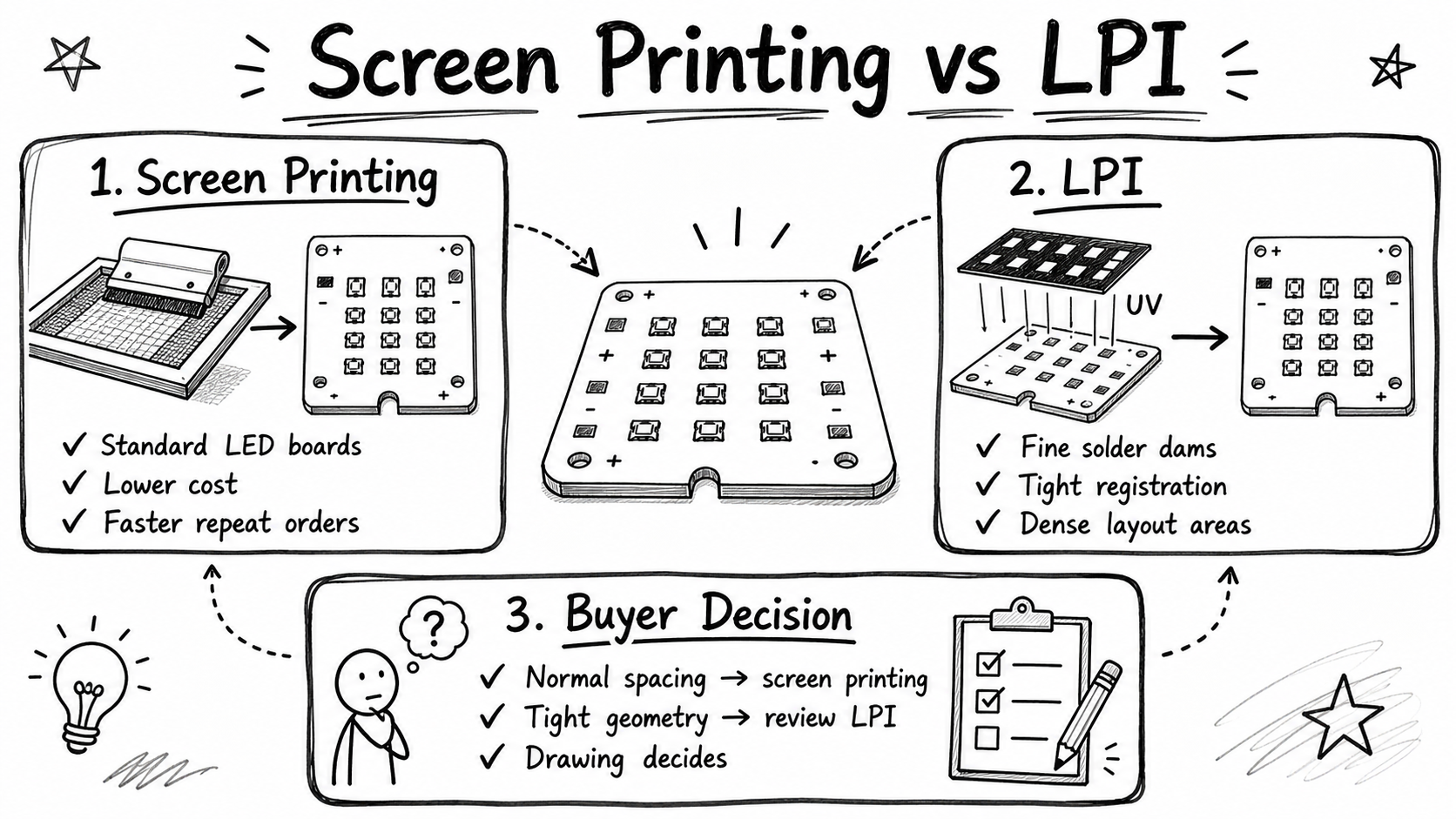 For most standard LED aluminum PCBs, the drawing should decide whether screen printing is enough or LPI is needed.
Quick Answer: Most LED Aluminum PCBs Can Use Screen Printing
Screen printing fits most LED aluminum PCB orders because the solder mask geometry is usually not very tight.
Standard LED boards often use packages such as:
- 2835
- 3030
- 5050
- COB layouts with enough pad clearance
- simple light source arrays
These boards need a solder mask process that is stable, repeatable, and cost-effective.
They do not always need the extra precision of LPI.
Practical rule:
If the LED pad spacing is comfortable and the board is a standard single-sided aluminum PCB, screen printing is usually enough.
Use LPI only when the drawing proves that you need it.
Bottom line:
Do not pay for tighter solder mask capability unless the layout actually needs tighter solder mask control.
Screen Printing vs LPI: The Fast Comparison
The key difference is simple.
Screen printing is a practical production process. LPI is a precision imaging process. Taiyo's LPI solder mask materials are built around photoimageable processing, while screen printing depends more on mesh transfer and print control.
For LED aluminum PCB buyers, that difference affects cost, lead time, and risk.
| Factor | Screen Printing | LPI Solder Mask |
|---|---|---|
| Best fit | Standard LED aluminum PCBs | Dense layouts and fine-pitch areas |
| Cost position | Usually better for bulk LED orders | Higher when not technically needed |
| Lead time | Often faster for suitable boards | More process steps |
| Feature control | Enough for many LED pads | Better for fine dams and tight openings |
| Buyer risk | Low when supplier controls aluminum process | Useful when registration is critical |
For most LED lighting boards, the winning process is not the one with the highest precision.
It is the one that gives stable results at the right cost.
Bottom line:
LPI is a precision tool. Screen printing is a production tool. The right choice depends on the board.
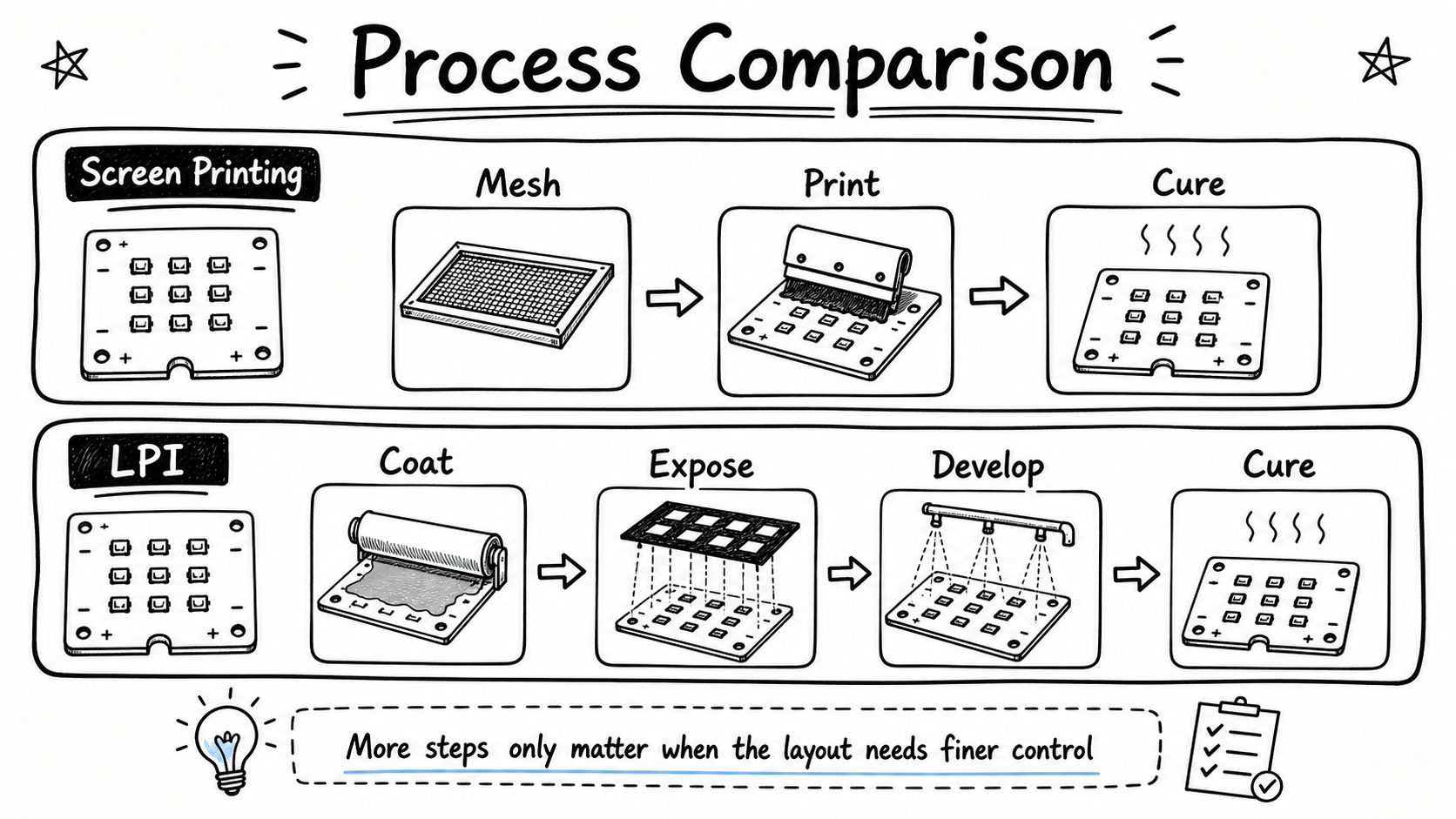 Screen printing is a direct production route. LPI adds imaging steps for tighter solder mask definition.
Why Most Standard LED Boards Do Not Need LPI
Most LED aluminum PCBs do not need LPI because their solder mask openings are not close to the process limit.
PCB design guidance from Epec places photoimageable solder mask in the finer feature category, while screen-printed mask is more suitable for coarser openings and less demanding solder dams.
Most standard LED light boards need stable production.
Only a smaller group needs high-precision solder mask imaging.
Typical screen-print-friendly boards include:
- LED bulb light source boards
- downlight aluminum PCBs
- panel light boards
- strip light sections
- simple module boards
- repeated LED array boards
These boards usually have clear pad spacing.
The layout is also predictable.
That makes screen printing a strong fit for repeat orders.
LPI becomes more useful when the board moves away from that simple pattern.
For example:
- very tight LED pitch
- narrow solder mask dams
- dense driver circuit areas
- strict registration requirement
- customer drawing that specifies LPI
Bottom line:
Do not choose LPI because it sounds more professional. Choose it because the board geometry needs it.
Why Screen Printing Wins in LED Mass Production
Screen printing wins in many LED aluminum PCB projects because it matches the real buying priorities.
Those priorities are usually:
- cost control
- fast sampling
- stable white solder mask
- repeat order consistency
- practical quality
- fewer unnecessary process steps
That is why screen printing remains common in LED aluminum PCB production.
Bottom line:
For standard LED boards, screen printing often protects the two things buyers care about most: cost and repeatability.
1. Lower Practical Cost
Screen printing can reduce unnecessary process cost when the layout is not fine-pitch.
For LED lighting buyers, this matters.
A board may be ordered in thousands or tens of thousands of pieces.
Small cost differences become visible quickly.
LPI may be worth the extra cost for tight layouts.
But if the LED pads are simple, the added precision may not improve the lamp.
For a buyer, this is the real risk:
You may pay more for a process that does not change brightness, soldering quality, or field performance.
2. Faster Production Flow
Screen printing can support faster production when the design is suitable.
LPI usually needs more steps:
- coating
- drying
- exposure
- development
- final cure
Those steps are normal in PCB manufacturing.
But they are not always necessary for standard LED aluminum PCBs.
KLA's solder mask application guide also treats solder mask application as a multi-step process, which is one reason buyers should avoid adding process complexity unless the design needs it.
For sample approval and repeat LED board orders, a simpler flow can help.
That matters when your lamp housing, LED source board, and assembly schedule are already waiting on sample approval.
3. Reliable Enough When Controlled Correctly
Screen printing does not mean low reliability.
The real reliability factors are:
- solder mask material
- aluminum surface preparation
- dielectric layer quality
- ink viscosity
- curing profile
- final inspection
If these are controlled, screen printing can be a stable process for LED aluminum PCB mass production.
For example, a Florida CirTech solder mask datasheet describes screen-print application conditions and reports reliability checks such as cross-cut adhesion, thermal shock, and solder bath resistance for its material system.
The process name alone does not decide quality.
The factory process window does.
So the better supplier question is not:
"Do you have LPI?"
It is:
"Have you made similar LED aluminum PCBs with stable solder mask results?"
4. Better Fit for Cost-Sensitive LED Boards
Many LED lighting products are cost-sensitive.
That does not mean the board can be careless.
It means the specification should be practical.
For a standard LED aluminum PCB, buyers usually need:
- clean pad openings
- consistent white color
- strong adhesion
- acceptable reflectivity
- stable soldering
- repeatable batch quality
Screen printing can support these needs when the layout is suitable.
Bottom line:
For cost-sensitive LED lighting boards, practical quality matters more than an unnecessarily high process label.
When LPI Is the Better Choice
LPI is the better choice when solder mask precision affects assembly yield or customer approval.
That usually happens when the board has tight geometry.
Use LPI when:
- pad pitch is below about 0.5 mm
- solder mask dams are very narrow
- the board includes dense driver circuitry
- the LED layout has tight spacing
- the customer drawing requires LPI
- the project has stricter approval rules
In these cases, LPI gives better control over mask openings and registration.
That can reduce solder bridging risk.
It can also make assembly more predictable.
But LPI should be a design-driven decision.
Not a default purchasing habit.
Bottom line:
Use LPI when it protects assembly yield or customer approval. Skip it when it only sounds better.
When Screen Printing Is the Better Choice
Screen printing is the better choice when the LED board has enough spacing and the order needs stable bulk production.
Use screen printing when:
- the board is a standard single-sided aluminum PCB
- LED pads have comfortable spacing
- the design uses common LED packages
- the main requirement is lighting-grade white mask
- the project is cost-sensitive
- the buyer needs faster sample or repeat supply
This is the common situation for many LED light source boards.
The goal is not to avoid LPI.
The goal is to avoid over-specifying a process that does not improve the final product.
Bottom line:
If the drawing is simple, screen printing should be reviewed first.
Aluminum PCBs Need Better Process Control Than FR4
Aluminum PCBs need tighter solder mask process control because the substrate is different from FR4.
NCAB's IMS guidance treats the dielectric layer, surface preparation, and thermal expansion mismatch as key issues for insulated metal substrates, which is why aluminum PCB solder mask processing should not be handled like a generic FR4 default.
An aluminum PCB stackup usually includes:
- copper circuit layer
- thermal dielectric layer
- aluminum base
- solder mask on top
That stackup sees heat in two ways.
First, during assembly.
Then, during LED operation.
This makes adhesion and thermal stability important.
For screen printing, the most important controls are below.
| Control Point | Why It Matters | What Buyers Should Ask |
|---|---|---|
| Surface preparation | Poor prep can cause peeling or bubbles | Has the supplier made similar LED aluminum boards? |
| Dielectric quality | The dielectric is part of the heat path | Is the stackup stable for the lamp application? |
| Cure profile | Weak cure can fail during soldering or aging | Is curing controlled for white solder mask? |
| Ink formulation | Generic white may discolor | Is the mask suitable for LED lighting use? |
| Final inspection | Defects are visible on white boards | Are pad openings, color, and adhesion checked? |
This is why a capable screen printing process can be better than an unnecessary LPI upgrade.
The important point is control.
Not just the process name.
Bottom line:
On aluminum PCBs, surface prep and curing can matter more than whether the buyer wrote "LPI" in the RFQ.
White Solder Mask Is Not Always Lighting-Grade
For LED aluminum PCBs, "white solder mask" is not a complete specification.
NCAB's LED solder mask guidance points out that white mask selection affects reflectivity and color stability in LED applications, while Taiyo's LED solder mask materials also focus on application-specific white mask performance.
White masks can differ in:
- reflectivity
- color tone
- yellowing resistance
- adhesion
- chemical resistance
- batch consistency
This matters because LED boards are often visible inside the lamp.
They also operate near heat.
A cheap white mask may look acceptable during sample review.
But it can shift color after assembly or long-term use.
Buyer takeaway:
If optical appearance matters, specify lighting-grade white solder mask.
If the board is hidden inside the product, a practical standard white may be enough.
Bottom line:
"White" describes color. "Lighting-grade white" describes the job the mask needs to do.
How to Specify Solder Mask Before Quotation
The best way to avoid confusion is to give the supplier a complete solder mask request.
This is especially important because solder mask performance is not only a color choice. It is connected to adhesion, cure, thermal exposure, and inspection, which is also why simple solder mask tests can be useful during quality checks.
Do not only write:
"White solder mask."
That leaves too much open.
Use this checklist instead.
| Specification Item | Practical Requirement | Buyer Note |
|---|---|---|
| Board type | Aluminum PCB / MCPCB / IMS | Do not describe it only as PCB |
| Process | Screen printing or LPI | Let the drawing decide |
| Color | White / lighting-grade white | Important for LED appearance |
| LED package | 2835 / 3030 / 5050 / COB / custom | Helps judge pad spacing |
| Pitch | Actual LED pad spacing | Needed for mask process selection |
| Copper thickness | Standard or special requirement | Affects cost and etching |
| Board thickness | Aluminum base and finished thickness | Affects handling and structure |
| Surface finish | HASL / OSP / ENIG | Affects soldering and appearance |
| Thermal condition | Reflow and operating temperature | Helps choose mask material |
| Quantity | Sample or bulk order | Affects process and cost decision |
For a new LED lighting project, sample testing is still recommended.
A sample can reveal issues that a quotation sheet cannot:
- solder mask color
- pad opening accuracy
- solderability
- adhesion
- fit with LED assembly
- appearance after reflow
This is where many quote problems start.
The supplier receives a Gerber file and the words "white solder mask."
Then both sides discover later that they were talking about different quality expectations.
Bottom line:
The clearer your RFQ is, the faster the factory can choose the right process.
How to Choose the Right Process From the Drawing
The drawing should decide the solder mask process.
Not habit.
Not sales language.
Not the idea that one process is always more professional.
Start with the LED pad layout.
If the pads are large and spacing is comfortable, screen printing is usually practical.
Then check the tightest solder mask area.
If the mask dams are narrow or the pad openings are close together, LPI may be safer.
Finally, look at the production goal.
If the order is a standard LED lighting board for repeat production, cost and consistency matter a lot.
If the board has a dense driver section or stricter customer approval, process precision may matter more.
Here is a simple way to read the drawing:
| What You See in the Drawing | What It Usually Means | Process Direction |
|---|---|---|
| Repeated LED pads with open spacing | Standard LED light source board | Screen printing is usually enough |
| Large white solder mask area | Visual consistency matters | Confirm lighting-grade white mask |
| Narrow solder dams between pads | Registration is more sensitive | Review LPI |
| Dense driver/control area | Mask opening accuracy matters | LPI may be safer |
| Customer note specifies LPI | Requirement is already fixed | Follow the drawing |
| No process note, simple LED layout | Avoid over-specification | Start with screen printing review |
This approach keeps the decision practical.
It also helps avoid paying for LPI when the board does not need it.
Bottom line:
The drawing is the filter. Use it before choosing the process.
A Simple Decision Rule
Here is the shortest way to decide.
Choose screen printing when:
- LED package spacing is normal
- the board is single-sided aluminum PCB
- the design is for standard lighting production
- cost and lead time matter
- the supplier has stable aluminum PCB process experience
Choose LPI when:
- the pad pitch is tight
- solder mask dams are narrow
- the board has dense driver areas
- registration is critical
- the customer drawing requires it
That is the practical split.
Not old process vs new process.
Not cheap vs premium.
Just fit vs over-spec.
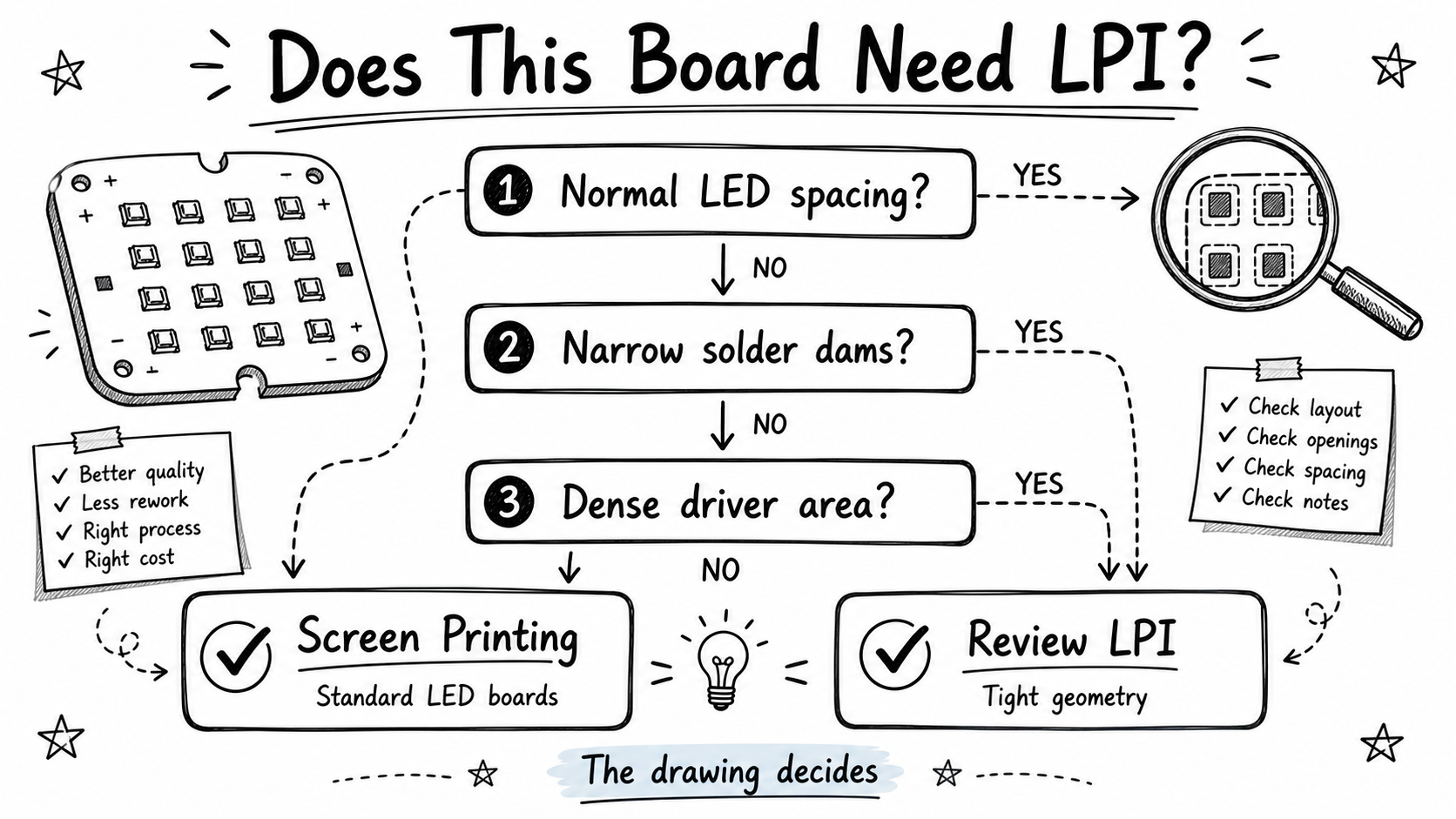 Start with pad spacing and solder mask dams, then check whether the drawing or customer approval requires LPI.
What to Send for a Faster Quote
To get a practical quote, send the factory enough information to judge the process.
The most useful items are:
- Gerber file or drawing
- board size
- aluminum thickness
- copper thickness
- finished board thickness
- LED package and pitch
- solder mask color
- surface finish
- sample or bulk quantity
- special visual or thermal requirement
If you are not sure whether screen printing or LPI is needed, send the drawing first.
The layout usually gives the answer.
You do not need to solve the solder mask process alone before asking for a quote.
A good factory should be able to review the layout and tell you whether screen printing is enough or LPI should be considered.
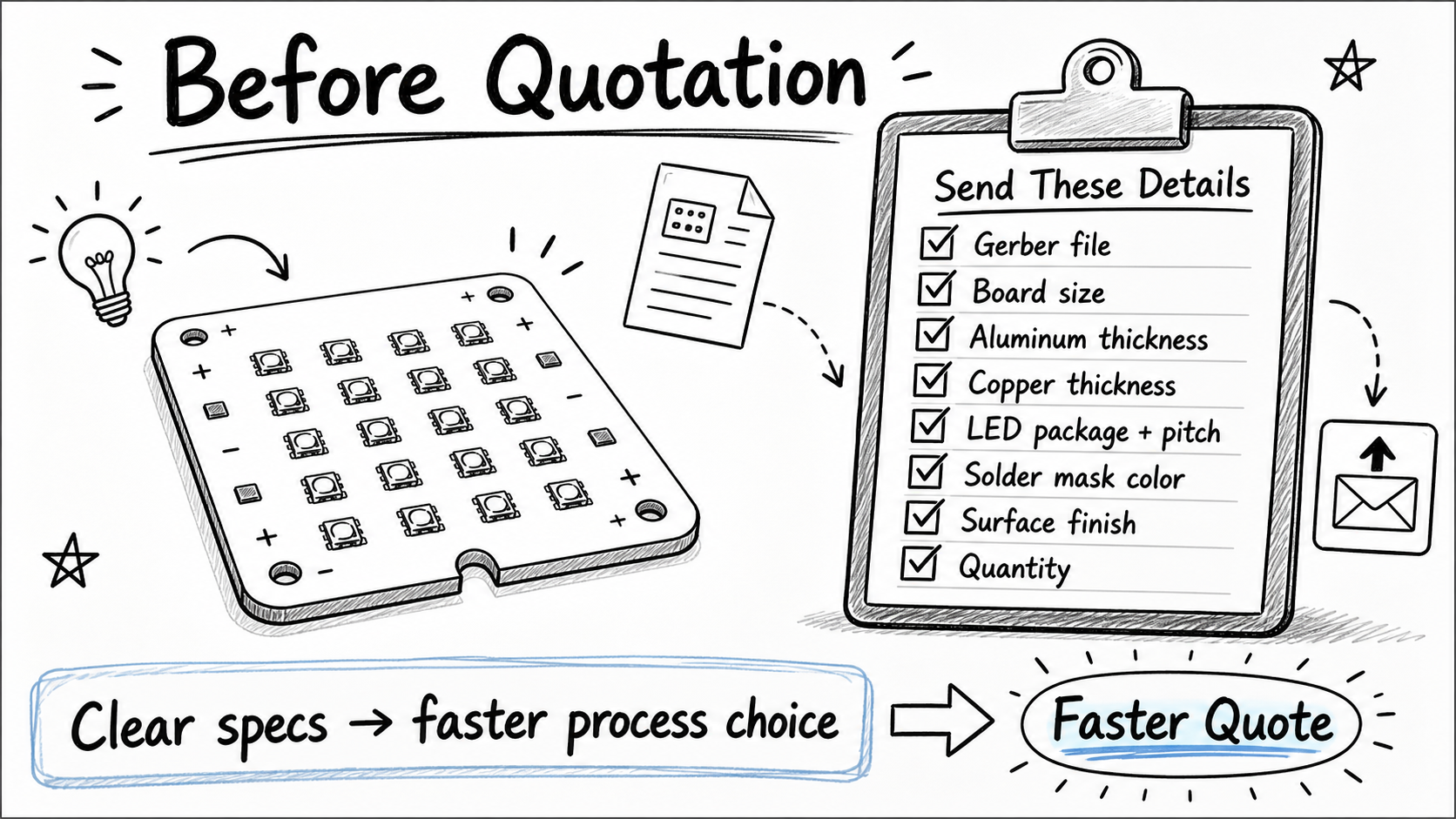 A complete RFQ helps the factory judge the solder mask process before pricing.
Conclusion
For most LED aluminum PCB mass production orders, screen printing is the practical solder mask choice.
It supports standard LED layouts, stable white mask, cost control, and repeat production.
LPI is still important.
But it should be used when the board needs fine solder mask definition or strict registration.
For buyers, the best solder mask choice should come from the drawing, LED pitch, mask opening, thermal condition, and order quantity.
If you need LED aluminum PCBs for sample or bulk production, send your Gerber file or drawing to our engineering team.
Also include board thickness, copper thickness, surface finish selection, solder mask color, LED package, and order quantity.
Lumina PCB can help check one practical question before quotation:
Is screen printing enough for this LED aluminum PCB, or does the drawing really need LPI?
Need a quotation?
Send Gerber files and basic specifications. We reply within 1 business day.
Ask for Quote